Read Time:
17 Mins
APAC Tech Talent Shortage Solutions for Indian Companies


Your Bengaluru engineering team just got approval for three senior hires. The roles are specific: a cloud security architect, a full-stack engineer with fintech experience, and a QA lead who can work APAC hours. You brief your agency panel. Two weeks pass. The CVs that arrive are either recycled from your last search or wildly off-brief. Meanwhile, a competitor with a Vietnam development centre filled the same profile in 11 days.
That gap — between what Indian companies need and what their current hiring infrastructure can deliver — is exactly where APAC tech talent shortage solutions become a strategic priority, not just an HR experiment. Southeast Asia has deep, underutilised tech talent pools. Vietnam's software engineering output is growing faster than most Indian TA leaders realise. Malaysia's fintech clusters are producing cloud and cybersecurity specialists at scale. The Philippines has a maturing QA and data engineering workforce. And yet, most Indian mid-market companies are still treating APAC hiring as a future consideration rather than a present-tense advantage.
This guide is for TA leaders and HR heads at Indian companies who are ready to move from "we should explore SEA" to "here's how we actually hire there." We'll cover market selection, salary benchmarks, agency ecosystems, platform infrastructure, compliance, and measurement — everything you need to build a repeatable APAC hiring engine.
The domestic tech talent market in India is not broken, but it is expensive, competitive, and increasingly concentrated in a handful of cities. Senior engineers in Bengaluru and Hyderabad command salaries that have risen sharply over the past three years. Niche skills, cloud security, AI/ML infrastructure, embedded systems, are genuinely scarce. And the best candidates are passive: they're not on job boards, and they're not responding to cold InMails from agencies they've never heard of.
APAC offers a different equation. Vietnam produces over 50,000 IT graduates annually, according to Vietnam's Ministry of Education, with a strong emphasis on software engineering and computer science. Malaysia's Multimedia Development Corporation (MDEC) has spent two decades building a digital economy talent base, particularly in fintech, cloud, and cybersecurity. The Philippines has a workforce deeply familiar with global delivery models. Indonesia's startup ecosystem is producing a new generation of product and growth engineers.
The opportunity cost of ignoring these markets is real. Every month a critical tech role stays open costs your business in delayed product delivery, lost revenue, and team burnout. If your current hiring infrastructure, domestic agencies, job boards, internal TA, can't fill the role in India, the answer isn't to wait longer. It's to look wider.
For a broader view of how Indian companies are structuring cross-border hiring, the Global Hiring from India: The 2026 Complete Guide covers the full strategic framework.
Not every SEA market is right for every role. The first step in any APAC tech talent strategy is matching your specific hiring need to the market most likely to deliver. Treating Southeast Asia as a single talent pool is the fastest way to waste three months and a significant agency budget.
Vietnam is the standout market for software engineering volume. Ho Chi Minh City and Hanoi have established tech ecosystems with strong output in Java, .NET, React, and mobile development. The talent pool skews younger, with strong foundational skills and a growing cohort of mid-level engineers (3-7 years of experience). English proficiency is improving rapidly, particularly among engineers who have worked with global clients. If you need full-stack developers, backend engineers, or mobile app specialists at competitive cost points, Vietnam should be your first call.
Kuala Lumpur and Penang have developed genuine depth in financial technology, cloud infrastructure, and cybersecurity. Malaysia's bilingual workforce (English and Malay, with significant Mandarin-speaking talent) makes it particularly valuable for companies with regional operations across Southeast Asia. The talent pool here is more senior on average than Vietnam, with a higher proportion of specialists who have worked in regulated industries. If your role requires cloud architecture, security engineering, or fintech product development, Malaysia is the right market.
The Philippines has a long history of global delivery, and that infrastructure has produced a strong QA, data annotation, and customer-facing tech workforce. English fluency is near-native, making collaboration with Indian and global teams seamless. The market is particularly strong for QA automation, data engineering support roles, and technical customer success. Senior engineering talent is thinner than Vietnam or Malaysia, but for specific profiles, the Philippines delivers fast.
Indonesia's growing startup ecosystem is producing product managers, growth engineers, and data scientists, particularly in Jakarta. The talent pool is younger and the market is competitive, but for companies building regional product teams, Indonesia is worth watching. Singapore remains the market for senior tech leadership, AI/ML specialists, and regional HQ roles. Compensation is significantly higher, but the talent quality and English fluency are unmatched in the region.
One of the most common reasons APAC hiring stalls for Indian companies is a misaligned salary brief. TA leaders often apply Indian compensation logic to SEA markets, either significantly underpaying (and losing candidates to local competitors) or overpaying (and blowing the budget on roles that didn't require it). Neither outcome is acceptable when you're trying to build a repeatable hiring engine.
A mid-level software engineer (3-5 years) in Ho Chi Minh City typically earns between USD 18,000 and USD 28,000 annually. Senior engineers (7+ years) with specialised skills command USD 30,000, USD 45,000. These figures are meaningfully lower than equivalent Indian metro rates, but the gap is narrowing as Vietnam's tech sector matures. Expect to pay a premium for engineers with strong English communication skills and experience working with international clients.
Cloud architects and senior fintech developers in Kuala Lumpur typically earn USD 35,000, USD 55,000 annually. Cybersecurity specialists with certifications (CISSP, CISM) command USD 45,000, USD 65,000. Malaysia's compensation levels are higher than Vietnam but lower than Singapore, making it a strong mid-tier market for specialist roles where quality matters more than cost.
QA automation engineers in Manila typically earn USD 15,000, USD 25,000 annually. Data engineers with 4+ years of experience range from USD 20,000, USD 32,000. Singapore is a different category entirely: senior software engineers earn SGD 90,000, SGD 140,000 (approximately USD 67,000, USD 104,000), and AI/ML specialists command significant premiums above that. Budget accordingly and don't brief a Singapore agency with a Vietnam-calibrated salary range.
Getting salary benchmarks right before you brief an agency isn't just good practice, it's the difference between a pipeline that moves and one that stalls at the offer stage. If you're evaluating the full cost picture, Recruitment Agency Cost in India: What You're Really Paying provides a useful framework for understanding total hiring costs across markets.
Here's the uncomfortable truth about APAC tech hiring: generalist agencies based in India cannot fill specialist roles in Vietnam or Malaysia. They don't have the local networks. They don't know the passive talent pools. They can't conduct in-language outreach or navigate local compensation norms. And yet, many Indian companies brief their existing domestic agency panel on APAC roles and then wonder why the pipeline is empty three weeks later.

The right approach is to work with specialist, in-country recruiting firms that have genuine networks in the specific SEA market you're hiring in. A boutique tech recruiter in Ho Chi Minh City who has placed 200 engineers in the last two years will outperform a generalist Indian agency every time on a Vietnam software engineering brief.
The challenge is that building this ecosystem independently is genuinely hard. Vetting agencies in markets you've never hired in requires local knowledge you don't have. Negotiating separate contracts for Vietnam, Malaysia, and the Philippines creates three new legal agreements, three invoicing cycles, and three sets of compliance obligations. Multiply that across five SEA markets and you've created an administrative burden that consumes your TA team's capacity before a single candidate is shortlisted.
This is the vendor sprawl problem, and it gets worse, not better, as you scale. For a detailed breakdown of how vendor sprawl compounds over time, How to Build a Consolidated Recruitment Vendor Pool covers the mechanics and the fix.
The alternative is to use a platform that already has vetted, specialist agencies across all your target SEA markets, accessible through a single contract and a single invoicing relationship. This is the model that forward-looking Indian TA teams are adopting for multi-geo APAC hiring. Instead of spending months building an agency ecosystem from scratch, you plug into one that already exists, with quality controls already in place.
For companies evaluating their options, Hiring Platforms India: Job Boards vs. Agencies vs. AI Marketplaces provides a clear comparison of the available models.
Hiring across three or four SEA markets simultaneously exposes every weakness in your recruitment infrastructure. Spreadsheets break down. Email threads across multiple time zones create version-control chaos. Your ATS, if it's not properly integrated with your agency workflow, becomes a data graveyard rather than a hiring command centre.
Your applicant tracking system needs to handle candidates from multiple markets, submitted by multiple agencies, with different currency and compliance fields. If your ATS integration isn't set up to handle this cleanly, you'll end up with duplicate candidates, missed follow-ups, and hiring managers who lose confidence in the process. The infrastructure investment here pays for itself in the first quarter of serious APAC hiring.
When you post a cloud security architect role for Kuala Lumpur, you need that brief to reach the right specialist agency in Malaysia, not a generalist firm in Singapore or a domestic Indian recruiter who happens to have "APAC" in their profile. AI vendor matching routes each role to the most qualified specialist agency for that specific market and skill set, automatically. This is the difference between a pipeline that starts moving in 48 hours and one that stalls while you manually brief agencies one by one.
Finance teams at Indian companies are not set up to process invoices in Vietnamese Dong, Malaysian Ringgit, Philippine Peso, and Singapore Dollar simultaneously. Unified invoicing, where all agency fees across all markets are consolidated into a single invoice in your preferred currency, removes a significant operational barrier to APAC hiring at scale. It also simplifies compliance and audit trails considerably.
AI resume screening tools trained primarily on Indian or Western candidate profiles will misread APAC CVs. Vietnamese engineers format their experience differently. Malaysian candidates often list certifications in a different order. Philippine candidates may have BPO-adjacent experience that looks irrelevant but signals strong delivery capability. Your screening layer needs to be calibrated for the markets you're hiring in, not just the markets you've always hired from. For a deeper look at how AI screening accuracy works in practice, AI Resume Screening: How to Choose the Right Tool in 2026 is worth reading before you commit to a tool.
Compliance is the most common reason Indian companies stall on APAC hiring after the initial enthusiasm. The employment law landscape across Southeast Asia is genuinely complex, and the differences between markets are significant enough to require market-specific guidance.
The practical implication for Indian companies is this: you need either a local entity, an EOR partner, or a hiring platform that has already navigated these compliance requirements on behalf of its clients. Trying to manage this independently across four markets simultaneously is a significant legal and operational risk.
You can't improve what you don't measure. APAC hiring introduces new variables, time zone differences, agency response rates, local market velocity, that your existing domestic hiring metrics won't capture. Building a measurement framework specific to your SEA hiring is not optional if you want to scale.

Realistic time-to-fill benchmarks vary significantly by market and role type. A mid-level software engineer in Vietnam can typically be sourced and shortlisted within 3, 4 weeks with the right agency. A senior cloud architect in Malaysia may take 5, 7 weeks. Singapore leadership roles can run 8, 12 weeks. If your current APAC hiring is consistently running longer than these benchmarks, the problem is almost always in the agency selection or briefing process, not the market itself.
For a detailed breakdown of how unfilled roles compound cost over time, Time to Hire: The Hidden Cost of Roles Left Open quantifies the business impact in terms your CFO will understand.
Agency fees for APAC tech roles typically range from 12% to 18% of first-year salary, depending on the market and role seniority. Vietnam tends toward the lower end of this range; Singapore toward the higher. These figures are broadly comparable to Indian domestic tech hiring fees, which means APAC hiring doesn't necessarily cost more, it just requires a different agency infrastructure to execute well.
Track not just whether agencies fill roles, but how many submissions it takes to produce a shortlist. A high-quality specialist agency in Vietnam should be able to produce 3, 5 genuinely relevant candidates per role. If you're receiving 15 CVs and shortlisting zero, the problem is agency quality, not market availability. Submission quality is a leading indicator of fill rate, and it's the metric most TA teams forget to track.
Everything described in this guide, market selection, salary benchmarking, specialist agency access, platform infrastructure, compliance navigation, and measurement, requires either significant internal investment or the right external partner. CBREX is built specifically for Indian companies that need to hire specialist tech talent across multiple geographies without building a separate infrastructure for each market.
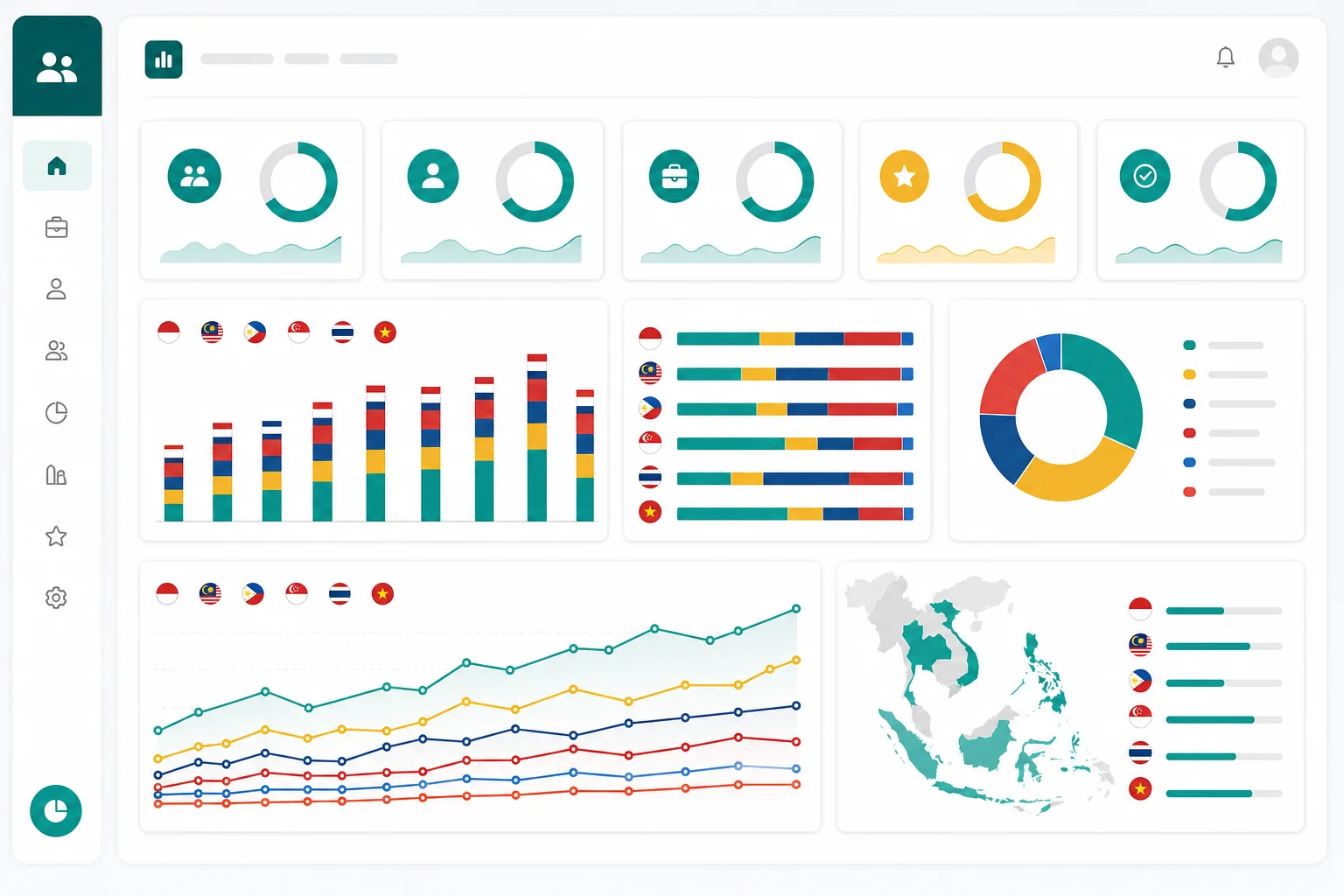
CBREX's network includes specialist recruiting firms across all major SEA markets, Vietnam, Malaysia, Philippines, Indonesia, Singapore, and beyond. These are not generalist agencies with a regional office. They are in-country specialists with genuine passive talent networks in their specific market. When you post a cloud security architect role for Kuala Lumpur, CBREX's AI vendor matching engine (C Map) routes that brief to the most qualified specialist agency for that exact market and skill set, automatically, within hours.
One agreement covers all 4,000+ agencies across 33 countries. No separate contracts for Vietnam, Malaysia, and the Philippines. No separate invoicing cycles. No compliance complexity from managing multiple agency relationships across multiple jurisdictions. Your finance team gets a single invoice. Your legal team signs one contract. Your TA team focuses on hiring, not administration.
C Screen, CBREX's AI resume screening engine, is trained on 250,000+ anonymised resumes across 570+ job categories, including APAC-specific candidate profiles. It validates candidate quality before your hiring manager ever sees a CV, filtering out mismatched submissions and stack-ranking genuinely relevant candidates. The result is a shortlist that reflects the actual talent available in the market, not a volume dump from an agency trying to hit submission targets.
CBREX operates on a pay-on-hire model. You pay when a hire is made, not before. No retainer fees. No platform seat licences. No upfront commitments. For Indian mid-market companies that are cautious about committing budget to unproven APAC markets, this model removes the financial risk from the exploration phase entirely.
If you're evaluating whether an RPO or marketplace model is the right fit for your APAC hiring stage, RPO vs Staffing India: Which Hiring Model Wins in 2026? provides a clear framework for the decision.
It depends on the role. Vietnam is the strongest market for software engineering volume at competitive cost points. Malaysia is best for fintech, cloud, and cybersecurity specialists. The Philippines excels for QA, data engineering, and customer-facing tech. Singapore is the right market for senior leadership and AI/ML specialists. Match the market to the role type, not the other way around.
With the right specialist agency, a mid-level software engineer in Vietnam can be shortlisted within 3, 4 weeks. Malaysia typically runs 4, 6 weeks for specialist roles. These timelines assume a well-briefed agency with a realistic salary range and a responsive hiring manager. Delays almost always trace back to one of those three variables.
Not necessarily. Many Indian companies hire in SEA markets through Employer of Record (EOR) arrangements, which allow you to employ talent in a country without establishing a local legal entity. This is the most common approach for companies in the early stages of APAC expansion. As hiring volume grows, establishing a local entity typically becomes more cost-effective.
Agency fees for APAC tech roles typically range from 12% to 18% of first-year salary, depending on the market and role seniority. This is broadly comparable to Indian domestic tech hiring fees. On a pay-on-hire model, you only pay this fee when a successful placement is made, there are no upfront costs.
In most cases, no. Domestic Indian agencies rarely have the in-country networks needed to source passive tech talent in Vietnam, Malaysia, or the Philippines. The most effective approach is to use specialist in-country agencies for each SEA market, accessed through a single platform that handles the contracting, invoicing, and quality control centrally.
The APAC tech talent shortage solutions that actually work for Indian companies are not theoretical, they're operational. They require the right market intelligence, the right agency relationships, the right platform infrastructure, and the right measurement framework. Building all of that independently takes 12, 18 months and significant internal resource. Using a platform that already has it takes days.
CBREX gives Indian mid-market companies immediate access to specialist recruiting firms across Vietnam, Malaysia, Philippines, Indonesia, Singapore, and 29 other countries, through a single contract, with AI-powered matching and screening, on a pay-on-hire basis. If your current hiring infrastructure is leaving APAC tech roles unfilled, that's a solvable problem.
Book a demo with CBREX to see how Indian companies are filling APAC tech roles in weeks, not months, without the vendor chaos, the retainer fees, or the administrative overhead of managing a fragmented agency panel across multiple markets. Or if you'd prefer to explore the platform first, sign up and start posting roles today. You can also reach out directly to discuss your specific APAC hiring brief.


