Read Time:
18 Mins
How to Choose a Recruitment Outsourcing Partner in 2026


Somewhere in a boardroom in Mumbai or Bengaluru, a TA leader is about to sign a recruitment outsourcing contract that will cost their company six months and a significant amount of money before they realise it was the wrong choice. Not because they didn't do their homework. Because the evaluation criteria they used were the wrong ones.
Recruitment outsourcing is one of the highest-leverage decisions a TA or HR leader can make in 2026. Get it right, and you unlock access to pre-screened, interview-ready talent across geographies you couldn't reach before. Get it wrong, and you're locked into a retainer with a vendor whose "global network" is three generalist agencies and a job board subscription.
This guide is for TA heads, HR Directors, and Deputy HR Managers at mid-market and enterprise companies — particularly India-founded businesses hiring across international markets — who need a clear, practical framework for evaluating recruitment outsourcing partners. We'll cover the essential selection criteria, the deal-breakers you cannot afford to overlook, and the specific questions that separate serious partners from expensive disappointments.
The most common mistake in selecting a recruitment outsourcing partner isn't choosing the wrong vendor. It's using the wrong evaluation framework entirely. Most TA teams assess outsourcing partners the same way they assess a single recruitment agency: price, speed, and a reference call. That approach works when you're filling one role in one city. It fails badly when you're trying to hire a Regulatory Affairs specialist in Germany, a DevOps engineer in Singapore, and a Finance Controller in Dubai — simultaneously.
The stakes are high. A poor recruitment outsourcing decision creates vendor lock-in, opaque candidate pipelines, and a cost-per-hire that spirals well beyond what your internal team would have spent. According to research on what it really costs to fill a role in 2026, the hidden costs of a bad outsourcing relationship, re-hiring, extended vacancy periods, and administrative overhead, can dwarf the headline agency fee.
The good news: the right recruitment outsourcing partner, evaluated against the right criteria, can transform your talent acquisition function. Here's how to find them.
Before you send a single RFP, you need to be precise about what you're outsourcing and why. Recruitment outsourcing is not a monolithic category. The model that works for a company hiring 200 junior roles domestically is completely different from the model that works for a company hiring 30 specialist roles across five countries.
Start by documenting your actual hiring needs across four dimensions:
The answers to these questions determine which outsourcing model you should be evaluating. A full RPO engagement makes sense for high-volume, predictable hiring. A recruitment marketplace with specialist agency access makes more sense for niche, cross-border, or variable-volume mandates. Understanding the difference before you enter vendor conversations will save you months of misaligned expectations. Our comparison of RPO vs staffing models in India breaks this down in detail if you need a clearer framework before proceeding.
Recruitment outsourcing in 2026 spans three broad models: traditional RPO (where a provider embeds recruiters into your team), agency-based outsourcing (where you delegate mandates to one or more agencies), and AI-powered recruitment marketplaces (where technology matches your roles to specialist agencies and screens candidates before they reach you). Each has a different cost structure, speed profile, and quality ceiling. Mismatching your needs to the wrong model is the root cause of most outsourcing failures.
When a recruitment outsourcing partner tells you they have "global coverage," ask them to prove it. Specifically. For your roles. In your geographies.
There is a significant difference between a vendor who has a database of candidates in 50 countries and a vendor who has active, specialist recruiting firms with local market knowledge in the cities where you're hiring. The first gives you recycled CVs. The second gives you passive talent that isn't on any job board.
For mid-market Indian companies hiring internationally, whether in Southeast Asia, the Middle East, Europe, or the Americas, genuine geographic coverage means:
A recruitment outsourcing partner with 4,000+ specialist agencies across 33 countries, like CBREX, can route a DevOps mandate to a specialist tech recruiter in Singapore and a Regulatory Affairs role to a life sciences boutique in Germany, simultaneously, through a single platform and contract. That's what genuine coverage looks like. A vendor with one "global partner" in each region is not the same thing.
Every recruitment outsourcing vendor in 2026 will tell you they use AI. The question is what their AI actually does, and whether it makes your hiring better or just faster at producing the wrong candidates.
There are two very different types of AI in recruitment. The first type filters resumes based on keyword matching. It's fast, it's cheap, and it produces shortlists full of candidates who know how to optimise their CVs for algorithms. The second type validates candidate quality against a deep, role-specific training dataset, assessing fit, not just format.
When evaluating a recruitment outsourcing partner's AI capabilities, ask about:
CBREX's C Screen tool, for example, is trained on 250,000+ anonymised resumes across 570+ job categories and delivers 98% screening accuracy. Critically, it works as a validation layer on top of candidates already sourced by specialist human recruiters, not as a replacement for human judgment. That's the combination that produces interview-ready candidates, not just algorithmically optimised CVs. For a deeper look at how to evaluate AI screening tools specifically, see our guide on choosing the right AI resume screening tool in 2026.
Be cautious of recruitment outsourcing partners whose entire model is AI-driven with no specialist human recruiter layer. AI-only platforms are excellent at finding active job seekers who are already visible online. They are poor at reaching the passive, high-performing talent who are currently employed and not looking, which is precisely the talent that moves the needle for most mid-market and enterprise companies.
The contract structure of your recruitment outsourcing engagement tells you more about a vendor's confidence in their own delivery than any sales presentation will.
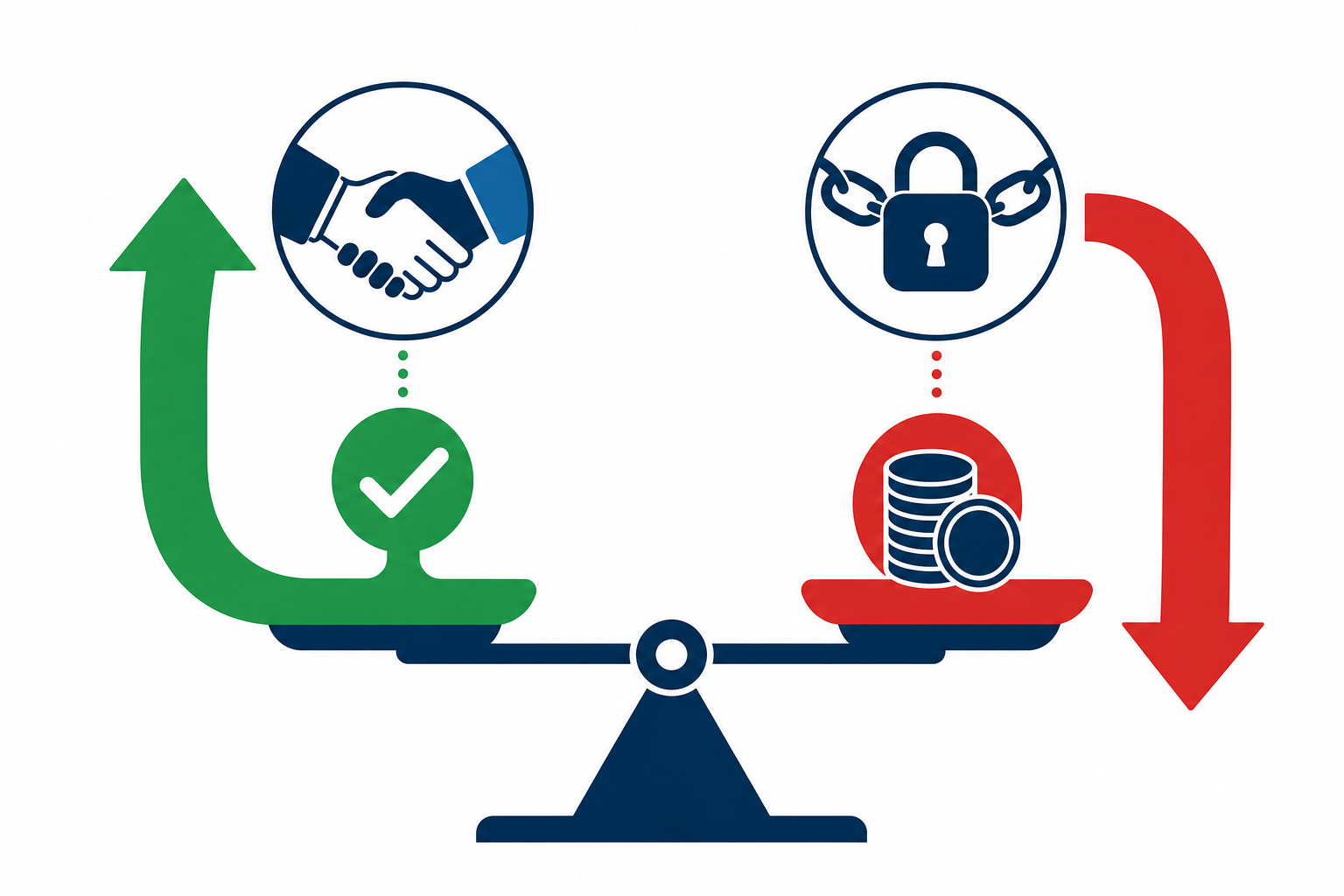
A vendor who demands a retainer upfront, before a single hire is made, is transferring financial risk from themselves to you. They are, in effect, asking you to pay for effort rather than outcomes. In 2026, that model is not just expensive; it's unnecessary. The best recruitment outsourcing partners are confident enough in their delivery to work on a pay-on-hire basis.
Pay-on-hire means you pay only when a candidate is successfully placed. This aligns the vendor's incentives with yours: they only earn when you hire. Retainer models, by contrast, guarantee the vendor revenue regardless of outcome. Some retained search arrangements are legitimate, particularly for highly confidential C-suite searches, but a blanket retainer requirement for mid-level or specialist hiring is a red flag.
Understanding the full cost picture of recruitment agency fees is essential before signing any outsourcing contract. Our breakdown of recruitment agency costs in India covers what you're actually paying for, and what you should push back on.
If your recruitment outsourcing partner requires you to sign separate contracts with each agency in their network, you don't have an outsourcing partner. You have a vendor directory. A genuine recruitment outsourcing solution covers all agencies, all geographies, and all roles under a single master agreement with unified invoicing. This is not just an administrative convenience, it's a fundamental indicator of whether the vendor has actually built an integrated solution or is simply brokering introductions.
For companies dealing with the complexity of managing multiple agency relationships, our guide on vendor consolidation in recruitment explains how to move from fragmented agency sprawl to a single-contract model.
A recruitment outsourcing partner who cannot integrate with your Applicant Tracking System is a partner who will create more administrative work, not less. In 2026, ATS integration is not a premium feature, it's a baseline requirement.
True ATS integration means candidate data flows automatically from the outsourcing platform into your ATS without manual data entry. It means your hiring managers can review shortlists, provide feedback, and track pipeline status inside the tools they already use. It means your TA team isn't maintaining two separate systems and reconciling data between them.
Ask every recruitment outsourcing partner you evaluate the following:
The hidden cost of missing or partial ATS integration is significant. When recruiters and TA teams have to manually transfer candidate information between systems, errors multiply, time-to-hire extends, and the quality of your hiring data degrades. Over a quarter of active hiring, this overhead adds up to dozens of hours of lost productivity per role.
Not every red flag is obvious in a sales presentation. Some of the most costly outsourcing mistakes come from warning signs that only become visible when you ask the right questions. Here are the deal-breakers that should end your evaluation of any recruitment outsourcing partner:
For a broader look at how to evaluate individual agencies within an outsourcing arrangement, our guide on choosing a recruitment agency: 10 criteria and 7 red flags provides a complementary framework.
The quality of a vendor's answers to these questions will tell you more than any case study or reference call. Ask them directly, and pay attention to how specific, or how evasive, the responses are.

The best recruitment outsourcing model in 2026 combines three things that most vendors offer separately: AI-powered vendor matching, specialist human recruiters with deep market knowledge, and a pay-on-hire commercial model that aligns incentives with outcomes.
Here's what that looks like in practice. A TA head at a mid-market Indian technology company needs to hire a Senior Cloud Architect in the Netherlands, a Compliance Manager in Singapore, and a VP of Sales in the UAE, all in the same quarter. Under a traditional outsourcing model, this means three separate agency relationships, three contracts, three invoicing streams, and three different candidate quality standards. Under a modern AI-powered recruitment marketplace model, it means one platform, one contract, and AI that routes each role to the most qualified specialist agency in each market, with every candidate pre-screened before it reaches the hiring manager's desk.
CBREX is built precisely for this use case. The platform connects companies with 4,000+ specialist recruiting firms across 33 countries through a single contract and unified invoicing structure. CBREX's C Map AI matches each role to the most relevant specialist agencies based on skill category, geography, and seniority. C Screen then validates every candidate submission against a training dataset of 250,000+ resumes across 570+ job categories, delivering a 98% accuracy rate on candidate quality. The result is a shortlist of pre-screened, interview-ready candidates, not a pile of CVs that your hiring managers have to re-screen themselves.
For companies managing multi-country hiring from India, this model eliminates the administrative chaos of vendor sprawl while dramatically improving the quality and speed of candidate delivery. Our complete guide to global hiring from India in 2026 covers the full landscape of options available to Indian companies expanding internationally.
The pay-on-hire model means there are no retainer fees, no seat licences, and no upfront costs. You pay when you hire. That's the commercial structure that a confident recruitment outsourcing partner offers, because they know their delivery will justify the fee.
"Your best hire isn't looking. AI finds them. Humans close them.", CBREX's approach to recruitment outsourcing combines the reach of a 4,000+ agency network with AI screening that delivers interview-ready candidates, not CV dumps.
If you're evaluating recruitment outsourcing partners and want to see this model in action, book a demo with CBREX to see how the platform handles your specific hiring profile, including the geographies, skill categories, and seniority levels that matter most to your business. Or, if you're ready to explore the platform directly, sign up and post your first role with no upfront commitment.
Recruitment outsourcing is a broad term for delegating some or all of your hiring function to an external partner. RPO (Recruitment Process Outsourcing) is a specific model where the provider takes over the entire recruitment process, often embedding recruiters within your team. Recruitment outsourcing also includes agency-based models and AI-powered marketplaces that handle sourcing and screening without embedding staff. The right model depends on your hiring volume, predictability, and geographic complexity. See our detailed comparison of RPO vs agency models for mid-market companies for a full breakdown.
Yes, and in many cases, it's more suitable for mid-market companies than for large enterprises. Mid-market companies typically lack the internal TA infrastructure to handle niche or cross-border hiring at scale. A recruitment outsourcing partner with specialist agency access and AI screening can give a mid-market company enterprise-grade hiring capability without the overhead of building it internally. The key is choosing a model with no retainer fees and a pay-on-hire structure, so the cost scales with your actual hiring activity.
Vendor lock-in typically comes from three sources: long-term retainer commitments, proprietary data that you can't export, and single-vendor dependency for all geographies. To avoid it, insist on a pay-on-hire model with clear exit terms, ensure you retain ownership of all candidate data, and choose a partner whose network is broad enough that you're not dependent on a single agency or geography. Reviewing your vendor consolidation strategy before signing any outsourcing contract is a useful exercise.
Costs vary significantly by model. Traditional RPO engagements often involve monthly management fees plus a per-hire fee. Agency-based outsourcing typically charges a percentage of the placed candidate's annual salary (commonly 8-18% depending on seniority and geography). AI-powered marketplace models like CBREX operate on a pay-on-hire basis with no retainers or upfront fees. Contact CBREX directly at tara@cbrex.in to discuss pricing for your specific hiring profile.
With a well-structured recruitment outsourcing engagement, you should see qualified shortlists within days of posting a role, not weeks. The time-to-shortlist depends on role complexity, geography, and the partner's agency network depth. A partner with AI-powered vendor matching and pre-screened candidate delivery should be able to produce interview-ready candidates significantly faster than a traditional agency model. If a vendor cannot commit to specific time-to-shortlist SLAs, treat that as a red flag.
The recruitment outsourcing market in 2026 is crowded with vendors making similar claims. The framework in this guide gives you the tools to cut through the noise: evaluate geographic coverage with specificity, demand AI screening with proven accuracy, insist on pay-on-hire contracts, and require seamless ATS integration. Walk away from any partner who can't answer your questions with precision.
The right recruitment outsourcing partner doesn't just fill roles faster. They give your TA function access to specialist talent networks, AI-validated candidate quality, and a commercial model that aligns their success with yours. For India-founded companies hiring globally, that combination is the difference between a talent pipeline that delivers and one that disappoints quarter after quarter.
CBREX was built to be that partner, with 4,000+ specialist agencies, AI-powered matching and screening, a single contract across 33 countries, and a pay-on-hire model that means you only pay when you hire. If you're ready to see what recruitment outsourcing done right looks like for your specific hiring needs, book a demo today and let's build a shortlist that's actually worth your hiring managers' time.


