Read Time:
18 Mins
RPO Services India: The Complete 2026 Service Guide


Most companies that sign an RPO contract do so because something broke. A critical role sat open for four months. A vendor delivered 30 CVs and none made it past the first interview. A new geography opened up and the existing agency network had no reach there. RPO services India have grown precisely because mid-market and enterprise companies need a more structured, accountable alternative to the chaos of managing recruitment ad hoc.
But "RPO" has become one of those terms that means different things depending on who's selling it. A traditional RPO provider will embed a team at your office and charge a monthly management fee. An AI-powered RPO platform will route your roles to specialist agencies and screen candidates automatically. A staffing firm will rebrand itself as an RPO partner without changing anything about how it works. This guide cuts through the noise. It explains what RPO services India actually include, how the process works from intake to offer, what realistic timelines and costs look like, and how newer AI-driven models compare to the traditional approach.
Recruitment Process Outsourcing means handing over some or all of your hiring process to an external provider. That's the textbook definition. In practice, the scope varies enormously, and understanding what's included before you sign is the most important due diligence you can do.
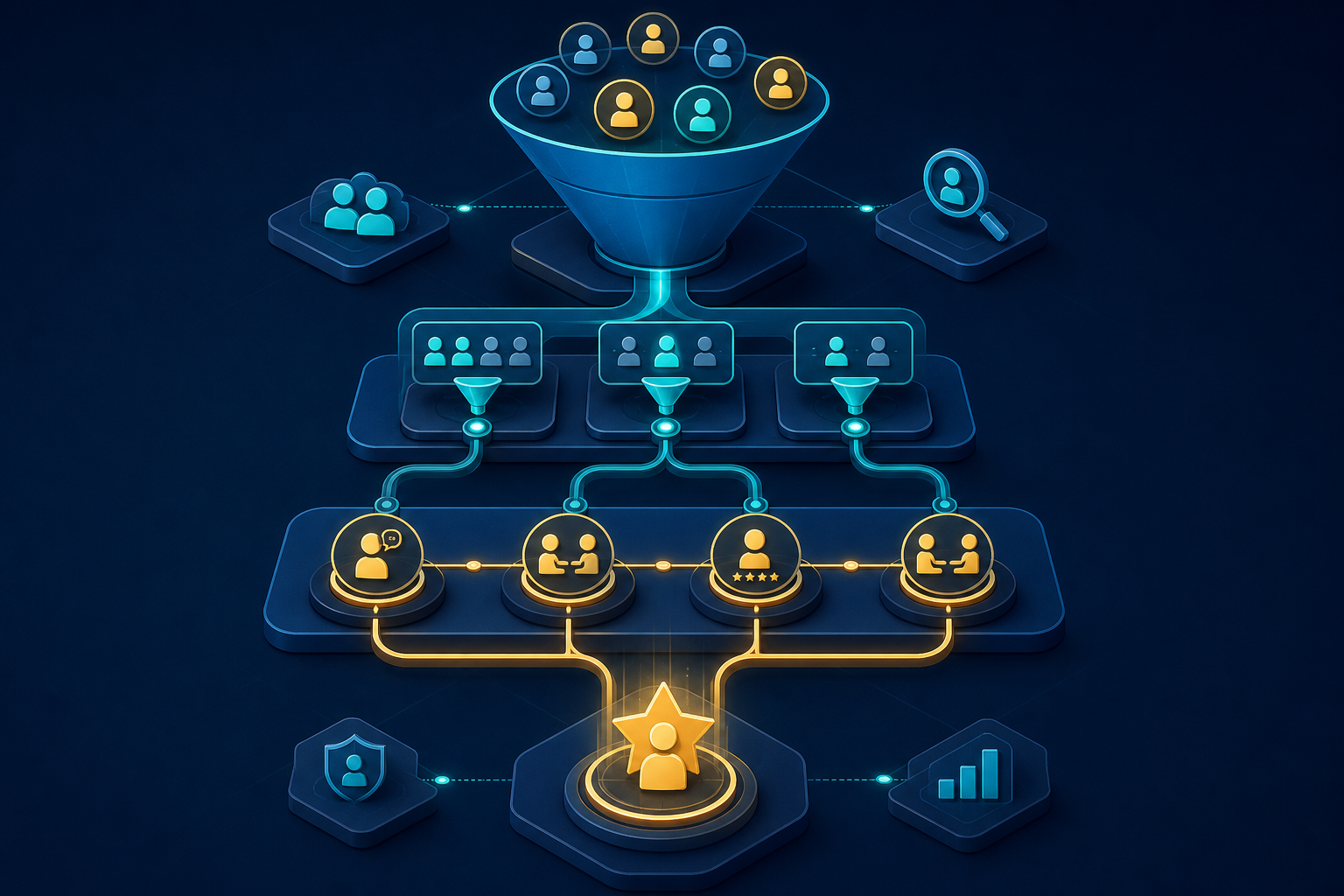
End-to-end RPO covers the full hiring cycle: job description creation, sourcing, screening, interview coordination, offer management, and onboarding handoff. The RPO provider effectively becomes your recruitment function. This model suits companies that want to fully outsource hiring or are scaling rapidly across multiple locations.
Selective or partial RPO covers specific stages of the process. A company might outsource sourcing and screening but retain interview scheduling and offer management internally. This works well when an in-house TA team exists but lacks bandwidth or specialist reach for certain roles.
Project RPO is time-bound. A company needs to hire 50 engineers in six months for a new GCC. They engage an RPO provider for that specific project, then revert to their normal model. It's flexible but requires clear SLA definition upfront.
Hybrid RPO combines elements of the above. An India-headquartered company might use full RPO for domestic hiring and project RPO for international mandates. This is increasingly common among mid-market companies expanding globally.
Background verification, payroll setup, visa and work permit processing, and post-hire onboarding are typically outside the RPO scope unless explicitly contracted. Many providers also exclude leadership hiring (C-suite and VP-level roles) from standard RPO packages, treating these as separate executive search mandates. Always clarify scope boundaries before signing.
For a deeper look at how to evaluate any recruitment outsourcing partner, see our guide on how to choose a recruitment agency with 10 criteria and 7 red flags to watch for.
Understanding the mechanics of RPO services India helps you set realistic expectations and hold your provider accountable. Here's how a well-run RPO engagement actually operates.
The engagement starts with a structured discovery phase. Your RPO provider maps your hiring volume, role types, geographies, and internal processes. SLAs are agreed upon: how many CVs per role, what the target time-to-shortlist is, how feedback will be captured. This phase typically takes one to two weeks. Skipping it, or rushing through it, is the single biggest cause of RPO underperformance.
Once intake is complete, the provider builds a sourcing plan. Traditional RPO providers rely heavily on job boards and their own internal candidate databases. AI-powered RPO models go further: they route each role to specialist agencies with proven track records in that function, seniority level, and geography. This distinction matters enormously for niche and cross-border roles where job board reach is limited.
This is where quality control either happens or doesn't. Manual screening is slow and inconsistent. AI-assisted screening, when trained on large, diverse datasets, can validate candidate fit at scale before a human reviewer ever opens a CV. The best models combine both: AI filters for baseline fit, human specialists validate for nuance and cultural alignment.
The RPO provider coordinates interview logistics, manages candidate communication, and captures structured feedback from hiring managers. This stage is often where traditional RPO models slow down, feedback loops between hiring managers and RPO teams can add days to each cycle. Digital platforms with real-time dashboards compress this significantly.
Once a candidate is selected, the RPO provider supports offer structuring, manages negotiation, and coordinates the pre-boarding process up to the point of joining. Some providers extend this to day-one onboarding support; most hand off at the offer acceptance stage.
A good RPO engagement generates data. Time-to-hire by role type, cost-per-hire by channel, offer acceptance rates, and pipeline conversion ratios should all be visible in a reporting dashboard. This data drives continuous improvement: if a sourcing channel is underperforming, the strategy adjusts. If a particular role type is taking twice as long as the SLA, the intake process gets reviewed.
One of the most common frustrations with RPO services India is the gap between promised timelines and actual delivery. Here's what the data looks like in practice.
For mid-level professional roles in India (3 to 8 years of experience), a well-run RPO engagement should deliver a shortlist within 7 to 10 business days and close a hire within 25 to 35 days. For senior roles (VP and above), expect 30 to 60 days from intake to offer acceptance. For niche technical roles or cross-border mandates, timelines extend further, 45 to 90 days is realistic depending on the market.
These benchmarks assume a clean intake process, responsive hiring managers, and a sourcing model with genuine depth. When any of those conditions are missing, timelines stretch. The hidden cost of slow hiring is significant, for a detailed breakdown, see our analysis of time to hire and the hidden cost of roles left open.
AI-powered RPO models address several of these bottlenecks simultaneously. Intelligent vendor matching routes roles to the right specialist agencies within hours, not days. Automated resume screening validates candidate fit before a human reviewer is involved, cutting shortlist time by 40 to 60 percent in well-implemented systems. Real-time dashboards eliminate the feedback lag that plagues traditional RPO engagements.
Cost is where the RPO conversation gets complicated. There is no single pricing standard for RPO services India, and the model you choose has a significant impact on your total spend.
Management fee model: You pay a fixed monthly fee for the embedded RPO team, regardless of how many hires are made. This provides cost predictability but creates a misalignment of incentives, the provider gets paid whether or not roles are filled.
Cost-per-hire model: You pay a fixed fee for each successful hire. This aligns incentives better but can lead to cherry-picking of easier roles and deprioritisation of niche or senior mandates.
Hybrid model: A base management fee plus a reduced cost-per-hire component. Common in large enterprise RPO contracts. Provides some incentive alignment while covering the provider's fixed costs.
The headline fee is rarely the full picture. Traditional RPO contracts often include additional charges for ATS seat licences, job board subscriptions, background check coordination, and technology platform access. Transition costs, the time and resource required to onboard a new RPO provider, are also significant and rarely factored into initial cost comparisons. For a full breakdown of what recruitment really costs, see our guide on recruitment agency cost in India.
AI-powered RPO models like CBREX operate on a fundamentally different cost structure. There are no retainers, no management fees, and no upfront costs. You pay only when a hire is made. This eliminates the financial risk of a long-term RPO contract that underdelivers, and it removes the hidden costs associated with embedded team models. For companies that want the process discipline of RPO without the financial commitment of a traditional contract, this model represents a meaningful shift.
To understand how recruitment agency cost structures compare across models, our detailed guide on what you're really paying for recruitment in India covers the full picture.
The RPO market in India has split into two distinct camps. Understanding the difference is essential before you commit to a provider.

A traditional RPO provider embeds a team of recruiters at your organisation. They use your ATS, follow your processes, and source candidates through job boards, LinkedIn, and their own candidate database. The model works reasonably well for high-volume, repeatable hiring in established markets. It struggles with niche roles, cross-border mandates, and any situation where the embedded team's network doesn't have the right reach.
The core limitation of traditional RPO is its single-source dependency. One team, one network, one pipeline. When that pipeline runs dry, as it inevitably does for specialist or senior roles, the model has no fallback.
CBREX approaches RPO services India differently. Instead of embedding a single team, CBREX connects your hiring requirements to a curated network of 4,000+ specialist recruiting firms across 33 countries through a single platform and contract. Two core AI tools drive the process.
C Map is CBREX's AI vendor matching engine. When a role is posted, C Map analyses the requirement and routes it to the most qualified specialist agencies for that function, seniority level, and geography. This happens in real time, not over days of manual coordination.
C Screen is CBREX's AI resume screening tool, trained on 250,000+ anonymised resumes across 570+ job categories. It validates candidate fit with 98% accuracy before a human reviewer is involved. Candidates go through a three-level screening process: agency pre-screen, C Screen AI validation, and stack ranking, so hiring managers only see interview-ready candidates.
The result is a model that combines the depth of specialist human recruiters with the speed and consistency of AI automation. Passive candidates, the high performers who aren't actively applying anywhere, are reachable through the specialist agency network in a way that no AI-only platform can replicate.
This is worth dwelling on. Most AI-only recruitment platforms recycle the same pool of active job seekers. They're fast, but they're shallow. The best candidates for most senior and specialist roles are not refreshing job boards. They're reachable only through trusted relationships, the kind that specialist recruiting firms have built over years in their specific domains.
CBREX's model preserves this human depth while adding AI efficiency on top. It's not AI replacing recruiters. It's AI making specialist recruiters faster and more accountable. For a full comparison of hiring platform models, see our guide on hiring platforms in India: job boards vs. agencies vs. AI marketplaces.
One of the most practical advantages of the CBREX model is contract simplicity. A single agreement covers all 4,000+ agencies across 33 countries. One invoice. One point of accountability. No separate negotiations with individual agencies, no fragmented invoicing, no compliance complexity across geographies. For companies managing 10, 15, or 20 agency relationships today, this consolidation alone delivers significant administrative savings. Our guide on vendor consolidation in recruitment covers this in detail.
RPO services India are not the right answer for every company or every hiring situation. Here's an honest assessment of when the model delivers and when it doesn't.

High-volume hiring at scale: If you're hiring 50+ roles per year across multiple functions, the process discipline and sourcing depth of RPO delivers clear ROI. Managing this volume through ad hoc agency relationships creates the vendor sprawl and quality inconsistency that RPO is designed to solve.
Multi-geography mandates: India-headquartered companies expanding into Singapore, Germany, the UAE, the US, or any of the 30+ countries where CBREX operates need a sourcing model with genuine local reach. Traditional agency relationships in each market are slow to build and expensive to manage. RPO with a global specialist network compresses this significantly.
Niche skill shortages: Roles that require rare combinations of skills, a regulatory affairs specialist with APAC market experience, a fintech compliance lead with German language proficiency, cannot be filled through job boards alone. RPO models with deep specialist agency networks are built for exactly this challenge.
Vendor consolidation: If your TA team is managing 15 agency relationships with separate contracts, invoices, and performance tracking, consolidating under a single RPO contract reduces administrative overhead and creates a single point of accountability.
For companies hiring fewer than 20 roles per year in a single location with well-defined, repeatable skill requirements, the overhead of an RPO engagement may not be justified. A well-chosen specialist agency or a targeted job board strategy may deliver better value at lower cost. The key question is whether your hiring complexity has outgrown your current model.
Indian companies between INR 50 crore and INR 5,000 crore in revenue represent the core use case for AI-powered RPO. They're large enough to have complex, multi-function hiring needs. They're growing fast enough that ad hoc recruitment is creating real operational risk. But they're not so large that they need a fully embedded RPO team with a multi-year contract. The pay-on-hire, single-contract model fits this segment precisely.
For companies at this stage considering their options, our comparison of RPO vs staffing in India provides a detailed framework for choosing the right model.
Not all RPO services India providers are equal. These six questions will separate genuine capability from polished sales decks.
Ask specifically: do you source from job boards only, or do you have access to specialist agency networks for passive candidate outreach? A provider that can only reach active job seekers will consistently underperform on senior and niche roles. Push for specifics on how many agencies they work with, in which geographies, and in which functional specialisms.
Manual screening is a bottleneck and a quality risk. Ask whether they use AI screening tools, what those tools are trained on, and what their accuracy benchmarks look like. Also ask what the human review layer looks like, AI without human validation misses nuance. The best answer combines both.
Retainer-based contracts create misaligned incentives. Management fee models charge you regardless of outcomes. Pay-on-hire models align the provider's incentives with yours. Understand exactly what you're paying for, when you're paying it, and what happens if SLAs are missed.
If you're hiring outside India, or planning to, this is non-negotiable. Ask for specific examples of roles filled in the geographies you care about. Ask how local compliance and currency differences are handled. A provider that can't demonstrate genuine cross-border capability will create more complexity than they solve.
Your RPO provider should integrate seamlessly with your existing applicant tracking system. Ask which ATS platforms they've integrated with, how long integration takes, and whether there are additional fees. Fragmented data between your ATS and your RPO provider creates reporting gaps and administrative duplication.
Ask to see a live demo of their reporting interface. You should be able to see pipeline status by role, time-to-hire by function, cost-per-hire by channel, and offer acceptance rates, in real time, not in a monthly PDF report. If the reporting is opaque, the accountability will be too.
RPO is well-suited to mid-market companies, particularly those with complex or multi-geography hiring needs. The traditional enterprise RPO model, with embedded teams and long-term management fee contracts, was designed for large organisations. But AI-powered RPO models with pay-on-hire pricing are specifically built for mid-market companies that need process discipline without the financial commitment of a traditional contract.
Traditional RPO onboarding typically takes four to eight weeks: discovery, process mapping, team embedding, and ATS integration. AI-powered platforms like CBREX compress this significantly. Because the infrastructure (agency network, AI screening, ATS integration) is already built, onboarding is primarily about intake configuration and role briefing, often completable in days rather than weeks.
Traditional RPO models are optimised for volume hiring and often struggle with leadership and niche mandates. AI-powered RPO models that route requirements to specialist boutique firms and independent search consultants can handle senior and niche roles effectively. CBREX's leadership hiring capability, for example, connects companies with curated boutique firms and independent search consultants, with no retainer fees. For more on this, see our complete guide to leadership hiring in India.
This depends entirely on your contract. Traditional RPO contracts often include SLA provisions with remediation clauses, but enforcement is complex when the provider is embedded in your organisation. Pay-on-hire models have a simpler accountability mechanism: if the provider doesn't deliver hires, they don't get paid. Ensure SLAs are defined in writing before engagement begins, with clear metrics and consequences.
A staffing agency fills individual roles on a transactional basis. An RPO provider manages the entire recruitment process, or a defined portion of it, as an ongoing engagement. RPO includes process design, sourcing strategy, screening methodology, reporting, and continuous improvement. Staffing is a transaction; RPO is a managed service. For a detailed comparison, see our guide on RPO vs staffing in India.
Yes, and for India-headquartered companies expanding internationally, RPO is often the most practical model. Managing individual agency relationships in each new market is slow, expensive, and administratively complex. An RPO provider with a genuine global specialist network, and a single contract covering all geographies, removes this complexity. CBREX operates across 33 countries, covering North America, LATAM, MENA, SEA, EMEA, APAC, Eastern Europe, Western Europe, the UK, China, Japan, and Oceania under one agreement. For a full guide to cross-border hiring, see our resource on global hiring from India.
The RPO market in India is maturing fast. Traditional models built around embedded teams and management fee contracts are being challenged by AI-powered platforms that deliver the same process discipline at lower cost, with greater sourcing depth and faster time-to-hire. For mid-market and enterprise companies navigating complex, multi-geography hiring in 2026, the question is no longer whether to use RPO services India, it's which model fits your scale, your budget, and your hiring complexity.
If your current recruitment model is generating vendor sprawl, inconsistent candidate quality, or slow time-to-hire on the roles that matter most, the answer isn't to add more agencies. It's to change the model entirely. CBREX combines 4,000+ specialist agencies, AI vendor matching, and AI resume screening under a single contract with no retainers and no upfront fees, so you only pay when a hire is made.
Your best hire isn't refreshing a job board. They're reachable through a specialist recruiter who knows their market. CBREX connects you to both, with AI making the process faster and more accountable than any traditional RPO model can.
Ready to see how AI-powered RPO services India work in practice? Book a demo with CBREX and see the platform in action, or sign up directly to post your first role with no upfront commitment. If you'd prefer to talk through your specific hiring challenges first, reach out to our team directly.


