Read Time:
3 Mins
The Death of the 'Generalist' Agency: Why 2026 Demands a Recruitment Exchange Model


At a Glance: In 2026, AI has made “finding” candidates easy but “hiring” them harder due to high application noise. This post explores why the Recruitment Exchange model is replacing generalist agencies by focusing on Filtering over Sourcing, resulting in a 40% increase in offer-acceptance and 90% faster technical screening.
In the pre-AI era, the recruiter’s value was in finding the candidate. Today, AI tools make it so easy to find and apply for jobs that recruiters are drowning in “perfect-looking” resumes that lack substance.
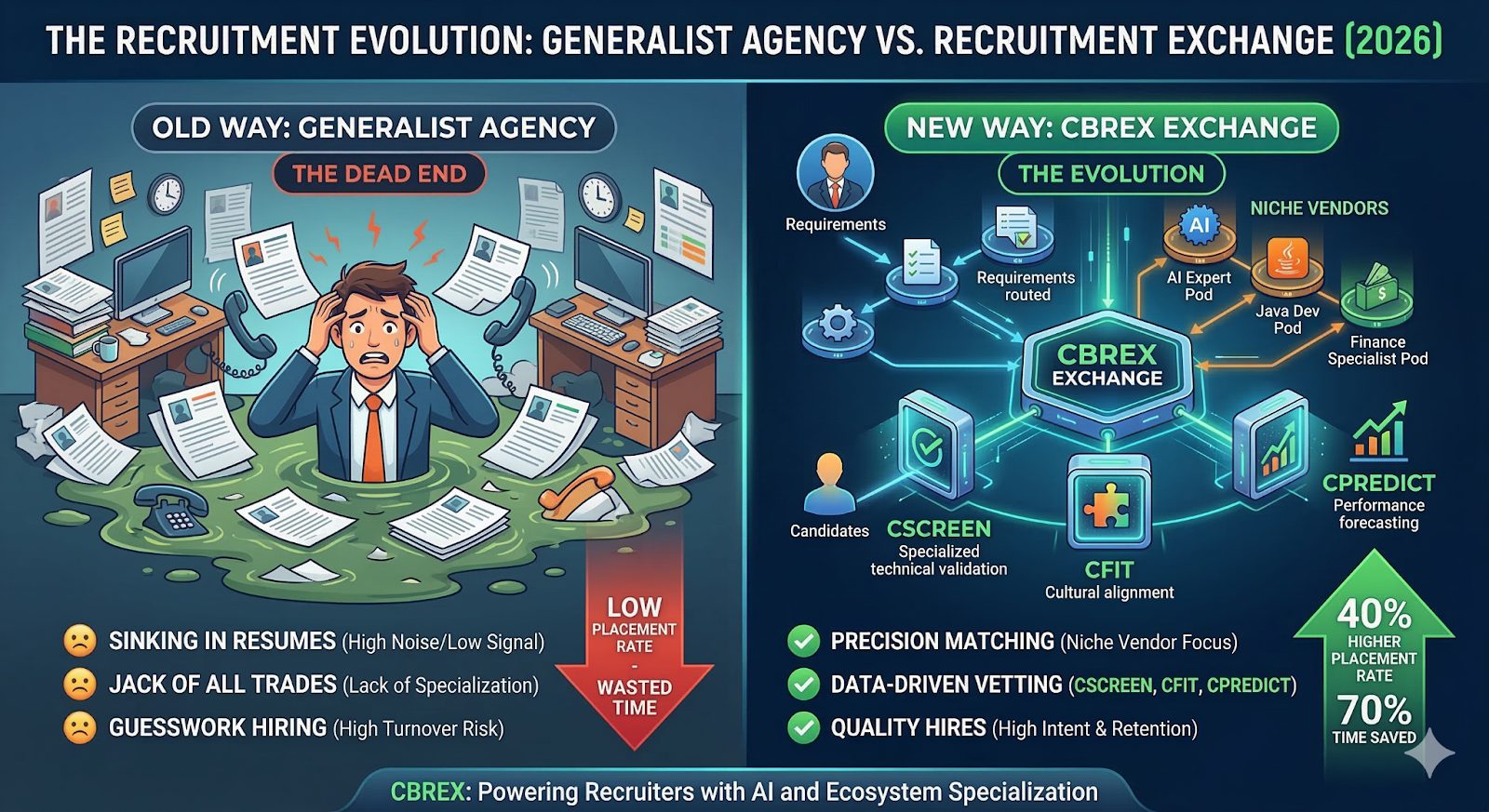
This is the 2026 Recruitment Paradox: Because AI makes it easier to apply, it has become significantly harder to hire. In this landscape, the value of a recruiter has shifted from Sourcing to Filtering. If your agency is still boasting about the size of its database, they are selling you a bucket of water in a flood. You don’t need more resumes; you need a high-precision filter.
Consider a multi-national FinTech firm specializing in digital lending and cross-border payments. In early 2025, they aimed to hire 50+ Senior Backend Engineers (Golang/Rust) across three time zones (EMEA, APAC, and AMER).
Their traditional “Tier 1” generalist agencies failed. Why? Because a generalist recruiter lacks the niche depth to distinguish between an engineer who uses AI and one who can build high-concurrency financial architecture. The internal team was spending 15 hours a week per recruiter on technical interviews for candidates who looked great on paper but failed at the whiteboarding stage.
The Pivot to the Exchange Model:
By moving to a Recruitment Exchange, the firm stopped relying on one “do-it-all” partner. Instead, the requirement was intelligently routed to four hyper-specialized micro-vendors who lived and breathed high-load FinTech. The result was a 40% increase in offer-acceptance rates because the candidates were pre-vetted for specific technical nuances and cultural fit before the first interview.
The primary reason generalist agencies are dying is that they cannot match the speed of an AI-integrated exchange. High-signal data shows exactly where the time is recovered:
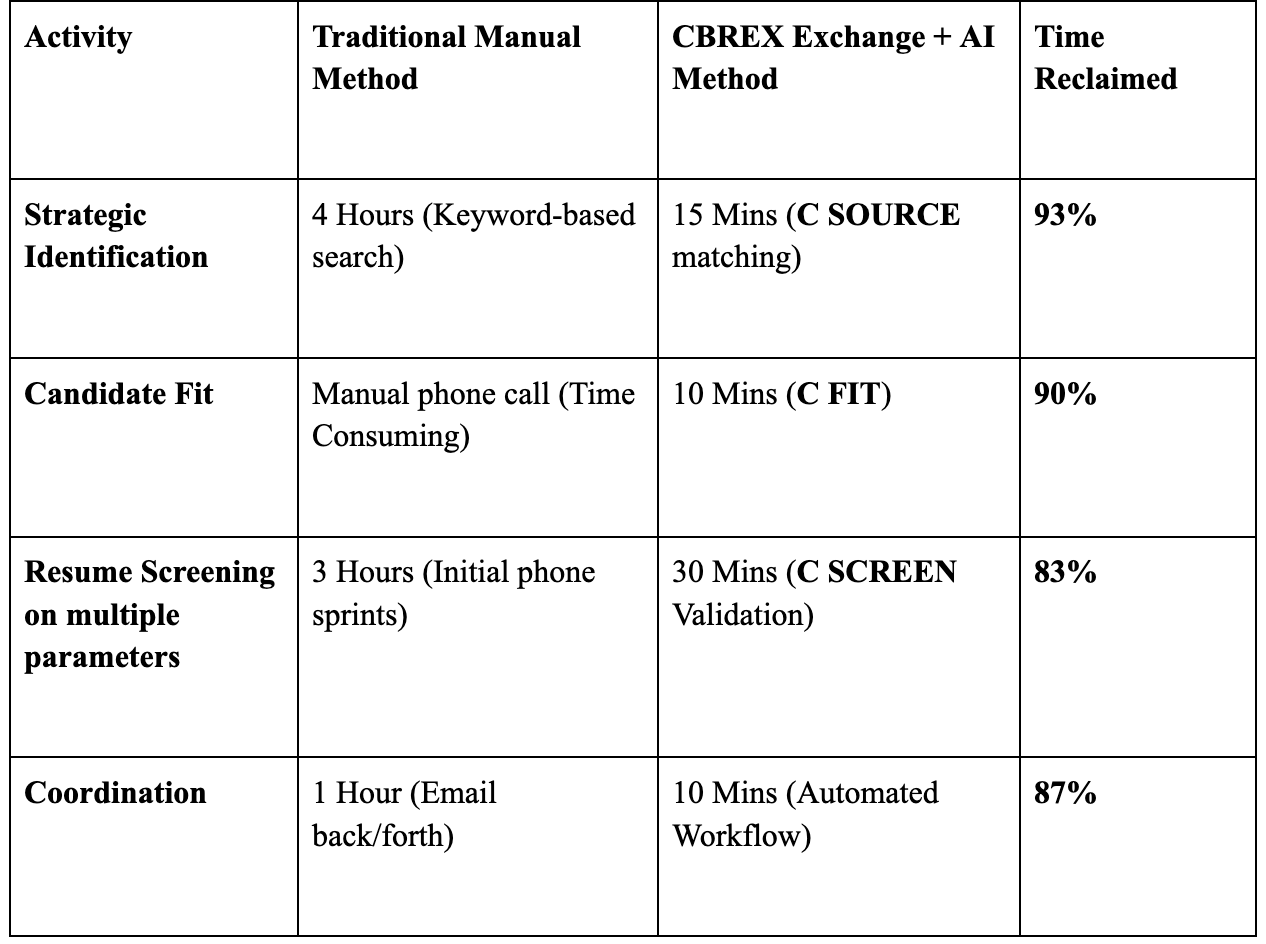
The gap between a “lucky hire” and a “predictable hire” is the technology stack used by the vendor. This is why the CBREX model has become the 2026 standard for enterprise talent acquisition.
When a client posts a requirement on the exchange, CBREX doesn’t just “look for resumes.” It allocates the job to a vetted vendor who utilizes a proprietary suite of AI tools. From CSOURCE for pinpointing specialized talent to CSCREEN and CPREDICT for validating competency and long-term performance, the process ensures that the “filtering” happens before the client ever sees a name. It turns recruitment from a game of chance into a high-precision exchange.