Read Time:
18 Mins
AI Vendor Matching in Recruitment: Cut Time-to-Fill


Your TA team just received approval for seven new roles — two in Singapore, one in Germany, two in the UAE, and two back home in Bengaluru. You open your vendor spreadsheet. Forty-one agency names stare back at you. You know three of them well. You vaguely remember briefing another five last quarter. The rest? Relationships inherited from a predecessor, or agencies that emailed at the right moment. You pick six based on gut feel and send the briefs. Then you wait. This is how most hiring teams still do AI vendor matching recruitment — except they're not using AI at all. They're using memory, relationships, and hope.
That approach has a measurable cost. Roles stay open longer. Shortlists arrive late and miss the mark. And the best specialist agencies — the ones who actually fill niche roles in unfamiliar geographies, never even see your brief. This guide breaks down how AI-powered vendor matching works, why it consistently outperforms human-curated shortlists, and how Indian enterprises expanding globally can use it to cut time-to-fill by weeks, not days.
Most TA leaders would describe their agency selection process as "relationship-based." In practice, that means the same five to ten vendors get briefed on almost every role, regardless of whether they're the best fit for that specific requirement. A generalist agency that filled your last three tech roles in Pune gets briefed on a regulatory affairs specialist role in Germany. A vendor with strong BFSI connections gets sent a brief for a manufacturing QA lead in Malaysia. The match is poor. The results follow.
The problem compounds when you're hiring across geographies. India mid-market companies expanding into MENA, Southeast Asia, or Eastern Europe rarely have established agency relationships in those markets. So they either brief their domestic vendors (who lack local networks) or spend weeks researching and onboarding new agencies in each country. By the time the right recruiter sees the brief, the candidate pipeline is already three weeks behind.
There's also a subtler cost: relationship bias. Agencies that are good at account management, frequent check-ins, polished presentations, responsive emails, tend to stay on preferred supplier lists long after their actual fill rates have declined. Meanwhile, specialist boutique firms with deep expertise in your target role or geography never get a look-in because no one at your company has met them at a conference. The result is a vendor panel that reflects your network, not your hiring needs.
For a detailed breakdown of what this actually costs per hire, see our analysis of recruitment agency cost in India, the numbers are often significantly higher than TA teams report to their CFOs.
The core problem with manual vendor shortlisting isn't effort, it's information asymmetry. You can't select the best agency for a role if you don't know which agencies are actually best for that role.
AI vendor matching in recruitment is the use of machine-learning models to automatically score and rank recruiting agencies against a specific job requirement. Instead of a TA leader manually deciding which agencies to brief, an algorithm evaluates every agency in a network against the role's parameters, and routes the brief to the highest-scoring matches.
The matching dimensions that matter most are:
This is fundamentally different from a static preferred supplier list (PSL). A PSL is a fixed list of approved vendors, usually updated once a year. AI vendor matching is dynamic, every new role generates a fresh relevance score for every agency in the network, based on that role's specific requirements. An agency that scores low on a tech role in Singapore might score highest on a finance role in Dubai. The system reflects reality; a PSL reflects history.
It's also different from simple keyword matching. Basic systems match agencies to roles by scanning for overlapping keywords in agency profiles and job descriptions. True ML-based matching uses weighted signals, historical performance data, and pattern recognition across thousands of past placements to predict which agency is most likely to deliver a quality shortlist, not just which agency has the right words in their profile.
Understanding the mechanics helps TA leaders evaluate platforms more critically and set realistic expectations. Here's how a well-built AI vendor matching engine processes a new role requirement.

When a hiring manager submits a role brief, the system extracts structured signals from the text: function, seniority, required skills, industry context, location, and urgency. This parsing step is critical, the quality of the match depends on the quality of the signal extraction. Platforms that rely on manual tagging introduce human error at this stage; platforms with NLP-based parsing extract signals automatically and consistently.
Every agency in the network has a continuously updated profile built from placement history, fill rates, time-to-submit metrics, candidate quality scores, geographic coverage, and specialisation depth. The AI model scores each agency against the parsed role requirements, weighting each dimension according to its predictive value for that role type. A boutique firm with 47 successful placements in regulatory affairs roles across Germany and the Netherlands will score significantly higher on a relevant brief than a generalist agency with 200 placements across mixed functions.
The model produces a ranked list of agencies for that specific requisition. This ranking is recalculated for every new role, it doesn't carry over from previous briefs. An agency's ranking on today's brief reflects today's data, including recent performance, current capacity, and the specificity of the match.
The brief is sent to the top-ranked agencies only. This is a deliberate constraint. Sending a brief to 40 agencies doesn't produce 40 times the results, it produces noise, duplicate candidates, and administrative chaos. Routing to the highest-scoring matches produces faster, higher-quality shortlists with less management overhead.
This is exactly how CBREX's C Map engine operates across its network of 4,000+ specialist recruiting firms in 33 countries. When a company posts a role on the CBREX platform, C Map scores every relevant agency in the network against that requirement and routes the brief to the best-matched specialists, in minutes, not days. The result is a shortlist that reflects genuine expertise, not just availability.
The case for AI vendor matching isn't theoretical. It's measurable across five dimensions that TA leaders care about.
Manual vendor selection takes time, reviewing agency profiles, checking past performance, making calls, sending briefs individually. AI matching routes a brief to the right agencies in minutes. For roles with tight timelines or competitive candidate markets, that speed difference directly affects whether you make the hire.
Human selection is subject to relationship bias, recency bias, and availability bias. AI matching is subject to data quality and model design, which are auditable and improvable. When the model is trained on real placement outcomes, it consistently outperforms human intuition on role-agency fit, particularly for niche or cross-border requirements.
A typical enterprise vendor panel has 10 to 30 agencies. CBREX's network has 4,000+. AI matching makes that scale usable, without it, a TA leader couldn't meaningfully evaluate thousands of agencies per role. With it, every role gets access to the full depth of a global specialist network.
Every role gets the same rigorous scoring process. There's no variation based on who's managing the requisition, which agencies called this week, or which vendor relationship is currently "warm." Consistency matters especially in multi-geo hiring, where different team members may have very different agency networks.
AI matching handles 1 role and 100 roles with the same process. For Indian enterprises managing simultaneous hiring across five or more countries, this scalability is the difference between a manageable operation and a vendor sprawl crisis. For more on how vendor sprawl develops and how to address it, see our guide on vendor consolidation in recruitment.
For India-headquartered companies expanding internationally, AI vendor matching isn't just a productivity tool, it's a strategic necessity. The challenge isn't finding agencies in general. It's finding the right specialist agencies in markets where your TA team has no existing relationships, no local knowledge, and no benchmark for what good looks like.
Consider a mid-market Indian pharmaceutical company hiring a regulatory affairs specialist in Germany, a clinical data manager in the Netherlands, and a QA lead in Malaysia, simultaneously. Their domestic agency panel has no meaningful presence in any of these markets. Building relationships with local agencies in each country takes months. Onboarding them individually means separate contracts, separate invoicing, and separate compliance checks in three different jurisdictions.
This is the exact problem AI vendor matching solves at scale. Platforms like CBREX use a single contract that covers the entire agency network across 33 countries. When a role is posted, C Map identifies the best-matched specialist agencies in the relevant geography, whether that's a boutique pharma recruiter in Frankfurt, a tech specialist in Kuala Lumpur, or a fintech headhunter in Singapore, and routes the brief automatically. The hiring company never needs to source, vet, or onboard those agencies individually.
The countries where Indian mid-market companies are currently hiring most actively include Germany, UAE, Singapore, USA, UK, Malaysia, Philippines, Australia, Brazil, and Japan. In each of these markets, the difference between a generalist agency and a true local specialist can mean the difference between a 6-week fill and a 6-month search. AI matching ensures the specialist always gets the brief.
For a broader view of the strategic and operational challenges of cross-border hiring from India, our global hiring from India guide covers the full picture, from entity setup to talent sourcing strategy.
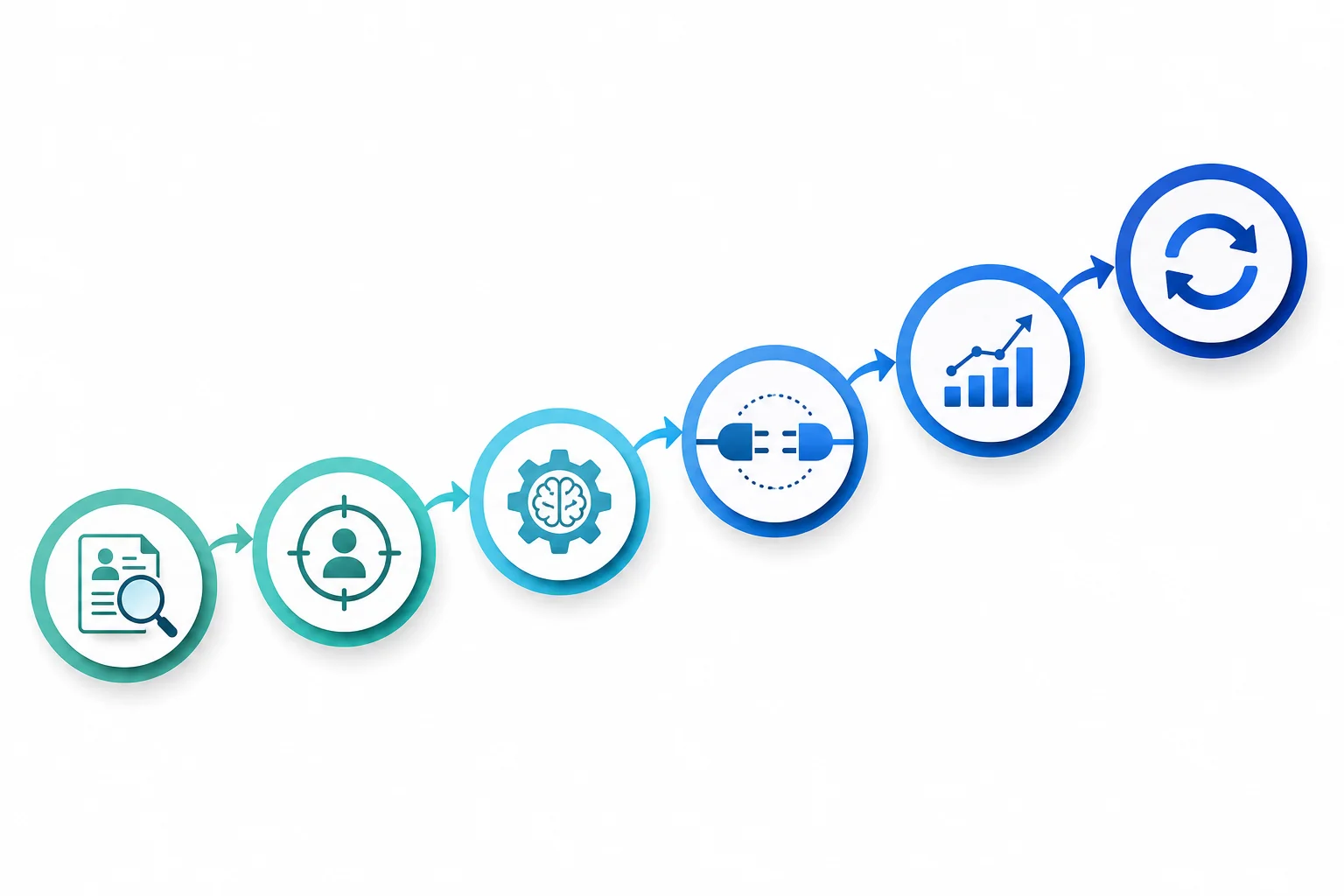
Implementing AI vendor matching doesn't require a complete overhaul of your TA function. It requires a structured approach to platform selection, integration, and performance measurement. Here's a practical six-step process.

Before you can improve your vendor matching, you need an honest picture of your current state. How many agencies are on your panel? How many have filled a role in the last 12 months? Which geographies and functions are underserved? This audit typically reveals that 60-70% of panel agencies are inactive, and that the active ones are concentrated in a narrow set of functions and locations. Document the gaps. They'll define your platform requirements.
Work with your hiring managers to define the dimensions that matter most for your typical roles: function, seniority, geography, industry vertical, and any specialist certifications or regulatory knowledge required. These criteria become the inputs your AI matching platform needs to score agencies accurately. The more specific your criteria, the more precise the matching.
Not all "AI matching" platforms use genuine machine learning. Some use keyword filters with an AI label. When evaluating platforms, ask specifically: what data does the matching model use? How is agency performance tracked and fed back into the model? Can you see why a specific agency was ranked highly for a role? Platforms that can't answer these questions clearly are likely using rule-based filters, not adaptive ML models. For a broader comparison of hiring platform types, see our analysis of hiring platforms in India.
AI vendor matching delivers its full value when it's connected to your applicant tracking system. ATS integration means candidate submissions from matched agencies flow directly into your existing workflow, no manual data entry, no duplicate profiles, no parallel tracking spreadsheets. It also means performance data (time-to-submit, interview conversion, offer acceptance) feeds back into the matching model, improving future recommendations. CBREX integrates with all major ATS platforms, making this step straightforward for most enterprise TA teams.
Define what success looks like before you go live: target time-to-shortlist, interview-to-offer conversion rate, fill rate by geography and function. Track these metrics by agency, not just in aggregate. This data tells you whether the matching model is working and which agencies in the network are consistently delivering. It also gives you the evidence base to retire underperforming vendors and expand relationships with high performers.
AI vendor matching improves with use. Every placement outcome, successful hire, declined offer, candidate withdrawal, feeds back into the model and sharpens future recommendations. TA leaders who treat match scores as a starting point for strategic vendor decisions (rather than just a routing mechanism) get compounding returns over time. After six months of active use, the model's recommendations for your specific role types and geographies will be significantly more accurate than at launch.
For teams also evaluating whether to outsource the entire recruitment function, our comparison of RPO vs agency models for Indian mid-market companies provides a useful framework for deciding when AI-matched vendor management is sufficient and when full RPO makes more sense.
Not every platform that claims AI vendor matching delivers it in a meaningful way. Here are the criteria that separate genuine capability from marketing language.
The matching model is only as good as the network it draws from. A platform with 200 generalist agencies will produce different results than one with 4,000+ specialist firms across 33 countries. Ask specifically: how many agencies are active (have submitted candidates in the last 90 days)? What percentage are specialists vs. generalists? What is the geographic distribution?
You should be able to understand why a specific agency was recommended for a specific role. Platforms that show you the matching rationale, placement history in this function, fill rate in this geography, time-to-submit on comparable roles, give you the confidence to act on recommendations and the data to challenge them when needed.
The best platforms continuously update agency profiles based on real placement outcomes. An agency that filled three roles last quarter in your target function should rank higher than one that hasn't submitted a candidate in six months. Ask vendors how frequently agency performance data is updated and how placement outcomes feed back into the matching model.
If you're hiring in Germany, Singapore, UAE, and Brazil simultaneously, your platform needs active specialist agencies in all four markets. Verify coverage with specific examples, not just a list of countries on a marketing page. Ask for the number of active agencies and recent placements in each of your target geographies.
Seamless ATS integration is non-negotiable for enterprise TA teams. Manual data transfer between a vendor matching platform and your ATS creates errors, delays, and duplicate work. Confirm that the platform integrates with your specific ATS and ask about the depth of integration, does it sync candidate status in real time, or just import CVs?
The commercial model matters as much as the technology. Platforms that charge retainers or seat licences create a fixed cost regardless of hiring outcomes. Pay-on-hire models align the platform's incentives with yours, you only pay when a role is filled. CBREX operates on a pay-on-hire basis with no retainers, no seat licences, and no upfront fees, which means the platform's success is directly tied to your hiring outcomes.
AI vendor matching routes briefs to the right agencies. But what happens to the CVs those agencies submit? Without a screening layer, you're still manually reviewing every submission. Platforms that combine vendor matching with AI resume screening, like CBREX's C Screen, trained on 250,000+ anonymised resumes across 570+ job categories, deliver pre-validated shortlists rather than raw agency submissions. For a deeper look at how AI resume screening works alongside vendor matching, see our guide on choosing the right AI resume screening tool.
No. AI vendor matching augments your existing relationships by adding data-driven rigour to the selection process. If your current agencies are genuinely the best fit for your roles, the matching model will confirm that, and route briefs to them accordingly. What it eliminates is the default behaviour of briefing the same agencies regardless of fit. Strong agencies benefit from AI matching because they get briefed on roles where they're most likely to succeed, rather than wasting time on briefs outside their expertise.
Most TA teams see measurable improvement in time-to-shortlist within the first two to four weeks of active use. The matching model improves over time as it accumulates placement outcome data for your specific role types and geographies, so results typically get better with each hiring cycle. Initial results depend heavily on the quality of the role brief, the more specific the requirement, the more precise the match.
This is where AI vendor matching delivers its greatest value. Niche roles, regulatory affairs specialists, semiconductor process engineers, clinical data managers, fintech compliance leads, are precisely the roles where generalist agencies fail and specialist boutique firms excel. A well-built matching engine identifies those specialist firms across a global network and routes the brief to them directly. For more on sourcing niche skills across borders, see our overseas niche hiring playbook.
On a large, well-maintained network, this is rare. But when it does occur, the platform should flag it transparently rather than routing to a poor match. CBREX's approach in this scenario involves the platform's talent operations team, who can identify and onboard specialist agencies for unusual requirements, maintaining the single-contract model while expanding coverage for edge cases.
Yes, with nuance. Leadership hiring requires a different matching profile, boutique executive search firms, independent search consultants, and firms with specific C-suite placement track records in the relevant industry and geography. AI matching for leadership roles weights these factors differently than for specialist mid-level hiring. CBREX's leadership hiring capability uses curated boutique firms and independent search consultants, with no retainer fees. For a full treatment of this topic, see our leadership hiring guide for India.
Manual agency shortlisting made sense when your hiring was local, your vendor panel was small, and your roles were relatively standard. None of those conditions apply to most Indian enterprises in 2026. Companies are hiring across 5, 10, or 15 countries simultaneously. Roles are increasingly specialised. Candidate markets are competitive. And the cost of a role staying open for an extra month, in lost productivity, delayed projects, and competitor advantage, is significant. For a full breakdown of that cost, our analysis of the hidden cost of time-to-hire puts concrete numbers on what most TA leaders already sense.
AI vendor matching in recruitment changes the structural equation. Instead of briefing the agencies you know, you brief the agencies best positioned to fill the role. Instead of waiting days for manual shortlisting, the brief reaches the right specialists in minutes. Instead of managing 40 agency relationships across 10 countries, a single platform and contract handles the coordination. The result is faster fills, better candidate quality, and a TA function that scales with your business rather than against it.
CBREX's C Map engine does exactly this, routing every role to the most relevant specialist agencies across a network of 4,000+ firms in 33 countries, with no retainers, no seat licences, and no upfront fees. If your current vendor shortlisting process relies more on relationships than data, it's worth seeing what AI-driven matching looks like in practice.
Book a demo with CBREX to see how C Map routes your specific role types to the right specialist agencies, and how the full platform, from AI vendor matching to three-level candidate screening, can cut your time-to-fill by weeks. Or if you'd prefer to explore the platform first, sign up directly and post your first role today. You can also reach out to our team to discuss your specific hiring challenges before committing to anything.


