Read Time:
19 Mins
Hiring in Malaysia for Indian Companies: The 2026 Handbook


Your Kuala Lumpur hiring manager just sent a message: the headcount is approved, the role is scoped, and the team needs someone in seat within three months. Back in Bengaluru, your TA team opens a browser tab and types "how to hire in Malaysia from India" — and gets a wall of generic EOR vendor pages and outdated government PDFs.
Malaysia is one of the most accessible international hiring markets for Indian companies. English is the working language of business. The talent pool is deep in IT, shared services, pharma, and manufacturing. The regulatory framework is stable and well-documented. Yet Indian companies consistently make the same avoidable mistakes: applying Indian salary logic to a Malaysian market, missing EPF obligations, or briefing agencies that have never placed a role in Kuala Lumpur.
This handbook covers everything you need to hire confidently in Malaysia — employment law, EOR vs. entity decisions, role-by-role salary benchmarks in both MYR and INR, realistic timelines, compliance complexity, and how to source vetted specialist talent without building a local agency panel from scratch.
Before briefing a single recruiter, your TA team needs the fundamentals. Here is Malaysia at a glance for Indian hiring teams.
| Population | Approximately 33 million; working-age population (~15–64 years) around 20 million |
| Official language | Bahasa Malaysia (national); English is the primary language of business, contracts, and corporate communication |
| Top hiring cities | Kuala Lumpur (KL), Petaling Jaya, Cyberjaya, Penang, Johor Bahru |
| Currency | Malaysian Ringgit (MYR); approximately ₹18, 19 per MYR (indicative, 2026, verify before budgeting) |
| Time zone | Malaysia Time (MYT) = UTC+8; 2.5 hours ahead of IST, strong overlap for real-time collaboration |
| Key industries for hiring | IT/tech, shared services, manufacturing, financial services, healthcare/pharma, logistics |
| Work week | Monday, Friday standard; some states observe Friday, Saturday weekend (Kelantan, Terengganu) |
The 2.5-hour time-zone gap between IST and MYT is one of Malaysia's practical advantages for Indian companies. Morning standups, real-time approvals, and same-day feedback loops are all workable, unlike hiring in LATAM or Europe, where the gap forces asynchronous workflows.
Malaysia's primary employment legislation is the Employment Act 1955, which was significantly amended in 2022 to extend coverage to all employees regardless of salary level. If you are hiring in Malaysia, this Act governs your obligations.
Probation periods are not legally mandated but are standard practice. Most employers set 3 to 6 months. During probation, either party can terminate with shorter notice, typically 2 to 4 weeks, as specified in the contract. Confirmation at the end of probation should be documented in writing.
The Employment Act sets minimum notice periods based on tenure:
In practice, the market norm for mid-to-senior roles is 1 to 3 months. Many candidates at manager level and above have 2-month notice clauses. Plan your hiring timelines accordingly, this is one of the most common reasons Indian companies miss their go-live dates in Malaysia.
Fixed-term contracts are permitted but carry risk. Malaysian courts have ruled that repeated renewal of fixed-term contracts can create an implied permanent employment relationship. Use fixed-term arrangements for genuine project-based work only, not as a way to avoid permanent employment obligations.
No. Malaysia does not have at-will employment. Termination requires just cause (misconduct, poor performance with documented process) or a formal retrenchment process. Wrongful dismissal claims are heard by the Industrial Court, and awards can be significant. Always follow a documented performance improvement or disciplinary process before terminating.
This is the first structural decision every Indian company faces when hiring in Malaysia. The answer depends on headcount, timeline, and long-term intent.
A Sdn Bhd (Sendirian Berhad) is Malaysia's equivalent of a private limited company. Setup is relatively straightforward compared to many Asian markets:
An EOR employs your Malaysian staff on your behalf, handling payroll, statutory contributions, and compliance. You direct the work; the EOR handles the legal employment relationship.
| Scenario | Recommended Structure |
|---|---|
| 1, 9 employees, testing the market | EOR |
| Hiring before entity is ready | EOR (bridge to own entity) |
| 10+ employees, long-term presence | Own entity (Sdn Bhd) |
| Regulated industry requiring local license | Own entity (mandatory) |
| Short-term project (<12 months) | EOR |
Misclassification risk: Using independent contractors for roles that are functionally permanent employment is a significant risk in Malaysia. The tax authority (LHDN) and EPF can reclassify contractor relationships and impose back-contributions plus penalties. If the work is ongoing, supervised, and integral to your operations, it is employment, not contracting.
For a broader view of how Indian companies are structuring their global hiring decisions, the Global Hiring from India: The 2026 Complete Guide covers the entity vs. EOR decision across multiple markets.
Malaysian salary benchmarks differ significantly from Indian equivalents, and from Singapore, which is the regional comparison point most candidates use. The figures below are approximate 2026 market ranges for Kuala Lumpur and Petaling Jaya. Penang and Johor Bahru typically run 10-15% lower for equivalent roles.
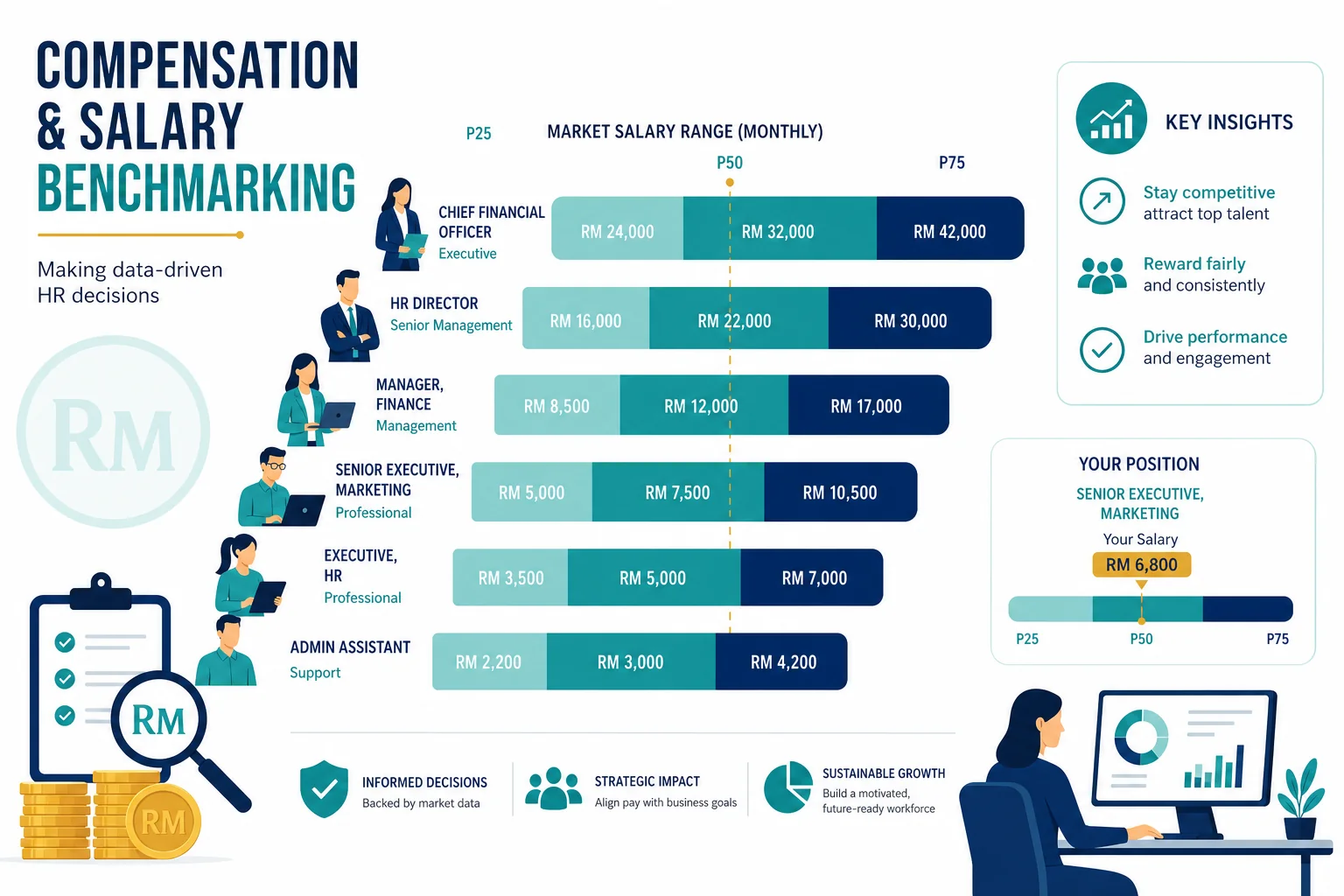
| Role | Monthly Gross (MYR) | Approx. Monthly (INR) | Notes |
|---|---|---|---|
| Software Engineer (mid-level) | MYR 6,000, 10,000 | ₹1.1L, 1.9L | Java, Python, cloud skills command upper range |
| Senior Software Engineer | MYR 10,000, 16,000 | ₹1.9L, 3.0L | Architect-level roles can exceed MYR 18,000 |
| Sales Manager | MYR 8,000, 14,000 | ₹1.5L, 2.7L | Variable commission typically 20-40% of base |
| Operations Manager | MYR 7,000, 12,000 | ₹1.3L, 2.3L | Manufacturing ops roles at upper end |
| Finance Manager | MYR 8,000, 13,000 | ₹1.5L, 2.5L | CPA/ACCA qualification adds 10-15% |
| HR Manager | MYR 7,000, 11,000 | ₹1.3L, 2.1L | HRBP roles in MNCs at upper range |
| Country Manager / GM | MYR 18,000, 35,000 | ₹3.4L, 6.7L | P&L responsibility; equity/ESOP rare outside tech |
Malaysian income tax is progressive, ranging from 0% to 30%. An employee earning MYR 10,000/month gross will pay approximately MYR 1,200, 1,500 in income tax and MYR 1,100 in EPF contributions, taking home roughly MYR 7,400, 7,700. When candidates compare your offer to a Singapore role, they are comparing net figures. Build this into your offer conversations.
Malaysian hiring timelines are longer than most Indian TA teams expect, primarily because of notice periods, not because of slow candidate pipelines.
The hidden cost of a slow hiring process is significant. For a deeper look at how unfilled roles compound costs over time, the analysis in Time to Hire: The Hidden Cost of Roles Left Open applies directly to cross-border hiring scenarios like Malaysia.
Malaysia punches above its weight as a talent market for Indian companies. The country has invested heavily in technical education and has a large English-speaking professional workforce shaped by decades of MNC presence.
Singapore-based companies actively recruit KL talent, often offering 30-50% salary premiums. This creates a constant upward pressure on compensation for top performers. Your offer needs to be competitive not just against other KL employers, but against Singapore relocation packages.
Malaysia has one of Southeast Asia's largest Indian-origin communities, approximately 7% of the population. This creates a natural cultural bridge for Indian companies. Many Malaysian professionals of Indian origin have family or educational ties to India, and some actively seek roles with Indian-founded companies. This is a genuine sourcing advantage, particularly for roles requiring India-market knowledge or cross-border collaboration.
Malaysian professional culture is relationship-oriented and consensus-driven. Understanding these norms prevents the most common drop-off points Indian companies experience.
Malaysian professionals tend toward indirect communication. Disagreement is rarely expressed bluntly, a candidate who says "I'll think about it" may mean "no." Build relationship-building time into your interview process. Rushing to close without establishing rapport is a common reason Indian companies lose candidates at the offer stage.
Multi-round interviews are standard in MNCs and larger companies. Candidates expect:
Compressing this to one or two rounds is possible for mid-level roles but may signal to senior candidates that the process is not rigorous.
Generally positive, particularly for candidates who have worked with Indian MNCs or GCCs before. The main sensitivity is around management style: directive, high-pressure approaches that work in some Indian corporate cultures can cause disengagement in Malaysian teams. Collaborative, feedback-oriented management styles land better.
Malaysia scores 2.5 out of 5 on CBREX's Compliance Complexity Index, moderate difficulty, manageable with the right setup, but with specific areas that catch Indian companies off guard.

| Compliance Dimension | Score (1=Easy, 5=Complex) | Key Detail |
|---|---|---|
| Income Tax | 2/5 | Progressive 0-30%; employer must withhold monthly (PCB system); relatively straightforward for salaried employees |
| Social Security / Pension (EPF, SOCSO, EIS) | 3/5 | Three separate schemes with different contribution tables; EPF employer rate is 12-13% depending on employee age and salary; all must be registered before first payroll |
| Payroll Cycle | 2/5 | Monthly payroll; must be paid within 7 days of month-end; late payment is a statutory offence under the Employment Act |
| Data Privacy (PDPA 2010) | 2/5 | Personal Data Protection Act applies to employee data; consent required for collection and processing; moderate compliance burden, less complex than GDPR |
| Background Check Limits | 2/5 | Criminal record checks permitted; credit checks restricted to financial services roles; reference checks standard and expected |
| Work Permit Complexity | 3/5 | Employment Pass for skilled foreign workers; quota-based system; processing through ESD; 4, 8 weeks typical; some sectors have local hire quotas |
Overall: 2.5/5, Moderate. Malaysia is significantly less complex than China (4/5) or Brazil (4.5/5) for Indian companies. The main compliance risks are EPF/SOCSO registration delays, misclassification of contractors, and work permit quota management for non-Malaysian hires. With proper setup, these are all manageable.
For a comparison of compliance complexity across Southeast Asian markets, see How to Hire in Southeast Asia from India (2026).
Most Indian companies hiring in Malaysia face the same sourcing problem: their existing agency panel has no Malaysia-specialist recruiters. The agencies they trust for Bengaluru or Hyderabad hiring have no network in Kuala Lumpur or Penang. Building a new local agency panel from scratch takes months, and comes with the same vendor management overhead they were trying to escape.
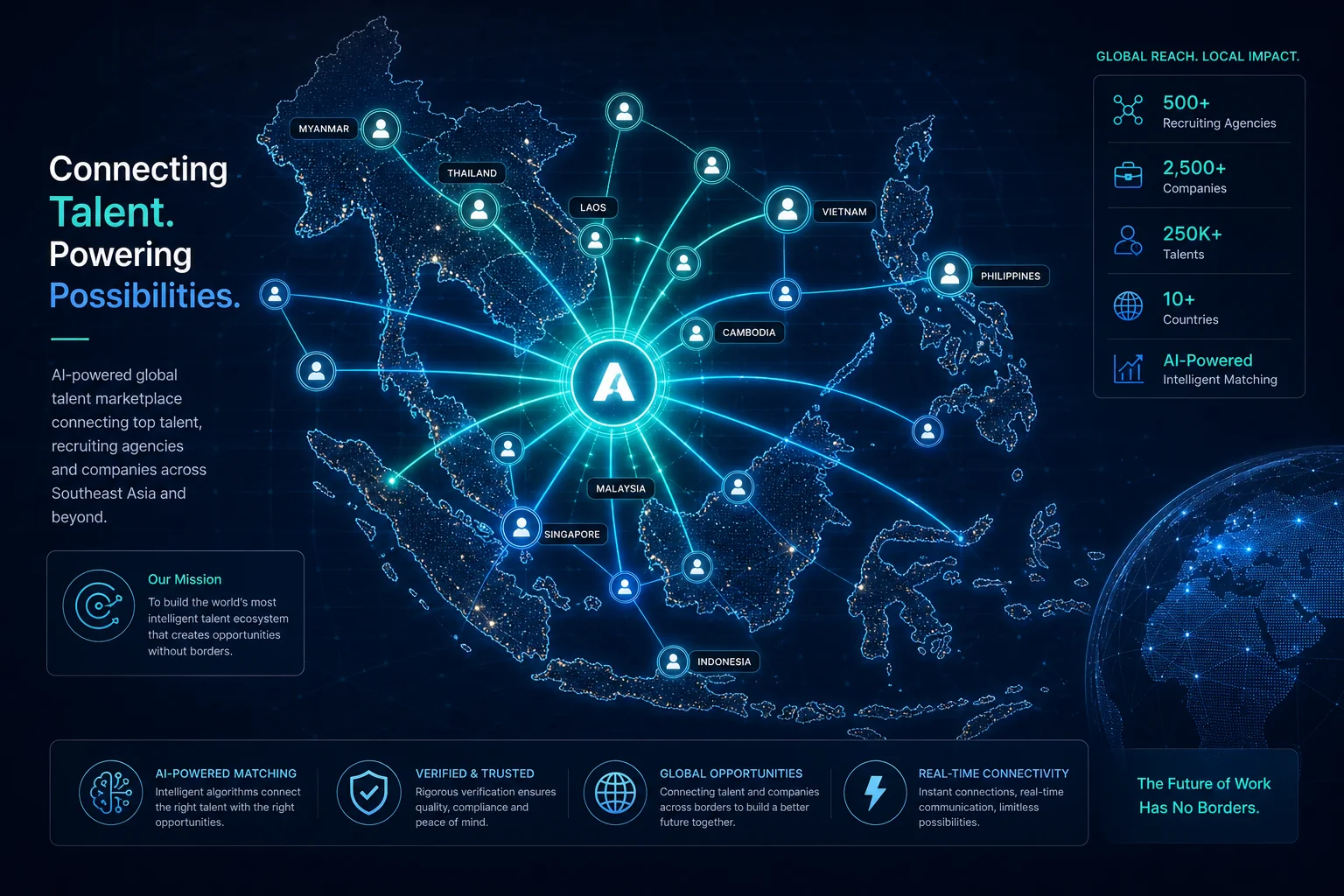
CBREX solves this through a different model entirely. Here is what the platform delivers for Malaysia hiring:
The practical implication: an Indian TA team can post a Malaysia role on CBREX on Monday and receive a pre-screened shortlist within 17 days, without signing a single new agency contract or managing a new vendor relationship.
For companies managing hiring across multiple Southeast Asian markets simultaneously, the RPO vs Agency India: Which Model Wins for Mid-Market Companies analysis is worth reading alongside this handbook.
These are the errors that consistently delay hires, inflate costs, or create compliance exposure for Indian companies entering the Malaysian market.
Malaysian hiring costs are moderate by regional standards, lower than Singapore or Australia, higher than Vietnam or Indonesia. Here is the full cost picture for a mid-level hire at MYR 10,000/month gross.
| Cost Component | Rate | Monthly Amount (MYR 10,000 base) |
|---|---|---|
| EPF (employer contribution) | 12-13% of gross | MYR 1,200, 1,300 |
| SOCSO (employer contribution) | ~1.75% of insured salary | MYR 70, 175 (capped) |
| EIS (employer contribution) | 0.2% of insured salary | MYR 20 (capped) |
| Total employer on-cost | ~14-15% | MYR ~1,300, 1,500/month |
Under the Employment Act, retrenchment compensation is:
This is a statutory minimum. Many companies pay more, particularly for senior roles, to avoid Industrial Court proceedings.
While not legally mandated, a 13th-month bonus (equivalent to one month's salary, paid in December or at Chinese New Year) is widely expected in manufacturing, shared services, and MNC environments. Budget for it as a near-certain cost rather than a discretionary one.
Total cost of employment (ongoing): Approximately 115-120% of gross salary, excluding one-time hiring and permit costs. For a MYR 10,000/month hire, budget MYR 11,500, 12,000/month in total employment cost.
For a detailed breakdown of how recruiter fees compound across a hiring programme, Recruitment Agency Cost in India: What You're Really Paying provides a useful framework that applies equally to cross-border hiring.
Use this checklist before you post your first Malaysia role. Each item represents a decision or action that, if skipped, will create delays or compliance exposure later.
Malaysia is one of the most accessible markets for Indian companies hiring in Southeast Asia, but only if you approach it with local knowledge rather than Indian assumptions. The companies that hire well here treat it as a distinct market, not a cheaper version of somewhere else.
Sourcing vetted specialist talent in Malaysia, without building a local agency panel, signing multiple contracts, or paying retainers, is exactly what CBREX was built for. With 4,000+ specialist recruiting firms across 33 countries, a 17-day average fulfillment timeline, and a pay-on-hire model that means you only pay when a hire is made, CBREX gives Indian TA teams the local specialist coverage they need without the vendor management overhead they don't.
Whether you are hiring your first Malaysia-based engineer or scaling a 20-person KL team, the process starts with a single conversation. Book a Demo with a CBREX specialist and get a clear picture of what specialist sourcing in Malaysia looks like for your specific roles and timeline. Or, if you are ready to post your first role, sign up and get started today, no retainer, no upfront fee, no new agency contracts to negotiate.
Questions before you commit? Let's talk, a CBREX specialist can walk you through the Malaysia talent landscape for your specific industry and role type.