Read Time:
How to Choose a Recruitment Agency in Dubai: A Guide for Indian Companies


To choose a recruitment agency in Dubai, shortlist three firms and test each on four things: proven placements in your sector, awareness of UAE licensing and Emiratisation rules, written replacement terms, and a clear fee basis. Contingency and retained search are the two common fee models. Indian companies hiring across several markets should also weigh one marketplace contract against many separate agency agreements.
Sector proof beats size: ask each agency for recent placements in your exact sub-specialty and seniority band, not a logo wall.
Compliance is a screening question: a credible agency can explain its MoHRE licence and how Emiratisation affects your headcount plan. Check current UAE rules yourself; this guide is not legal advice.
Fee models differ in risk: published market guides put contingency at roughly 12% to 22% of annual salary and retained search at roughly 25% to 33%. These are market figures, not CBREX prices.
Get replacement terms in writing: window, trigger and remedy should all be on paper before you sign.
One contract wins at scale: if you hire in Dubai plus other countries, a single pay-on-hire contract removes duplicate paperwork. For one role in one niche, a single boutique agency may be enough.
Decision point | What to look for | Why it matters |
|---|---|---|
Sector specialism | Named placements in your sub-specialty and level | Generalists recycle the same active candidate pool |
Licensing | A valid MoHRE recruitment licence you can verify | Dubai hiring is regulated, and unlicensed intermediaries add risk |
Emiratisation awareness | Can explain how current quotas touch your headcount | Affects who you can hire and how you plan teams |
Contingency fee | About 12% to 22% of annual salary (market range) | Paid only on placement; agencies compete on the same role |
Retained search fee | About 25% to 33% of annual salary, in stages (market range) | Paid before the hire; suits senior and hard-to-find roles |
Replacement terms | Written window, trigger and remedy | Protects you if the hire leaves early |
Contract structure | One agency, several agencies, or one marketplace contract | Drives admin load, invoicing and negotiation effort |
Check four things: whether the agency has placed people in your exact sector and seniority, whether it holds a verifiable UAE recruitment licence, whether it understands Emiratisation, and whether its fee and replacement terms are written down. Everything else, from office views to client logos, is secondary.
Dubai is not an extension of the Indian market. Talent here is international, salaries are quoted in dirhams, and employers often compare packages that mix fixed pay, housing and allowances. An agency that treats your brief like an Indian job description will waste your first two weeks.
The UAE also regulates the business of recruitment itself. In February 2022, the Ministry of Human Resources changed licensing and permit requirements for employment agencies under Ministerial Decree No. 51 of 2022, setting strict conditions on who may operate. So a licence check is not a formality.
Ask for three recent placements in your sub-specialty, at your seniority band, and ask how the candidates were found. A pharma regulatory lead, a logistics operations head and a fintech product manager sit in very different talent pools. A recruiter who works all three is probably strong in none.
The sharper question is about passive candidates. Job boards recycle people who are already searching. Ask what share of a typical shortlist comes from direct approach, and what the recruiter says in the first call to someone who is not looking. A vague answer tells you the shortlist will be mostly job-board applicants.
For a deeper look at this filter, our guide to choosing a recruitment agency for niche roles covers the vetting questions in more detail.
Ask for the agency's MoHRE licence details and verify them with the ministry yourself. Then ask how it handles Emiratisation in client briefs. You are not testing legal expertise. You are testing whether the agency raises the topic before you do.
Emiratisation is the UAE's policy of increasing private-sector employment of UAE nationals, and the rules and targets change. We will not quote current quotas here, because they move and depend on company size and sector. Check the latest requirements with MoHRE or a UAE employment lawyer before you set a hiring plan.
On candidate fees, the principle is simple. Licensed UAE recruiters are generally expected to charge employers, not candidates. The International Organization for Migration also advises employers to prohibit charging recruitment fees and related costs to migrant workers in their dealings with labour recruiters. Put that in your contract.
Replacement terms say what happens if a hire leaves or fails early. Get four things in writing: the length of the window, what counts as a trigger (resignation, dismissal, probation failure), whether you get a free replacement or a refund, and any exclusions.
Windows vary by agency and by seniority. For context, CBREX's own replacement guarantee on its marketplace runs 30 to 90 days after joining, depending on the level of hire. Use that as a reference point when comparing, not as a promise about any specific Dubai agency.
Watch for terms that void the guarantee if you pay late, change the role scope or make the offer outside the agency's process. Those clauses are common and easy to miss.
Ask what the percentage is calculated on. The usual base is annual fixed salary, but some agencies include housing, transport and guaranteed bonus. On a Dubai package, that difference can move the fee by thousands of dirhams.
Then ask when the invoice is raised: on offer acceptance, on joining, or after probation. Ask whether fees change if you hire a candidate the agency introduced to a different role later. The IOM publishes a checklist of provisions employers can use in service agreements with labour recruiters, which is a useful template for your own review.
Contingency means you pay a percentage of first-year salary only if you hire a candidate the agency introduces. Retained search means you pay in stages, usually engagement, shortlist and placement, whether or not you hire. Contingency suits mid-level and volume roles; retained search suits senior or hard-to-find hires.
Published Dubai market guides put contingency at roughly 12% to 22% of annual salary, with some sources reaching 25% for niche skills. Retained search is commonly quoted at 25% to 33%, paid in tranches. Treat these as market ranges. Your quote will depend on role, level and volume.
Factor | Contingency | Retained search |
|---|---|---|
When you pay | On successful placement | In stages, starting before the hire |
Typical market range | About 12% to 22% of annual salary | About 25% to 33% of annual salary |
Best for | Mid-level and volume roles | C-suite, regulated and scarce-skill roles |
Agency commitment | Several agencies may work the same role | Dedicated consultant, usually exclusive |
Main risk to you | Lower agency effort on hard roles | Paying even if the search does not close |
Suppose you hire a sales director on a fixed salary of AED 25,000 a month, which is AED 300,000 a year. This is an illustration only, using the market ranges above.
Contingency at 15%: AED 45,000, payable on placement.
Contingency at 20%: AED 60,000, payable on placement.
Retained at 30%: AED 90,000, paid in tranches, with part due before any hire.
The base matters. If the agency counts a guaranteed bonus or allowances inside "annual salary", each percentage applies to a bigger number. Settle the definition before the search starts, not at invoice time.
If you want the same logic applied outside the UAE, see our explainer on recruitment agency fees as a percentage of salary.
Score each shortlisted agency from 1 to 5 on sector proof, compliance awareness, replacement terms, fee clarity and candidate quality. Weight sector proof and candidate quality highest. Ask every agency the same questions in the same order, so differences come from the agency and not from your questioning.
Dubai agencies broadly fall into three types. We describe them by category only, because a good fit depends on your role, not on a brand.
Agency type | Strength | Watch for | Best fit |
|---|---|---|---|
Large generalist firm | Broad reach, established process | Thin depth in narrow sub-specialties | Volume and common mid-level roles |
Sector boutique | Deep network in one niche | Limited cover outside that niche | Hard-to-fill or senior roles in one sector |
Recruitment marketplace | Many specialist firms under one contract | Confirm who works your role and their licence | Multi-role or multi-country hiring |
Run a short test before you commit. Give two agencies the same brief and ask for two anonymised profiles within a few days. Profile quality, and how well the recruiter understood the role, will tell you more than any pitch deck.
One marketplace contract beats several agencies when you hire several roles, sectors or countries at once. You negotiate terms once, receive one invoice and avoid managing separate agreements. For a single senior role in one niche, one specialist boutique is usually simpler.
The cost of many contracts is mostly hidden. Each agency needs its own terms, onboarding, feedback loop and invoice reconciliation. If your team also hires in Singapore, the UK or the US, the same work repeats in every market. We cover that drain in what recruitment vendor sprawl costs Indian companies.
Here is the rule we would apply. If Dubai is your only market and you hire fewer than a handful of roles a year in one sector, sign one specialist. If Dubai is one of three or more markets, or you hire across several functions, consolidate. The break-even is about admin load, not about the fee percentage.
One thing is not settled: whether a marketplace always matches a long-standing agency relationship on very senior, confidential searches. Some boards want one named partner for those. In that case, a retained boutique may still be the right call.
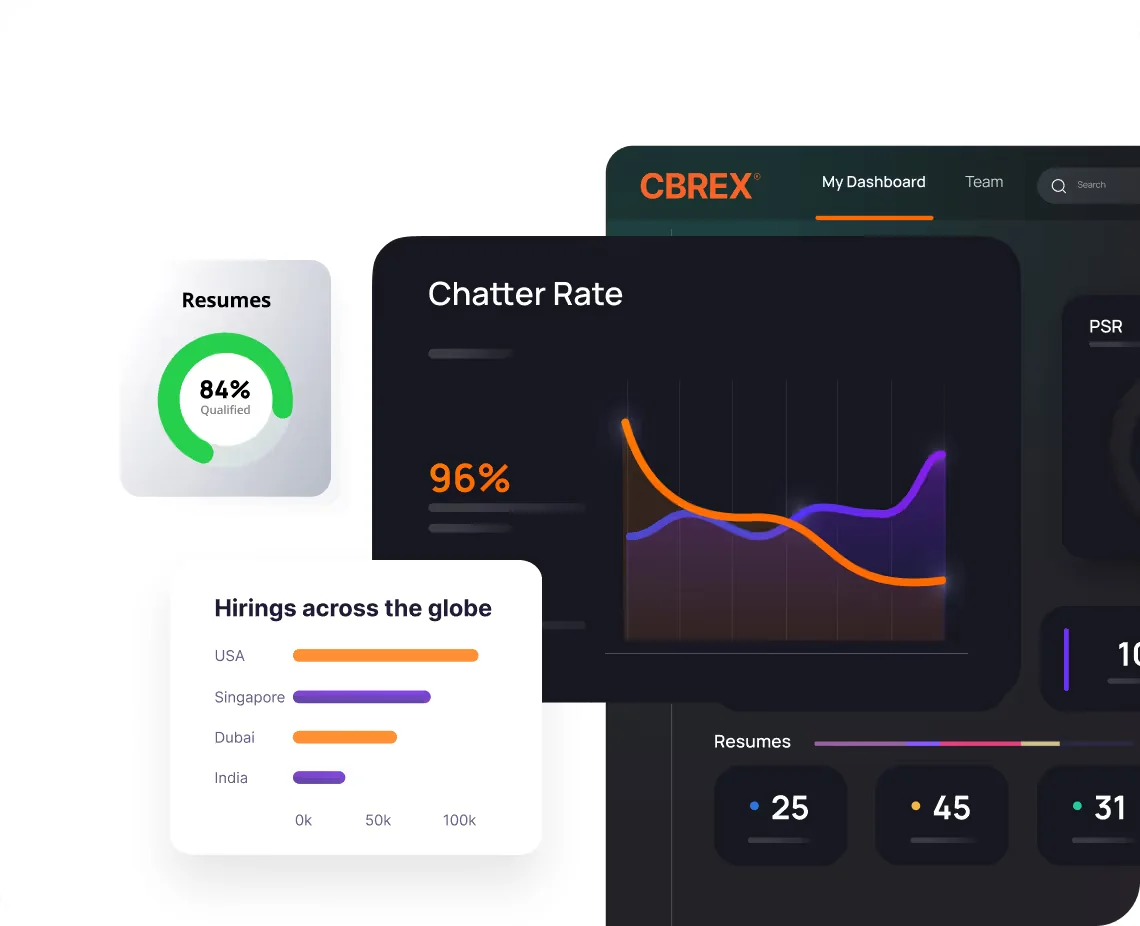
CBREX is a recruitment marketplace. You post a role, AI matches it to relevant specialist agencies from a network of 4,000+ recruiting firms across 55 countries, and you pay CBREX only when you hire. There are no retainers, seat licences or upfront fees, and one contract covers every agency.
These are CBREX's own reported figures. It has made 6,500+ global hires, and it reports a 98% resume shortlist ratio. Its typical time to first shortlist after a role is posted is 24 hours. Those numbers come from CBREX's platform history across markets, and we do not offer them as a guaranteed Dubai time-to-hire.
The first difference is risk. A retained search asks for money before a hire; CBREX does not. The second is structure: a contingency agency bills you directly, while on CBREX you receive one invoice even when several agencies work the role.
The third difference is honesty about limits. The market ranges above are not CBREX prices, and fees on any given role depend on the role and the agencies involved. Ask for current terms in a demo. Also confirm the licensing position of whichever local agency handles your Dubai role, as you would with any agency.
Say a Bangalore-headquartered manufacturer needs a plant manager in the UAE, a country head in the UK and a sales lead in the US. Under the agency route, that is three negotiations and three invoices. On a marketplace, it is one agreement, with the trade-offs between marketplace and agency set out up front.
Our US experience also shapes the advice we give on briefs. The most common mistake we see from Indian founders is treating the US as one market, with no allowance for state-by-state salary differences and a muddled fixed-versus-variable split. The same discipline applies in the UAE. Spell out fixed pay, allowances and variable pay in the brief, so every agency quotes against the same base.
Write a one-page brief. Include role, level, fixed pay, allowances, variable pay, reporting line and must-have skills.
Pick three candidates for the shortlist. Include at least one sector boutique and one option with a wider network.
Ask the same ten questions. Cover licence, Emiratisation, passive sourcing, fee base, invoice timing and replacement terms.
Run a two-profile test. Judge relevance, not volume.
Negotiate the contract in writing. Confirm fee base, replacement window, exclusivity and what voids the guarantee.
Licensed UAE recruitment agencies are generally expected to charge employers, not candidates. If an agency asks a candidate for a fee, treat it as a red flag. Confirm the current rule with the UAE labour ministry, and add a clause to your contract banning candidate charges.
It depends on role seniority, sector and how fast your team gives feedback. Agencies can often present first profiles within days, but offers, notice periods and visa processing add weeks. Ask each agency for its recent timelines in your sector, not a general average.
Retained search is worth it for senior, confidential or scarce-skill roles where you want a dedicated consultant and exclusivity. For mid-level and repeat hiring, contingency or a pay-on-hire marketplace usually carries less financial risk because you pay only when someone joins.
That is a legal and tax question, not a recruiting one. Hiring an employee in the UAE normally involves employer status and visa sponsorship. Take advice from a UAE employment lawyer, and see our comparison of an employer of record versus a recruitment marketplace.
A sound Dubai search starts with a tight brief, a verified licence, a clear fee base and replacement terms in writing. If your hiring spans more than one country, you can also cut the contract count to one.
Book a demo to see how CBREX routes a Dubai role to specialist agencies under one pay-on-hire contract. You can also calculate your hidden hiring tax to see what multiple agency agreements cost your team, or talk to us directly about your brief. If you run a Dubai recruiting firm, sign up as a talent supplier to receive roles through the marketplace.