Read Time:
Recruitment Agency in Belgium: How to Hire Through Vetted Specialist Agencies (2026)


To hire through a recruitment agency in Belgium, brief a specialist firm that knows your function, agree that you pay only when a candidate is hired, and expect a first shortlist within days, not weeks. Across European placements, CBREX sees fees of 15-30%, and a typical EU search takes 24-72 hours to source plus about three weeks to hire.
This guide is for HR and talent leaders, including India-HQ companies hiring in Belgium for the first time. It covers what a Belgian agency actually does, how it differs from executive search, how fees and timelines work, and the checks to run before you sign.
CBREX routes roles to vetted specialist agencies from a network of 4,000+ recruiting firms across 55 countries, under one contract and one invoice, and Belgium is one of the countries we cover.
A recruitment agency in Belgium finds, screens and presents candidates for a role you want to fill permanently. It handles sourcing, first interviews and shortlisting. The hiring company decides, makes the offer and employs the person directly. The employer normally pays the fee, and with a contingent agency only when the hire happens.
Belgium has several kinds of firm, and they do very different jobs. A recruitment and selection firm fills permanent roles. An executive search boutique runs senior, often confidential, searches. An interim agency supplies temporary workers, a model Belgian law calls uitzendarbeid. Mixing these up is the first way a brief goes wrong.
Regulation also matters. In Flanders, the rules for private employment mediation come from the Decree of 10 December 2010, and an agency working there should be able to show how it complies. Belgium's regions run their own labour-market rules, so ask any agency which region's requirements apply to your role.
An India-based TA team rarely has a Belgian candidate network, local salary knowledge or a feel for how Belgian candidates read an offer. A local specialist brings all three. The cost is administrative: each new agency means another contract, another invoice and another vendor to manage.
That is the gap a single-contract model closes. Instead of finding and papering agencies one by one, you post the role once and CBREX's AI matching (C Map) routes it to the specialist agencies best suited to it. If you are weighing this route more broadly, our guide to the overseas recruitment agency model for Indian companies explains how it works across countries.
Use a contingent recruitment agency for most professional and mid-senior permanent roles, and executive search for senior, confidential or very scarce leadership hires. The agency is paid when you hire; a retained search firm is typically paid in stages from the start. The right choice depends on seniority and how discreet the search must be.
| Route | What it does | How it is usually paid | Best for |
|---|---|---|---|
| Contingent recruitment agency | Sources, screens and presents candidates for a permanent role | Fee only on a successful hire | Professional and mid-senior roles, niche technical skills |
| Executive search | Approaches senior and passive candidates directly, often confidentially | Retained firms are paid in stages; contingent search firms are paid on completion | Leadership roles, GCC heads, confidential replacements |
| Interim agency | Supplies temporary workers for short-term cover | Per assignment, set by the agency | Absence cover, peaks in workload |
The payment split is a general feature of the sector. As Wikipedia's executive search entry notes, contingent search firms are paid only when the search is completed, and the fee is paid by the hiring company.
For leadership roles, CBREX maps only boutique search firms whose owners are industry veterans with more than two decades of experience. They know how to stay discreet when taking on a search, and they hold the industry networks that senior candidates trust. There are no retainer fees on this route, which removes the cost most first-time buyers worry about.
Agency fees are a percentage of the hire's first-year salary, paid by the employer, usually only when the candidate is hired. CBREX sees 15-30% for European placements. The exact percentage depends on the country of the hire, and on the seniority of the person being placed.

A fee on salary is the standard model in contingent search, as the executive search overview describes, and some firms also count total remuneration rather than base pay. Always ask which definition is in the contract, because bonus and benefits can move the fee noticeably.
Clients sign one contract and receive one invoice, with no retainers, seat licences or monthly fees. That matters if you are replacing a scattered vendor list. In one example, a client consolidated 54 agency contracts into a single CBREX contract. For a wider country-by-country view, see our guide to recruitment agency fees by country, or book a demo and ask for a Belgium-specific fee discussion.
The most common mistake in a first hiring brief is benchmarking the quality of hire against market salaries but not paying at that level. If you want very high-quality talent, the salary band has to match. Agencies will submit fewer candidates, or none, when the pay does not fit the profile.
For European roles, CBREX typically sees qualified candidates within 24-72 hours of opening a role, with about another three weeks to complete the hire. A first shortlist usually arrives in 24 hours. Roles that need a work permit take longer, because permit processing sits outside the agency's control.

| Stage | Reported CBREX timing |
|---|---|
| Role posted to first shortlist | 24 hours (typical) |
| Sourcing time, EU roles | 24-72 hours |
| Interview, offer and acceptance, EU roles | About 3 weeks after sourcing |
| Germany search, role opening to hire | 30-45 days, with no visa step because candidates were local or EU citizens |
The Germany example is the nearest like-for-like reference we have for Belgium: a continental European search with candidates who already had the right to work. It is not a Belgian result, so treat it as a planning guide.
If your preferred candidate is outside the European Economic Area and Switzerland, you will usually need a single permit, which combines permission to work and permission to reside, for employment longer than 90 days. Only the employer can apply, and the job has to exist first. The process can also require showing that no qualified worker was available locally, though this does not apply to certain shortage occupations in Flanders and Wallonia.
Start permit planning the day an offer is accepted, and ask the agency whether it has placed non-EEA candidates in your function before. Where possible, forecast needs three to six months ahead, as IOM guidance on working with labour recruiters advises, so screening of agencies does not squeeze your timeline.
Write a Belgium-specific brief, post the role once, review the ranked shortlist, interview, then make an offer backed by a replacement guarantee. On CBREX, each step runs through one platform, so you never negotiate separate terms with each agency that works on your search.
Duplicate submissions are blocked at source. The duplicate check is built into the CBREX platform, so when two agencies submit the same candidate, the second agency is told immediately and cannot upload that profile. You do not get two invoices or two arguments about credit.
On quality, more than 90% of our local hires stayed at least 12 months. That figure covers local hires placed through the platform, not Belgium alone.
Before signing, check four things: the agency's licence or registration documents, its screening process, the contract terms on fees and guarantees, and its data terms on candidate resumes. Ask for documentation at onboarding, and do not route a role to an agency that cannot produce it.
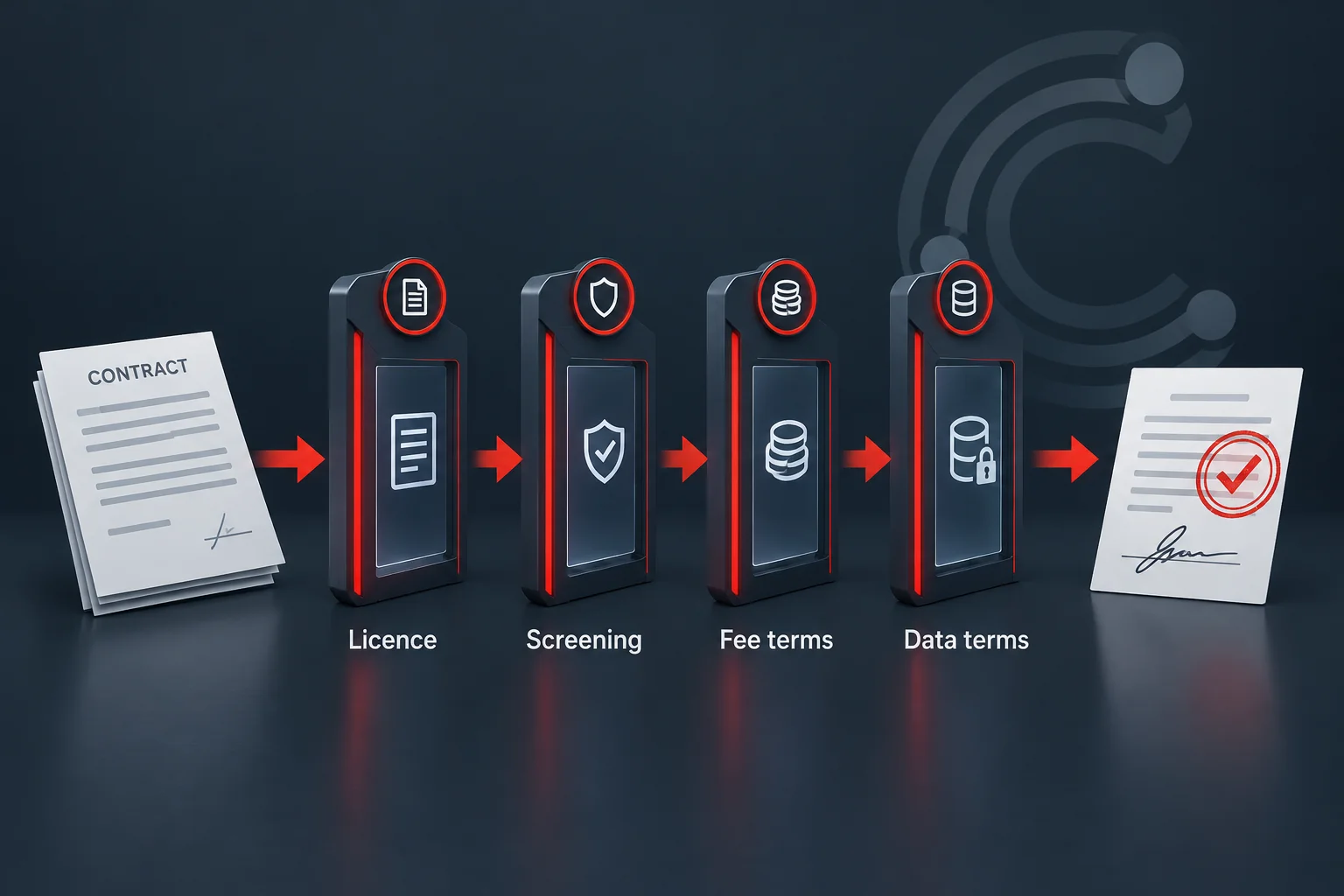
Ask for proof that the agency is entitled to operate in the region where it recruits. For Flanders, the Decree of 10 December 2010 on private employment mediation is the starting point, and Belgian case law has treated protections in it, including on commissions and exclusivity, as matters of public order. In practice, that means contract terms that undermine them may not hold up. Have counsel read any unusual clause.
Ask what happens before a CV reaches you. On CBREX the answer is three levels: agency pre-screen, C Screen AI validation, then stack ranking. C Screen is a screener trained on more than 250,000 anonymised resumes across 570+ job categories, with 98% accuracy.
Get these in writing, in one place:
The IOM checklist for labour recruiter service agreements lists provisions employers can include in agreements with recruiters, and it is a useful second opinion on your draft.
Candidate data is the asset an agency brings. On CBREX, resume ownership stays with the uploading company or entity while the job is open. After the job closes, the resume is purged after a specified period. Ask any agency outside a platform to state the same two points: who owns the CV, and when it is deleted.
Start with the brief: region, salary band, fixed and variable split, and whether the hire needs a work permit. Then decide which route fits, contingent agency or confidential executive search, and choose a model that gives you one contract and one invoice instead of several.
If you want to see how Belgian roles would be matched, screened and ranked, book a demo of the CBREX platform. To size up what slow, scattered agency management is costing you, use the Hidden Hiring Tax calculator. Or write to the team through Let's Talk.
Running a recruitment, staffing or executive search firm in Belgium or nearby? Registration is free, and corporates post jobs globally that you can fill for a commission on each successful hire. Sign up as a recruiting firm. If you are comparing other European markets, our guides to a recruitment agency in Ireland and a recruitment agency in Spain follow the same structure.