Read Time:
Recruitment Agency in Malaysia: How to Hire Through Vetted Specialist Agencies (2026)


To hire through a recruitment agency in Malaysia, write a Malaysia-specific brief with a market-level pay range, route it to a specialist agency that already places that profile, screen every shortlist in layers, and pay only when someone is hired. Done this way, you avoid signing a new contract for every local firm.
At CBREX, that route runs through one platform and one contract. We connect companies with 4,000+ specialist recruiting firms across 55 countries, and Malaysia is on that map. This guide is for TA and HR leaders at India-founded and global companies who need Malaysian hires without managing several local agency relationships.
Agencies can only be as good as the brief they receive. A vague "senior sales lead for Kuala Lumpur" gets vague candidates. A brief that names the skills, the seniority, the pay range and the start date lets a specialist say yes or no within hours.
The most common mistake we see from India-based GCC heads in a first brief is this: they want very high-quality talent but do not benchmark pay against market salaries. The agency then spends weeks presenting people who decline the offer. Check the Malaysian market range before you brief, not after the first rejection.
A usable Malaysia brief covers:
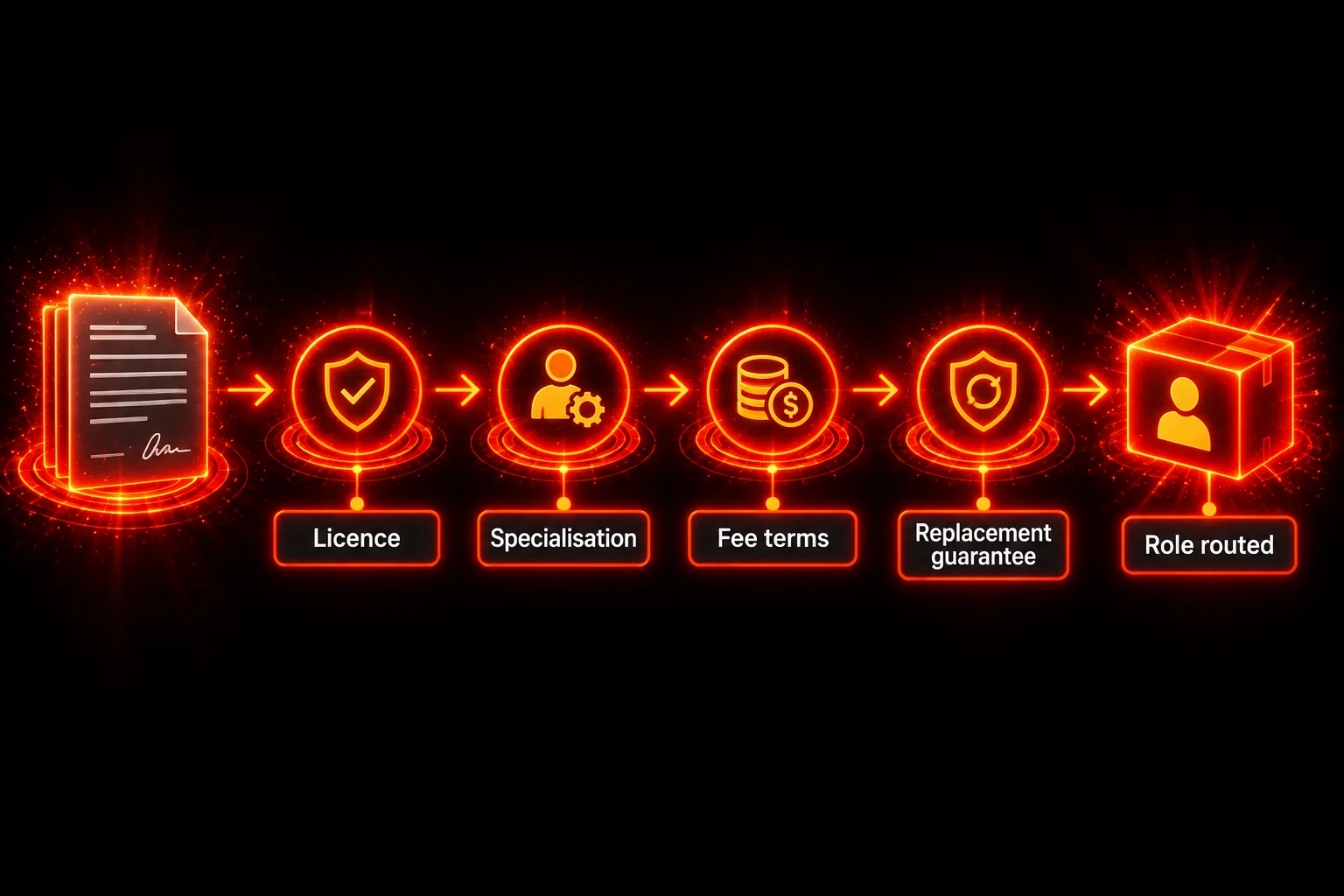
Look for an agency that specialises in your function and seniority, is licensed or registered where it operates, has placed similar roles before, states its fee trigger and replacement terms in writing, and can show its documents at onboarding. Specialisation matters most for niche and senior roles.
On licensing, the International Organization for Migration advises in its recruiter vetting tool to work only with recruiters and employment agencies that are licensed or registered to provide recruitment services in both the countries of origin and destination. Our own approach is to ask for documentation at the time of onboarding, before any role is routed.
| Check | What good looks like | If it fails |
|---|---|---|
| Specialisation | Agency can name recent placements of the same function and level | Move to a firm that focuses on your skill area |
| Licence or registration | Documents supplied at onboarding and still valid | Do not route the role until the paperwork is in hand |
| Fee terms | Fee is payable on a successful hire, with the trigger written down | Reject retainers or upfront fees you did not agree to |
| Replacement guarantee | Period and conditions stated in writing | Ask for the terms before the first submission |
| Candidate ownership | Clear rule on who owns a submitted resume and for how long | Agree it in the contract, not after a dispute |
Some Malaysian roles are filled by candidates from outside the country, including Indian nationals. The IOM's guidance for employers of migrant workers in Malaysia tells employers to always verify that potential migrant workers hold a valid PLKS.
If the candidate is an Indian national, the High Commission of India in Kuala Lumpur points employers to the eMigrate website for an updated list of Indian recruiting agencies, and advises approaching only registered, active ones. Put work-pass responsibility in the brief so no agency assumes it is yours or theirs.
Each extra agency adds another contract, another invoice, another set of terms and another duplicate-candidate dispute. That admin eats TA bandwidth before any interview happens. One contract and one interface remove the repeated paperwork, so the team spends its time on candidates, not on vendor management.
The cost is visible in our own client data. In one example, a client consolidated 54 agency contracts into a single CBREX contract, and their time to hire had been 60 to 75 days before consolidation. In an AI talent example, we consolidated 65+ specialist vendors.

Duplicate submissions are the other drag. On CBREX the duplication check is built into the platform. When two agencies submit the same candidate for one role, the second agency is told at the moment of upload that it is a duplicate and cannot add the candidate. That settles credit without a dispute.
A standalone vendor management system tracks the agencies you already have. If supply drops, you are stuck. Because CBREX adds new agencies to the marketplace on demand, a niche shortage in one market does not stall your search.
You post the role once. CBREX's AI vendor matching, called C Map, routes it to the specialist agencies best suited to the skills and level, and their candidates come back through one interface. You sign one contract, receive one invoice, and pay only when a hire is made.
In practice, the steps look like this:
The commercial model is simple: one contract and one invoice, with no retainers, seat licences or monthly fees. Recruiters register for free and earn a commission on each successful hire, which is why agencies compete on candidate quality rather than on retainer terms.

Every submission passes three filters before you see it: an agency pre-screen, C Screen AI validation, and stack ranking. Weak or duplicate resumes drop out early, so hiring managers meet a short, ranked list instead of a pile of unscreened CVs.

The effect shows up in interview-to-offer ratios. Clients saw 1:3 to 1:4 after three-level screening on recent searches. In our Singapore and Malaysia new-market-entry example, the interview-to-offer ratio was 1:3.5, meaning roughly three to four interviews for each offer.
Resume ownership stays with the company that uploaded it while the job is open. After the job closes, the resume is purged after a specified period.
CBREX reports qualified candidates within 24 to 72 hours of a role opening, a 15 to 45 day time to hire on India-based roles, and a replacement guarantee of 30 to 90 days after joining, depending on the level of the hire. Malaysian searches vary with seniority and niche.
These are CBREX cross-border figures, not Malaysia-only numbers. Use them as planning anchors, then ask for a role-specific estimate once your brief is in.
| Measure | CBREX reported figure | Basis |
|---|---|---|
| Role opening to qualified candidates | 24 to 72 hours | Typical across searches |
| Time to hire | 15 to 45 days | India-based roles |
| Time to hire, Germany search | 30 to 45 days | No visa step; local or EU-citizen candidates |
| Last India GCC or niche search | 24 days | Opening to hire |
| Replacement guarantee | 30 to 90 days after joining | Depends on the level of the hire |
| Local hires staying 12+ months | More than 90% | CBREX local hires |
Speed has a flip side. For sales and revenue roles, we tell clients to finish the process within 3 weeks, because strong sales candidates have a very short shelf life. Slow interview scheduling loses more offers than any pricing issue.
Start with the brief, then check your current agency spread. If you manage several agencies across Southeast Asia, our guides to a recruitment agency in Indonesia and a recruitment agency in Hong Kong show the same single-contract route in neighbouring markets. For mainland roles, see hiring through a recruitment agency in China.
If you want to see C Map matching and three-level screening on a live Malaysian role, book a demo and bring your open brief. To size the admin cost of your current agency spread, calculate your hidden hiring tax.
Run a specialist boutique in Malaysia? Recruitment, staffing and executive search agencies, and self-employed recruiters, can sign up as a talent supplier. Registration is free, and you get a Quickstart Guide and a dedicated Technical Support team. For other questions, talk to the CBREX team.


