Read Time:
17 Mins
Specialist vs. Generalist Recruiting Agency: Which Fills Hard Roles Faster?


Your hiring manager just escalated a role that has been open for eleven weeks. The job board has delivered 40 CVs. Your generalist agency has sent six more. None of them are right. The role requires a regulatory affairs specialist with EU MDR experience, based in Warsaw. Your agency's Warsaw contact covers everything from logistics coordinators to software architects. They're trying their best — but they don't know this talent pool.
This is the moment when the generalist vs. specialist recruiting agency network debate stops being theoretical. For Indian mid-market companies expanding globally, it happens more and more often. The question isn't which model sounds better on paper. It's which one actually closes the role.
Not all open roles are equal. A high-volume sales hiring drive in Bengaluru is a fundamentally different problem from sourcing a fintech compliance lead in Singapore or a clinical operations manager in Germany. The first has a large, active talent pool. The second and third require reaching professionals who are not looking — and who will only engage with a recruiter they trust.
A role becomes genuinely hard to fill when three or more of these conditions are true:
For India-headquartered companies building global teams, this combination is increasingly common. A pharma company in Hyderabad hiring a QA lead in the Netherlands. A fintech firm in Mumbai sourcing a risk manager in Dubai. A GCC in Pune filling a senior data architect role in Kuala Lumpur. Each of these is a hard role. And each one exposes the limits of the generalist model.
The comparison framework that matters here is not about which agency type has a better brand or a larger database. It comes down to three measurable outcomes: fill rate, time-to-hire, and candidate quality. Let's look at what each model actually delivers.
Generalist staffing firms are built for breadth. They cover multiple industries, functions, and geographies under one roof. Their value proposition is convenience: one relationship, one contract, one point of contact for everything from junior analysts to department heads.
For the right use case, that breadth is genuinely useful. High-volume, repeatable hiring, customer support teams, sales development representatives, administrative staff, is where generalist firms perform well. The talent pool is large, active, and accessible through standard job boards and databases. Speed of onboarding the agency matters more than domain depth.
But the model has structural limits that become visible the moment a role gets hard:
The result is predictable. According to data from the Society for Human Resource Management, average time-to-fill for specialist and technical roles is 50, 60 days through standard agency channels, and that figure climbs significantly for cross-border or highly niche positions. Generalist firms often hit that ceiling and stall.
A specialist recruiting agency is built around depth. A boutique firm focused exclusively on life sciences regulatory affairs, or one that covers only fintech compliance roles in Southeast Asia, has something a generalist cannot replicate: a warm, trusted network of passive candidates who take their calls.
The advantages compound over time:
The limitation of a single boutique specialist agency is coverage. One firm that excels at pharma regulatory hiring in Germany cannot help you fill a fintech role in Singapore or an engineering leadership position in Brazil. This is where the specialist recruiting agency network model becomes the decisive upgrade.
A curated network aggregates dozens or hundreds of specialist agencies, each with deep domain and geographic expertise, under a coordinated structure. Instead of choosing between depth and breadth, you get both. The network routes your role to the agency best positioned to fill it, regardless of function or geography.
This is fundamentally different from simply briefing multiple agencies. A true specialist network has quality controls, performance data, and coordination mechanisms that a DIY multi-agency approach cannot replicate.

When you move past anecdote and look at performance data, the specialist network advantage on hard roles is consistent across three key metrics.
Fill rate measures the percentage of briefed roles that result in a successful placement. For standard roles, generalist and specialist agencies perform comparably. For hard-to-fill roles, niche skills, cross-border, senior individual contributors, the gap widens significantly.
Research from LinkedIn Talent Solutions consistently shows that passive candidates make up roughly 70% of the global workforce. Generalist agencies, which rely heavily on active-seeker databases, are structurally excluded from that 70% for specialist roles. Specialist agencies, by contrast, are built to access exactly that pool.
Time-to-hire is where the cost of the wrong model becomes most visible. Every week a critical role sits open has a measurable business impact, delayed product launches, revenue gaps, team overload. For a detailed breakdown of what open roles actually cost, see our analysis of the hidden cost of roles left open.
Specialist agencies typically deliver a qualified shortlist 30, 40% faster than generalist firms on hard-to-fill roles. The reason is structural: they start with a warm network, not a cold database search. When that specialist expertise is aggregated into a network with AI-powered role routing, the speed advantage compounds further.
Quality is harder to measure but easier to feel. Hiring managers at companies using specialist networks consistently report higher interview-to-offer ratios, meaning fewer wasted interviews, fewer rounds of "close but not quite," and faster decisions. When the recruiter understands the domain, the pre-screening is genuinely predictive rather than keyword-based.
For TA leaders managing hiring across multiple functions and geographies, candidate quality also has an administrative dimension. Receiving 30 CVs and finding 2 relevant ones is not just frustrating, it consumes hiring manager time that has real opportunity cost. Specialist networks, especially those with AI-assisted screening layers, dramatically improve the signal-to-noise ratio.
Fairness requires acknowledging where generalist firms genuinely win. Not every role needs a specialist network, and deploying one for the wrong use case adds unnecessary complexity.
Generalist agencies are the right choice when:
The honest answer is that most TA functions need both models. The mistake is defaulting to the generalist for every role, including the ones where that default costs you weeks of delay and a string of irrelevant CVs.
There are specific hiring scenarios where the specialist network model doesn't just perform better, it's the only model that reliably works.
Roles requiring deep domain expertise, embedded systems engineers, pharmacovigilance specialists, quantitative analysts, EU MDR regulatory affairs managers, have talent pools that are small, passive, and highly skeptical of generic outreach. Only a recruiter with genuine domain credibility can access and convert these candidates.
Indian companies expanding globally face a compounded version of this problem. Not only is the role specialist, but the talent pool is in a geography where your existing agency panel has no real presence. A specialist network with verified agencies in the target country, agencies that know the local market, compensation benchmarks, and compliance requirements, is the only scalable solution.
For a practical framework on this, see our guide to global hiring from India and the detailed playbook on hiring niche skills overseas.
Senior professionals are not browsing job boards. They are reachable only through trusted relationships, which means the recruiter needs to have built those relationships over years in the specific domain. A specialist network that includes boutique executive search firms and independent search consultants, operating on a no-retainer basis, gives you access to this talent without the traditional retained search cost structure.
When a company needs to fill specialist roles across MENA, SEA, EMEA, and LATAM simultaneously, no single agency, generalist or specialist, can cover all of it with genuine depth. A specialist network that aggregates verified agencies across all these regions, coordinated through a single platform, is the only model that delivers consistent quality across geographies without creating vendor sprawl.
The obvious fix when a generalist agency fails on a hard role is to brief a specialist. Then another specialist for the next geography. Then another for the next function. Within 18 months, a mid-market TA team managing global hiring can find itself coordinating 15, 20 agency relationships, each with its own contract, invoice format, SLA, and performance tracking requirement.
This is vendor sprawl, and it's a problem that affects a significant number of Indian enterprises with multi-country hiring needs. The administrative overhead alone can consume 20, 30% of a TA team's capacity. Finance teams struggle to reconcile invoices in multiple currencies. Legal teams manage compliance across dozens of separate agreements. And when a role needs to be filled urgently, the TA leader has to manually decide which of their 18 agencies is best positioned, without any data to support that decision.
The specialist network model solves this without sacrificing depth. Instead of managing 18 separate agency relationships, you access all of them through a single contract, a single invoice, and a coordinated platform that routes roles to the right agency automatically.
For a detailed look at how to structure this, see our guides on building a consolidated recruitment vendor pool and vendor consolidation in recruitment.

CBREX is built specifically for the problem this article describes: accessing deep specialist expertise across multiple geographies, without the vendor sprawl that comes from managing those specialists independently.
The platform aggregates 4,000+ specialist recruiting firms across 33 countries, each vetted for domain expertise and geographic coverage, under a single contract and unified invoicing structure. For an India-headquartered company hiring a regulatory affairs manager in Germany, a fintech compliance lead in Singapore, and a data architect in Brazil simultaneously, CBREX routes each role to the agencies best positioned to fill it, without the TA team having to manage those relationships individually.
When a role is posted on CBREX, the platform's AI vendor matching engine, C Map, analyzes the job requirements and routes it to the most relevant specialist agencies in the network. This is not keyword matching against agency profiles. It's a matching model trained on placement history, domain expertise signals, and geographic performance data. The right specialist agency gets the brief within hours, not days.
Every candidate submitted through CBREX goes through three screening layers: agency pre-screen (the specialist recruiter's domain judgment), C Screen AI validation (a screening model trained on 250,000+ anonymised resumes across 570+ job categories, with 98% accuracy), and stack ranking against the role requirements. Hiring managers receive a shortlist of genuinely qualified candidates, not a volume dump of keyword-matched CVs.
For more on how AI screening works in practice, see our analysis of how to choose the right AI resume screening tool.
One agreement covers all 4,000+ agencies across all 33 countries. No retainers. No seat licences. No upfront fees. You pay when a hire is made. This eliminates the financial risk of the traditional specialist agency model, where retained search fees are paid regardless of outcome.
For a full breakdown of what recruitment agency cost structures actually look like, see our guide to recruitment agency costs in India.
For companies that want to fully outsource the coordination layer, CBREX offers an AI-powered RPO model, end-to-end hiring with AI-driven vendor coordination, reporting, and candidate management. This is particularly relevant for Indian mid-market companies managing multi-country hiring programs where internal TA capacity is limited. For a comparison of models, see our breakdown of RPO vs. agency hiring in India.
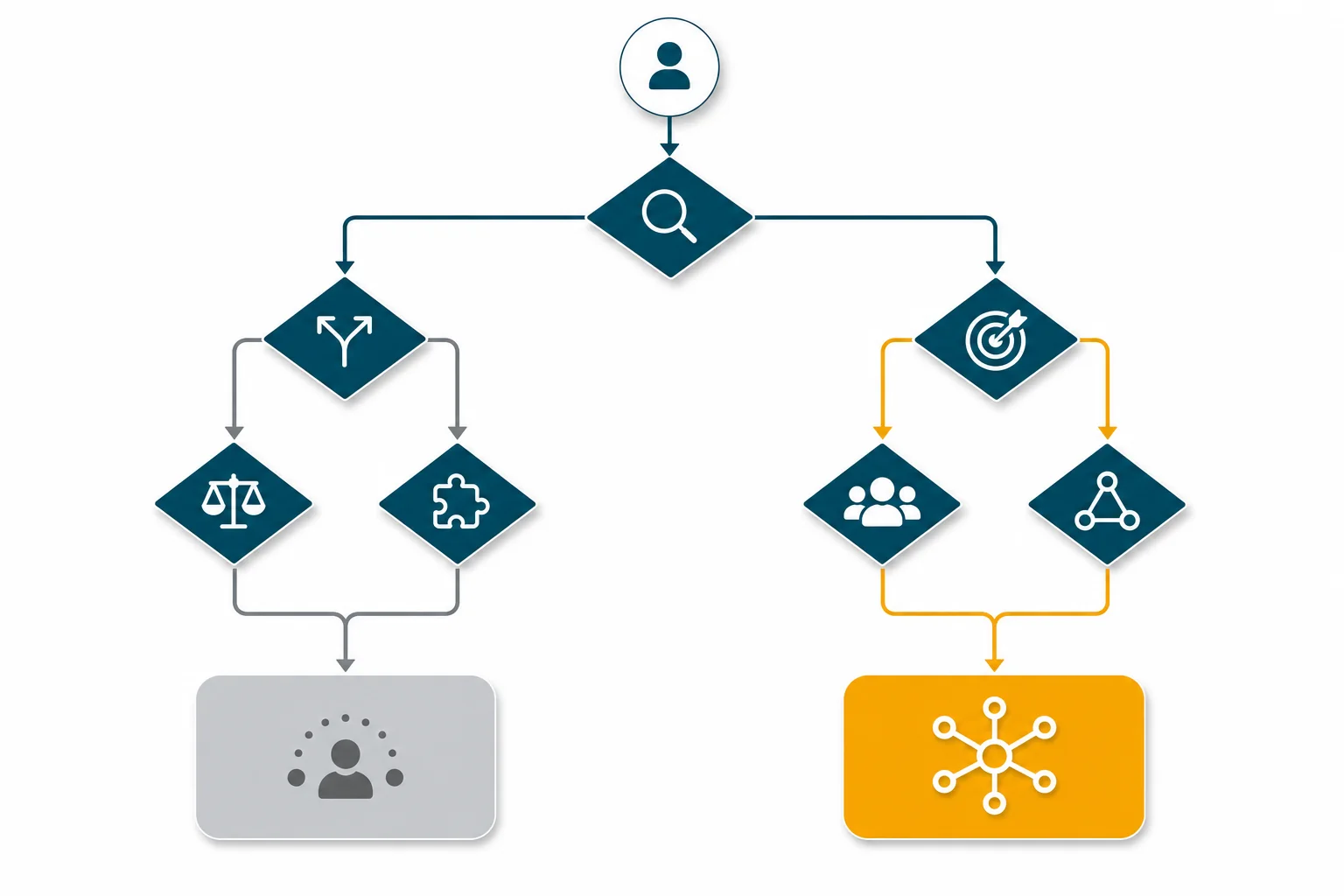
Use this five-step framework before briefing your next agency on a difficult role.
Is this role genuinely specialist, or is it high-volume and repeatable? If the required skill set is narrow, domain-specific, or requires a candidate with a particular combination of experience that is rare in the active job seeker pool, it is a specialist role. If it is a standard function with abundant supply, a generalist agency is sufficient.
Where do the best candidates for this role actually spend their time? If they are active on job boards and LinkedIn, a generalist agency can reach them. If they are employed, performing well, and not looking, which is true for most senior and specialist roles, you need a recruiter with a warm network in that specific domain.
Is this a single-market hire or a multi-country requirement? For domestic Indian hiring, your existing agency panel may have adequate coverage. For roles in Germany, Singapore, the UAE, Brazil, or any other international market, you need verified local specialist presence, not a generalist firm's overseas office that covers everything.
How many agency relationships can your TA team realistically manage well? If you are already coordinating 10+ agencies with separate contracts and invoices, adding more specialists without a consolidation layer will create more administrative overhead than hiring value. A specialist network accessed through a single platform solves this.
What does this role cost your business for every week it remains open? For revenue-generating roles, the answer is often significant. For operational roles, the cost shows up in team overload and delayed projects. Quantifying this number makes the case for investing in the right sourcing model, rather than defaulting to the cheapest or most familiar option.
The question is never "which model is cheaper?" It's "which model fills this specific role faster, with better candidates, at a total cost that accounts for the price of delay?" For hard-to-fill roles, the specialist network wins that calculation consistently.
If you want to understand the full cost picture before making this decision, calculate your hidden hiring tax to see what your current approach is actually costing you.
A specialist recruiting agency network is a curated group of boutique recruiting firms, each with deep expertise in a specific domain (such as pharma, fintech, engineering, or legal) or geography, coordinated through a single platform or managed service. Unlike a single specialist agency, a network provides broad coverage across functions and geographies while maintaining the depth that specialist firms offer.
A single boutique agency has deep expertise in one domain or geography but cannot cover multi-function or multi-country hiring needs. A specialist network aggregates many boutique firms under a coordinated structure, giving you access to specialist depth across all the domains and geographies you need, without managing each agency relationship separately.
Yes. This is one of the primary use cases for specialist networks. Indian mid-market and enterprise companies expanding globally need specialist agencies with genuine local presence in markets like Germany, Singapore, the UAE, the UK, and the US. A specialist network with verified agencies in those markets, accessible through a single contract, is the most efficient way to access that expertise. See our guide to global hiring from India for a full framework.
Specialist networks perform best on roles where the talent pool is predominantly passive, the skill set is domain-specific, or the hire is cross-border. This includes senior technical roles, regulatory and compliance positions, leadership hires, and any role in a geography where your existing agency panel lacks genuine local expertise.
CBREX connects companies to 4,000+ specialist recruiting firms across 33 countries through a single contract. When a role is posted, the AI vendor matching engine routes it to the most relevant specialist agencies for that function and geography. All candidate submissions go through three-level screening before reaching the hiring manager. Companies pay only when a hire is made, no retainers, no upfront fees, no separate invoices per agency.
If your TA team is managing hard-to-fill roles across multiple geographies, or if you're an India-headquartered company building global teams and running into the limits of your current agency panel, the specialist network model is worth a direct look.
Book a demo with CBREX to see how the platform routes your specific roles to the right specialist agencies, screens candidates before they reach your hiring managers, and eliminates the vendor sprawl that comes from managing specialists independently. Or if you'd prefer to start a conversation directly, let's talk about your current hiring challenges.


