Read Time:
3 Mins

Struggling with AI-generated job applications? Learn how precision vetting reduces resume noise and improves hiring accuracy in 2026.

By
CBREX

Executive Summary: In the high-velocity tech corridors of 2026, "Ghosting" has evolved from an annoyance into a systemic financial risk. As candidates in hubs like Bengaluru and Riyadh hold record-high offer counts, "Hope" is no longer a viable recruitment strategy. This post explores how the CBREX Guaranteed Delivery model uses behavioral data to close the "Certainty Gap" and ensure 100% interview integrity.

The 2026 Crisis: The "Offer-Hoarding" Economy

In the current landscape, a Senior DevOps Engineer or AI Architect doesn't just look for a job; they manage a portfolio of offers. "Ghosting"—the act of skipping interviews or failing to show up on Day 1—is often a byproduct of Offer-Hoarding. For the hiring manager, the cost is staggering. When a candidate ghosts a final round, it’s not just the recruiter's time that is wasted; it is 5–10 hours of senior technical leadership’s time. In 2026, this "Reliability Debt" is the #1 silent killer of high-growth tech hubs.

The Senior Insight: Ghosting is rarely a personality trait; it is a Data Failure. If a candidate doesn't show up, your sourcing funnel failed to flag the "Lack of Intent" signals early enough.

How to ensure 100% interview attendance and delivery in competitive tech markets?

The only way to guarantee delivery in a saturated market is to replace "Subjective Promises" with "Predictive Reliability." This requires a move away from generalist agencies who are spread too thin and a shift toward an exchange model that incentivizes Certainty.

The CBREX model solves for this by treating Certainty as a technical SLA (Service Level Agreement), not a "Best-Effort" goal.

The 3 Layers of Intent Validation:

  1. Specialized Micro-Vendors: CBREX routes your roles to vendors who have "high-trust" relationships with their talent pools. These specialists know who is actually looking to move and who is just "window shopping."
  2. CPREDICT (Intent Scoring): Our AI analyzes behavioral micro-signals—engagement frequency, response latency, and historical reliability data—to provide a Reliability Score before the first round.
  3. CSCREEN (Skin-in-the-Game): By requiring candidates to undergo a high-precision technical audit, we filter out "casual" applicants. A candidate who completes a CSCREEN audit has a statistically higher "Intent-to-Join."

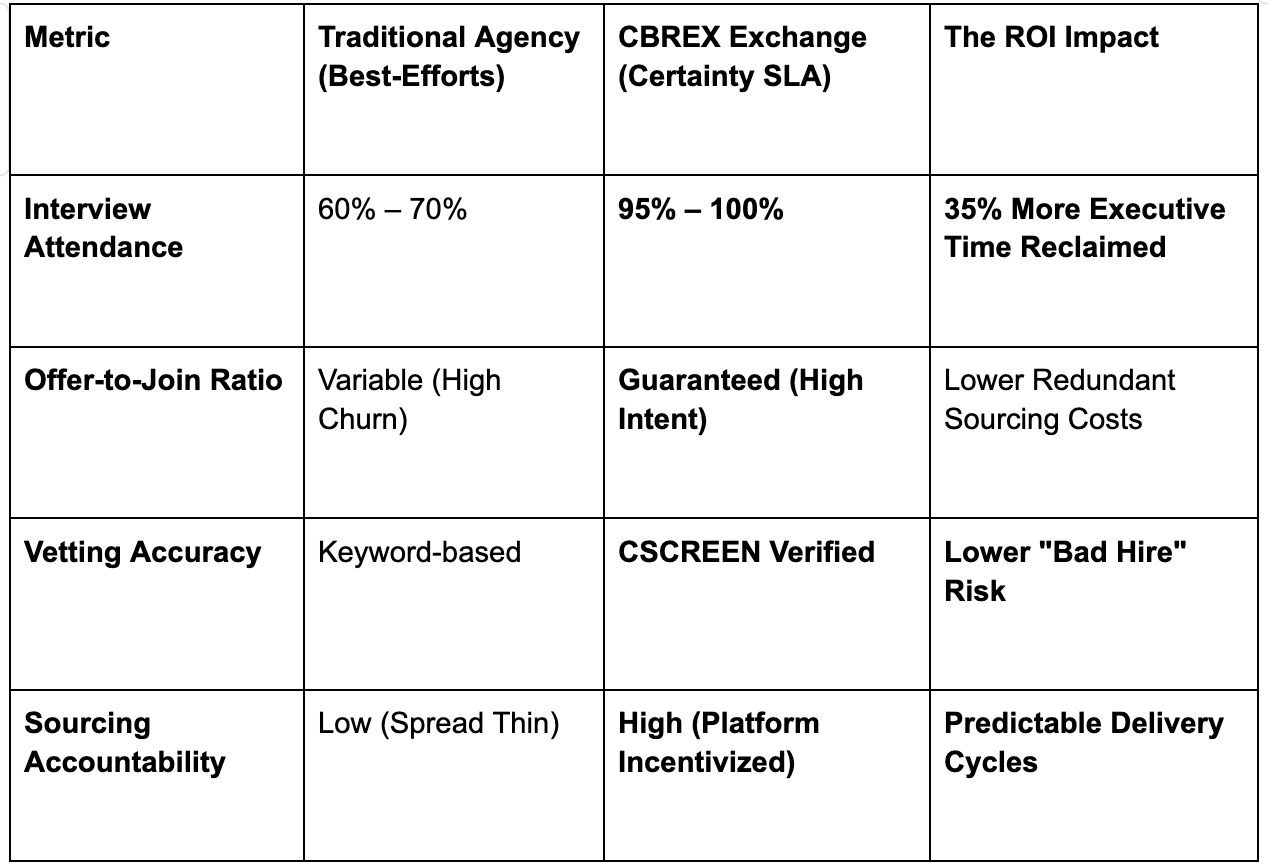
The Reliability Breakdown: "Best Efforts" vs. "Certainty SLA"

Data from the 2026 CBREX Reliability Index highlights the impact of data-driven intent validation.
The CBREX Pillars: Convenience, Certainty, and Accuracy

We’ve built our platform to act as the "Insurance Policy" for your talent pipeline:

  • Certainty (The Core Promise): We don't just "search" for candidates. We provide the Certainty of a vetted, high-intent shortlist that actually shows up.
  • Convenience: You get the Convenience of a single dashboard to track reliability scores across 5,000+ specialized vendors.
  • Accuracy: Our Accuracy and Precision layer (CSCREEN) ensures that "Intent" is backed by "Competency."

The Bridge: Moving from Hope to Hiring

In 2026, the companies that scale the fastest are those that have eliminated "Process Friction." By adopting the CBREX exchange model, you move away from the "Ghosting Crisis" and toward a predictable, high-integrity hiring engine.

Stop gambling on "Best Efforts." Start hiring with Certainty.
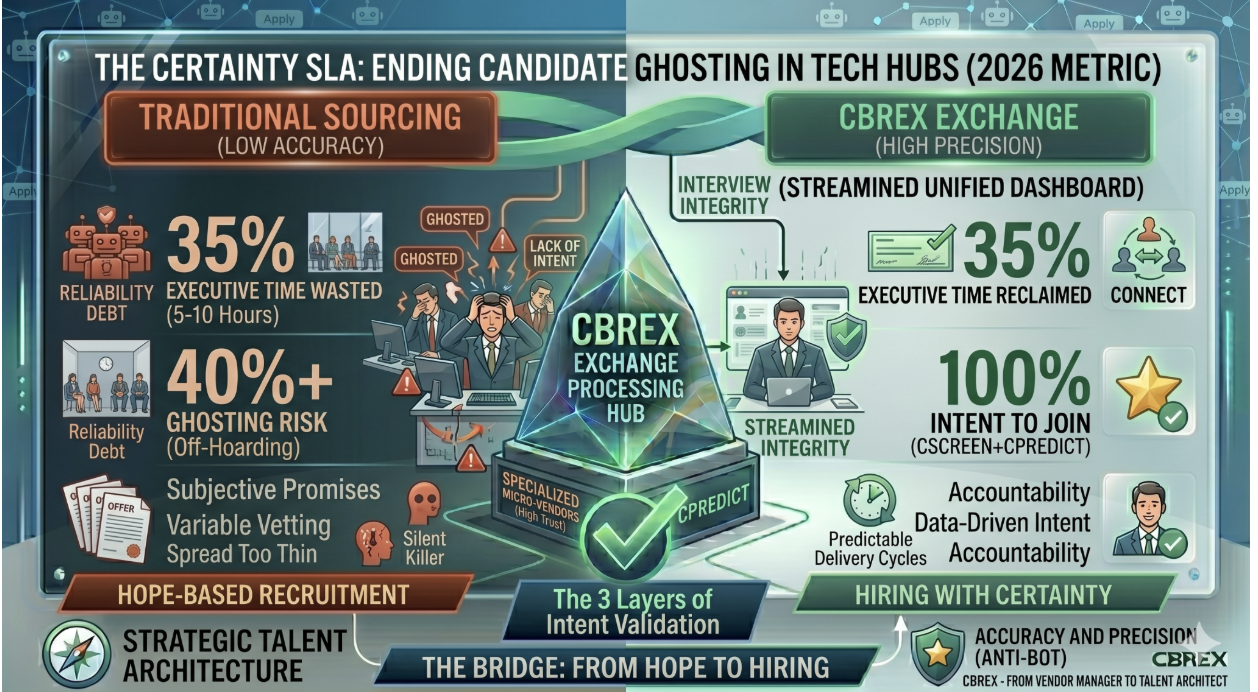
Table of contents

Sign up for regular updates
Get all the news delivered to your inbox.
Thank you! Your submission has been received!
Oops! Something went wrong while submitting the form.

Similar blogs

Read Time :
Managing Recruitment Vendors Across Countries: One Dashboard
An operational guide for TA heads running recruiting vendors in multiple countries without drowning in contracts, invoices and duplicate CVs. Covers why multi-country vendor sprawl compounds faster than domestic sprawl (separate agreements, currencies, data rules, time zones), what a single-contract multi-vendor model replaces, how consolidated invoicing and a single dashboard change vendor accountability, and the metrics worth tracking per market. Practical and tool-agnostic, written for India-headquartered teams hiring across geographies.
Read Time :
No Retainer, No Upfront Fee: Global Recruitment Explained
Why Indian companies are moving away from upfront retainers for international hiring, and what the alternative looks like in practice. Covers the cash-flow case against retainers for overseas roles, what a no-upfront-fee global recruitment platform actually charges and when, how vendors stay motivated without a retainer, the risk-sharing logic behind outcome-based fees, and the specific situations where a retainer still makes sense (confidential C-suite searches, ultra-scarce markets). Aimed at CFOs and TA heads questioning international recruiting spend.
Read Time :
Hiring in Ukraine for Indian Companies: The 2026 Handbook
The complete 2026 guide to hiring in Ukraine from India — employment law, EOR vs. own entity, role-by-role salary benchmarks (local + INR), realistic hiring timelines, the compliance score, total cost to hire, common mistakes, and how CBREX sources vetted specialist talent in Ukraine.