Read Time:
3 Mins
The 2026 Global Hiring Compliance Map: Navigating EOR vs. Exchange-Led Sourcing in SE Asia
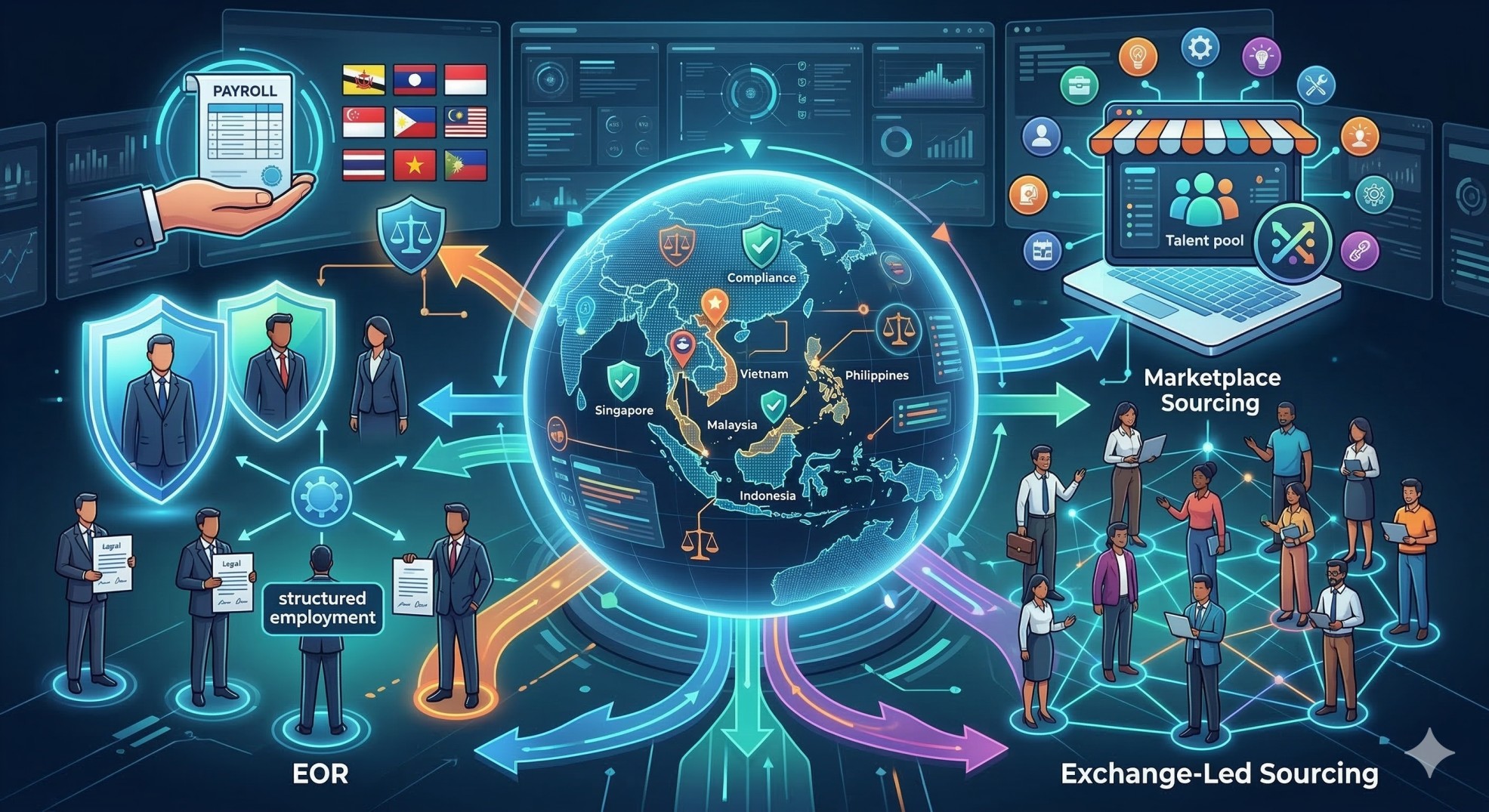

Expanding into Southeast Asia in 2026 is no longer a "nice-to-have" growth strategy; it is a necessity for technical and operational resilience. However, the region—spanning from the high-tech hubs of Vietnam to the fintech centers of Indonesia—has introduced some of the world's most complex digital labor laws this year.
For the global CXO, the fear isn't just "finding talent"—it's the catastrophic legal and financial fallout of misclassification, non-compliant vetting, and "ghost hiring" in a high-stakes regulatory environment.
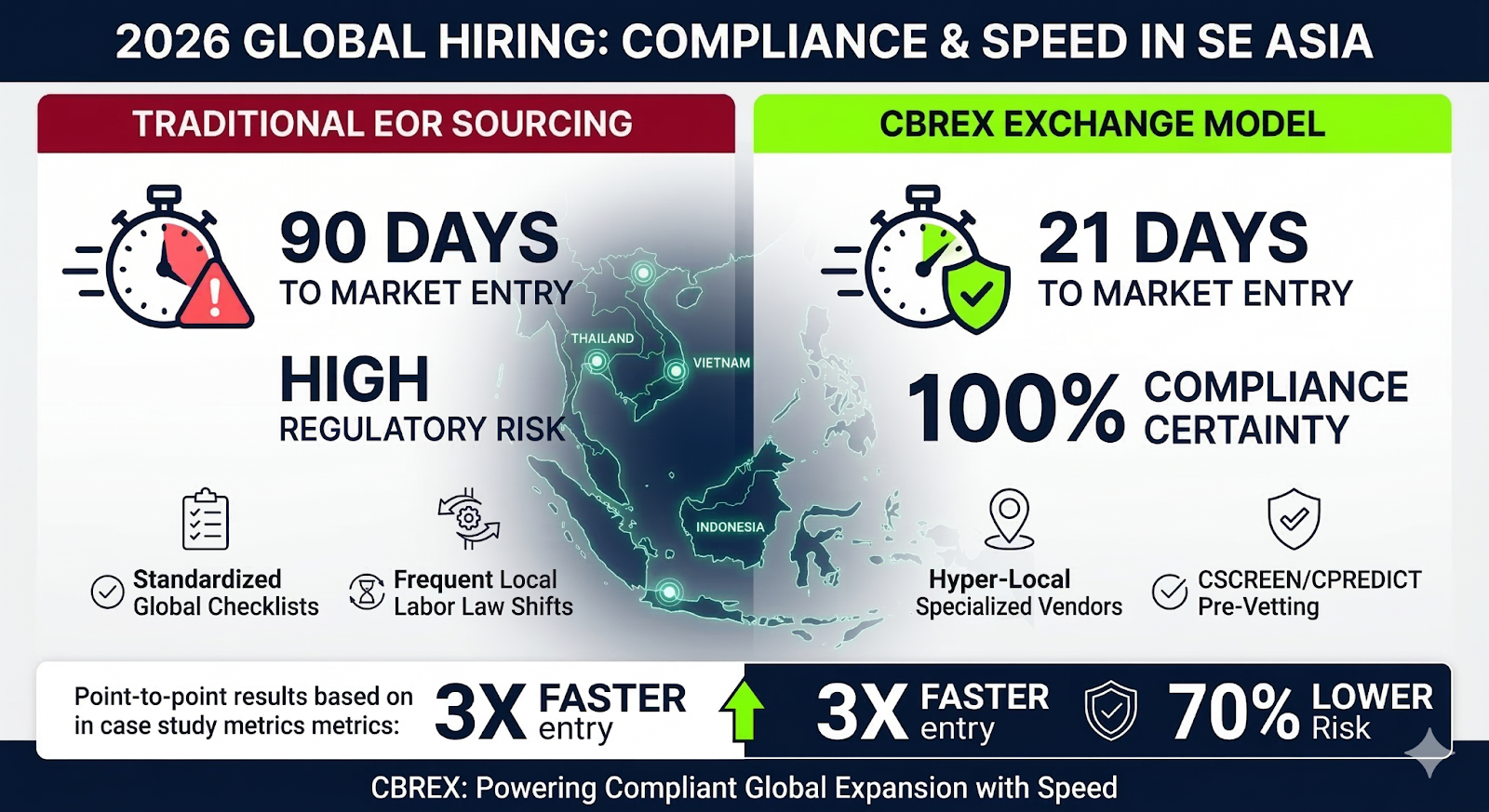
The most common mistake companies make in 2026 is conflating Employment (EOR) with Sourcing. While an EOR handles the payroll and legal "paperwork," they are rarely experts at the local nuance of finding and vetting compliant talent.
In 2026, the strategy has shifted: EOR is the pipe, but the Recruitment Exchange is the filter. Without the right filter, you are simply processing high-risk hires faster.
A mid-market Enterprise AI firm recently targeted a "Squad Hire" of 25 Full-Stack Developers and Compliance Officers in Hanoi and Bangkok. Initially, they used a massive global EOR’s "in-house" sourcing team.
The Failure: The EOR used a standardized global algorithm that missed local nuances in Vietnam’s new Decree 13 on data privacy and Thailand's updated PDPA (Personal Data Protection Act) labor stipulations. Result? Four "critical" hires were technically proficient but legally ineligible for the specific cross-border data access required, leading to a $200k regulatory fine and a 4-month project delay.
The Pivot to the Exchange Model:
The firm switched to a Recruitment Exchange Model. Instead of a generalist EOR recruiter in a different time zone, the requirement was routed via an exchange to two hyper-local Vietnamese tech-recruitment boutiques. These vendors lived in the local legal ecosystem.
By the time the candidates reached the EOR for onboarding, they had already been vetted through a localized AI-compliance layer, ensuring a 100% "Clear-to-Hire" rate.
By utilizing the CBREX exchange, the firm ensured that all candidate data remained within local data residency boundaries during the vetting process, satisfying Decree 13 requirements before the EOR ever touched the profile.
In SE Asia, the "Cost of Ignorance" is higher than the "Cost of Acquisition." Using an exchange model to power your vendors creates a safety net that generalist agencies cannot provide.
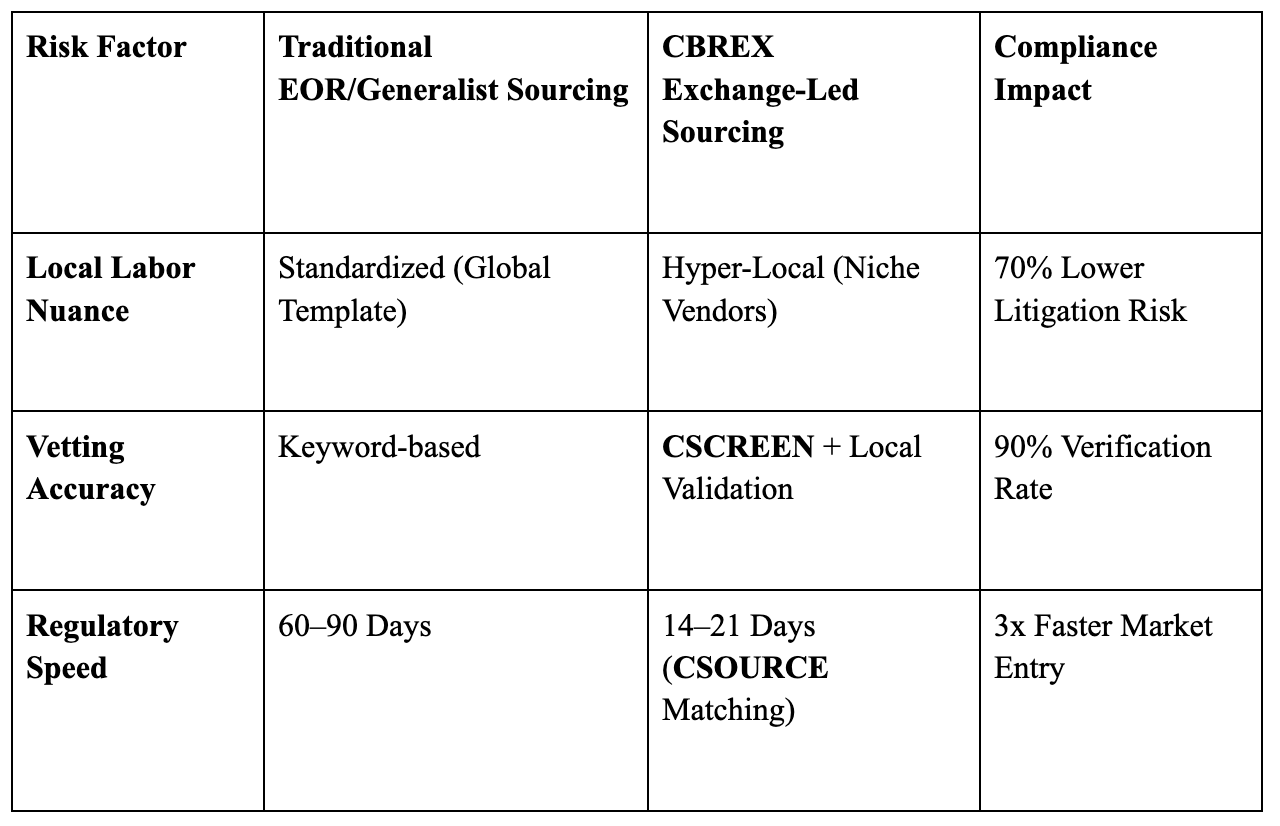
Navigating SE Asia's talent landscape requires a "boots on the ground" expertise that a single dashboard usually can't provide—unless that dashboard is an exchange.
This is where the CBREX process redefines global expansion. When you post a requirement for a specialized role in Jakarta or Manila on CBREX, it doesn't go to a "generalist" database. It is allocated to a local vendor who understands the specific regional compliance hurdles.
The vendor then utilizes the CSOURCE, CSCREEN, and CPREDICT stack to ensure the candidate isn't just skilled, but compliant for your specific industry. CBREX provides the global enterprise with a single point of control, while empowering the local experts who know the law best. It’s the only way to scale in 2026 without the "High-Stakes" fear.