Read Time:
Where Is Global Talent Moving in 2026? A Report for India's TA Teams


Global talent is moving toward Europe, the Gulf and Asia-Pacific, while North America is shifting from relocation to local hiring. For India's TA teams, that means more searches outside India, more countries per quarter, and a bigger need to plan by market instead of by "overseas". Demand is rising fastest for tech, AI, senior sales and pharma profiles.
At CBREX, we see this from the inside. Our platform connects employers with a network of 4,000+ specialist recruiting firms across 55 countries, all under a single contract, and employers pay only when a hire is made. This report pulls together what public data and our own searches say about where to look next.
Seven shifts matter most for a TA head planning cross-border searches this year. The table below sums them up; the sections after it give the evidence and the planning step that follows from each.
| Shift | Region | What it means for your search plan |
|---|---|---|
| Shrinking working-age populations pull in foreign talent | EMEA | Expect competition for skilled hires; plan 24-72 hours to first shortlist and about three more weeks to hire |
| Germany opens more visa capacity for Indians | EMEA | Hire locally or from the EU where possible; Germany searches can close with no visa step |
| Government-to-government talent agreements spread | APAC, EMEA | Add mobility partners to your country shortlist |
| Gulf and East Asia stay active | APAC, MENA | Brief specialist agencies per country and per function |
| US sponsorship gets costlier and less certain | North America | Re-cost every US role and favour local hiring |
| Tech and AI skills lead demand | Global | Your offer competes with every other employer's |
| Multi-country hiring multiplies vendors | Global | Consolidate contracts and invoices before you scale |
Europe's labour pool is getting smaller, and that is why it keeps drawing skilled people from abroad. NITI Aayog's analysis notes that the European Union's working-age population fell from 269 million in 2012 to 264 million in 2021, and is projected to keep declining.
India is a visible beneficiary. In 2024, Indians received one in five EU Blue Cards for highly skilled workers, more than any other nationality, and the IOM reports that Germany raised its yearly quota of skilled-worker visas for Indians from 20,000 to 90,000.
Two things follow. First, you now compete with European employers for the same mobile talent. Second, the fastest searches avoid the visa step altogether by hiring people already allowed to work in the country.
Our own European numbers show the pattern. Sourcing typically takes 24 to 72 hours, and hiring takes another three weeks. A recent Germany search closed in 30 to 45 days, with no visa step because the candidates were local or EU citizens. Our fastest European shortlist came back in 48 hours, and a typical European notice period is 30 days, so build that into your start-date promise.
Asia-Pacific and the Gulf are where many Indian employers open their next offices. The IOM's Asia-Pacific Migration Data Report 2025 shows Asian labour movement oriented towards Gulf Cooperation Council countries, North America and Europe, so the Gulf competes directly with the West for the same people.

Governments are also formalising these flows. The Press Information Bureau reports that the Ministry of External Affairs has shared data on 25 priority countries, with sectors and job roles facing labour shortages, and that India has signed mobility MoUs with 8 countries, including Australia and Denmark.
Our sourcing covers Singapore, Japan, South Korea, Hong Kong, China, Malaysia, Thailand, Vietnam, Indonesia, the Philippines, the UAE, Qatar, Saudi Arabia and Australia, among others. For software roles across East Asia, 58 partner agencies cover the region.
The practical lesson: do not brief "Asia" as one market. Pay norms, notice periods and work-permit rules differ by country. For a deeper walk-through of one corridor, see our guide on how to hire in Southeast Asia from India.
US demand has not vanished; the way Indian employers fill it is changing. The H-1B fee hike and the pause in the PERM labour certification route have made sponsored hires costlier and less predictable, and the legal position on the fee has kept shifting through 2026.
Large Indian IT firms had already cut green card applications before the freeze, which tells you the sponsorship pipeline was thinning before the headlines. The sensible response is to re-cost each US role with the new fee and longer wait, then compare it against a local hire.
The most common mistake we see in a first US sales brief is treating the US as a single market. Salary and candidate catchment differ sharply by state, and many briefs also get the split between fixed and variable pay wrong.
We have helped Indian companies hire sales talent in the US for the last six to seven years, and 104 US-based recruiting firms are active on CBREX each month. That depth matters when a Texas field-sales role and a New York enterprise role need different agencies, not one generalist.
Tech and AI engineering lead cross-border demand, followed by senior sales across domains and pharma. In our own searches, the sectors that hire abroad most are tech, financial services, manufacturing, pharma and B2B platforms. Employers also want the human skills that put AI to work.
The global tech Net Employment Outlook for Q4 2026 sits at 37%, which means your overseas hire competes with everyone else's. Having an Indian brand and a good brief is not enough on its own to win a candidate in Berlin or Singapore.
AI hiring is already at scale for us: we have filled 445 AI and LLM engineer searches. For senior sales and tech, the UK is where we place most often; for pharma, we have filled roles in the US, Europe, APAC and India.
The most common error we see in first hiring briefs from India-based GCC heads is asking for very high-quality talent without paying at that level. Do not benchmark the level of hire against market salaries and then offer below them. Use current local pay for the exact city and seniority, and let the agency tell you where the brief and the market disagree.
Growth plans are set faster than the agency setup behind them. A survey of 1,008 senior decision-makers across seven Indian cities found that 77% plan to increase overseas hiring in the next 12 to 18 months, and 54% already keep more than a quarter of their staff outside India.
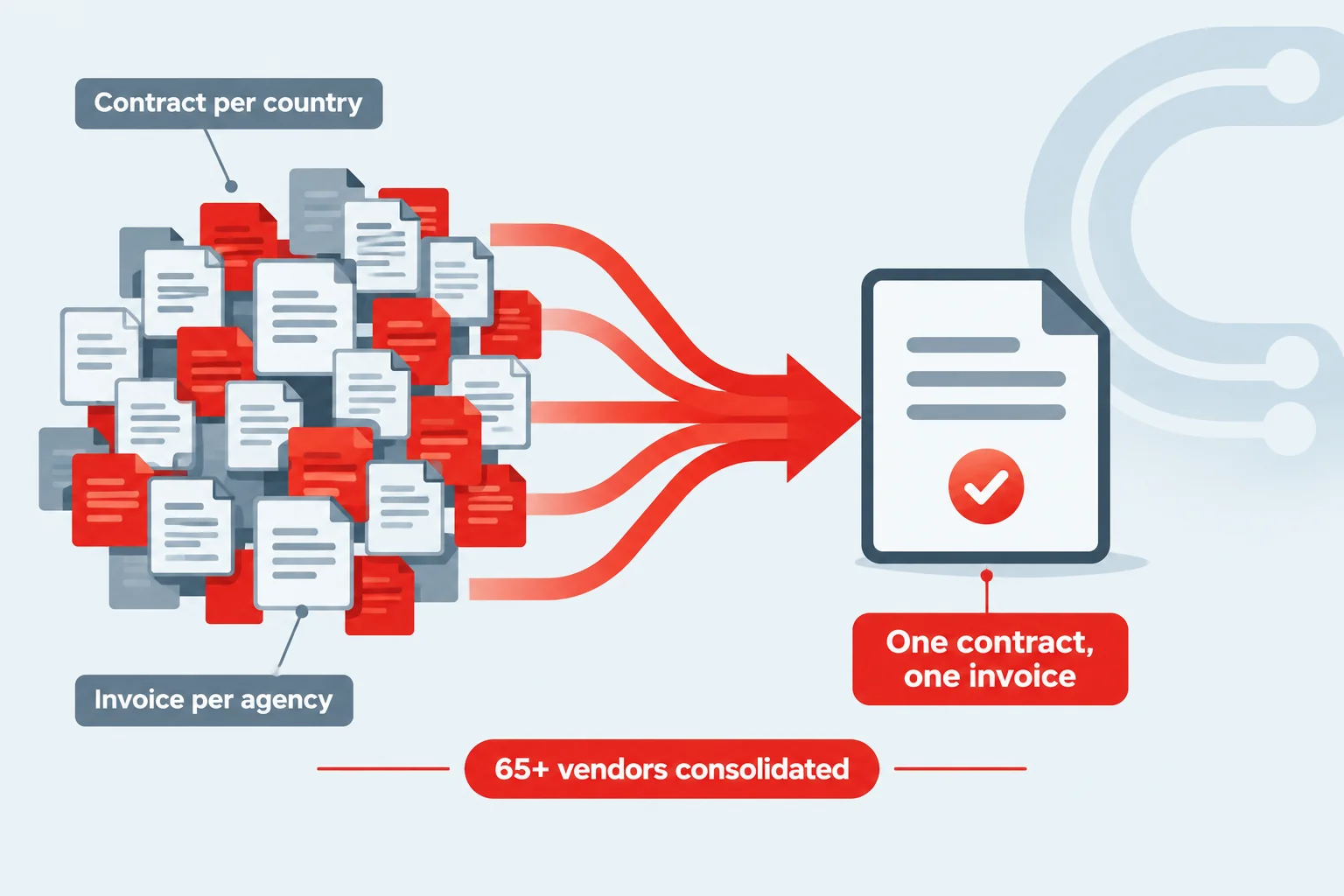
Picture an India-headquartered team opening roles in Germany, Qatar and Thailand in the same quarter. The default is three agency searches, three contracts and three sets of invoices. Each contract needs legal review. Each invoice needs someone in finance to chase it. TA bandwidth goes into admin, not candidates.
Quick audit for your own setup:
In one AI talent engagement, we consolidated 65+ specialist vendors and closed 470 roles at scale. For more on why companies are leaving single-agency models, read why companies are moving away from single agencies.
One CBREX contract gives an employer access to vetted specialist recruiting firms in 55 countries through a single platform. The employer posts a role, AI matching routes it to the most relevant agencies, and invoicing is unified. The employer pays only when a hire is made.
The flow has four parts. First, C Map routes the role to the specialist firms best suited to it, not to one generalist vendor. Then three screening levels apply: the agency pre-screens its own candidates, C Screen AI validates them, and stack ranking puts the strongest first.

C Screen is a 98% accurate screener, trained on 250,000+ anonymised resumes across 570+ job categories. After three-level screening, clients have seen an interview-to-offer ratio of 1:3 to 1:4 per recent search.
A standalone vendor management system manages the agencies you already have. We add new agencies to the marketplace on demand, so a gap in a country or skill can be filled with a specialist supplier quickly. Clients do not need to worry about supply dropping mid-search.
Speed is the other test. Across India-based roles our typical time to hire is 15 to 45 days, and our last India GCC or niche search took 24 days from opening to hire. If an eligible hire turns out to be a poor fit, remedies are a free replacement or a refund.
We cover companies from Series A and B funded start-ups to multi-billion-dollar Indian giants, and we have made 6,500+ global hires. For the full picture of the route, see Global Hiring from India: The 2026 Complete Guide.
Use this sequence when the next batch of overseas roles lands on your desk.
Many readers reach this topic through two phrases: AI in talent acquisition and GCC talent acquisition. They are linked. AI matching and screening decide how quickly a role reaches the right agency, and India-based GCC heads are often the ones opening roles in several countries at once.
If that is your situation, our guides on GCC hiring in India and our site's AI talent acquisition material cover each side in more depth.
If you are planning roles in Europe, the Gulf, APAC or the US this quarter, book a demo and we will show how C Map would route your specific roles across the countries you are targeting. You can also calculate your Hidden Hiring Tax to see what multi-vendor admin is costing you today.
Recruiting firms with specialist profiles can sign up as a talent supplier. Registration is free, corporates post jobs globally, and you earn a commission on each successful hire.