Read Time:
Background Verification (BGV): Process, Documents and Cross-Border Checks


Background verification (BGV) is the process of confirming that what a candidate told you is true: who they are, what they studied, where they worked and whether they have a record that affects the role. A standard BGV covers identity, education, employment, criminal and reference checks, starts only after written consent, and needs country-specific handling for overseas hires.
| Check | What it confirms | Typical documents | Cross-border watch-out |
|---|---|---|---|
| Identity | The person is who they say they are | Government photo ID, proof of work authorisation | ID types differ by country |
| Education | Degrees and institutions are genuine | Certificates, transcripts, enrolment details | Foreign degrees may need verification at the issuing institution |
| Employment | Past roles, dates and designations | Offer and relieving letters, payslips, employer contact | Past employers in other time zones slow replies |
| Criminal record | No disqualifying record for the role | Signed consent, address history, ID | In some countries only specific authorities can release it |
| Address | Residence matches the claim | Utility bill, rental agreement, ID with address | Needed to route criminal checks correctly |
| References | Peers and managers confirm conduct and performance | Two or three named contacts | Candidate consent needed before calling current managers |
Background verification is a structured check of a candidate's identity, education, work history and record, done with their written consent. Employers use it to confirm that the facts given at interview are accurate and to lower the risk of a bad hire, especially in roles with money, data or client access.
BGV sits late in the hiring funnel. It answers one question: is this person who they say they are? It does not answer whether they can do the job, will fit the team or will accept your offer. That is why teams that rely on BGV alone still make poor hires.
In India, BGV is a separate process from KYC under the Aadhaar framework, although it reuses some of the same documents. For TA leaders hiring across borders, the practical point is that one candidate file may need to satisfy two or three different legal regimes at once.
A standard BGV includes identity, education, employment history, criminal record and references. Many employers add address verification. Credit checks are used selectively, usually for finance roles. Which checks you run should depend on the role's risk and on what the hire country allows, not on a single template.
Identity verification matches a government ID to the person and, for overseas roles, confirms the right to work in the hire country. Address verification confirms where the candidate has lived. It matters more than it looks, because criminal checks are often routed by address history.
Education checks go to the issuing institution or its authorised portal. Employment checks confirm title, dates and, where the candidate agreed, reason for leaving. Gaps are the usual flag. A gap is not a failure; an unexplained gap that the candidate hid is.
Criminal checks look for records relevant to the role. References add a human view of conduct. Treat them as two different signals: a clean record says nothing about how someone works, and a warm reference says nothing about legal history.
Start by writing the check list before the offer, per role. Decide the minimum set for every hire (identity, education, employment) and the extra set for higher-risk roles (criminal, credit, directorship or licence checks). Then confirm each item is lawful and obtainable in the hire country.
A simple decision rule works well:
Pass mark: every item on the list returns a result that matches the candidate's claim. Walk-away mark: a falsified degree, a hidden employer or a refused consent. Anything in between, such as a date off by a few weeks, deserves a conversation, not a rejection.
Consent is the gate. Nothing should begin until the candidate signs an authorisation that says what will be checked, who will do it and how the data will be used. In India this is usually in the offer letter or a separate form. Under the Digital Personal Data Protection Act, 2023, consent has to be specific and informed.
In the US, the Federal Trade Commission tells employers to give applicants a written notice, in a stand-alone format, that the information may be used for employment decisions. That means the notice cannot be buried inside a long application form.
Timing matters too. A US government vetting guide recommends telling candidates early in the application process about what will be reviewed. Early notice avoids last-minute refusals and withdrawals.
This article is a process guide, not legal advice. Have your counsel confirm consent wording for each country you hire in.
Ask for documents in one request, not five. Candidates drop off when verification arrives in drips. Send a checklist with the offer and tell them which items they may not have to hand, such as old relieving letters.
| Check | Ask the candidate for | If a document is missing |
|---|---|---|
| Identity | Government photo ID, proof of right to work | No substitute; do not proceed |
| Education | Final degree certificate and transcripts | Accept the institution's own confirmation |
| Employment | Relieving or experience letter, last payslips | Use bank statements or the employer's HR confirmation |
| Address | Utility bill or rental agreement | Accept a second ID that shows the address |
| References | Two or three contacts with email and phone | Ask for a replacement; do not skip |
For roles sourced through recruiting firms, there is a second set of documents: the agency's own credentials. Our guidance for agencies in a market you have not used before is to ask for documentation at the time of onboarding, for example a licence where the local regulator requires one. That is a vendor check, separate from the candidate's BGV.
BGV timelines depend on the check, the country and how fast the candidate and past employers respond. Identity checks tend to be quick. Education and employment checks depend on third parties. Criminal checks can be slow, restricted or unavailable to private firms in some countries. Ask your screening provider for a per-check turnaround in writing.
The better planning tool is your own hiring calendar. On CBREX, time to hire for an India-based role is typically 15 to 45 days. Our last India GCC or niche search took 24 days from opening to hire. For Europe, sourcing takes 24 to 72 hours and hiring takes another three weeks. A typical European notice period is 30 days.
Put those together and the rule is clear: run BGV during the notice period, not before it. If your check takes longer than the notice, you either delay the start date or you start the person before clearance, which is the riskier choice.
Take a Germany search where the candidate is a local or an EU citizen. For these hires, we have seen 30 to 45 days from opening to hire with no visa step.
With a 30-day notice period, BGV has a clear window: start the moment the offer is signed and aim to clear it inside the notice. If a check is still open at day 20, decide then whether to extend the start date, not on day 29.
Review every result against the candidate's claim and sort it into three buckets: clear, minor discrepancy and material discrepancy. Clear results close the file. Minor ones, such as a date off by weeks or a title variation, go back to the candidate for a short written explanation. Material ones, such as a fake degree, go to a named decision maker.
Two rules protect you. First, give the candidate a chance to respond before you withdraw an offer; this is good practice, and in the US the law around adverse action on background reports is specific, so check it with counsel. Second, record the reason for the decision, because you may need it later.
Cross-border checks differ in what can be verified, which authority releases it, how consent works and how fast records come back. There is no standard global background check. In one country a criminal record can be released only by specific authorities; in another it may be restricted, delayed or closed to private firms.
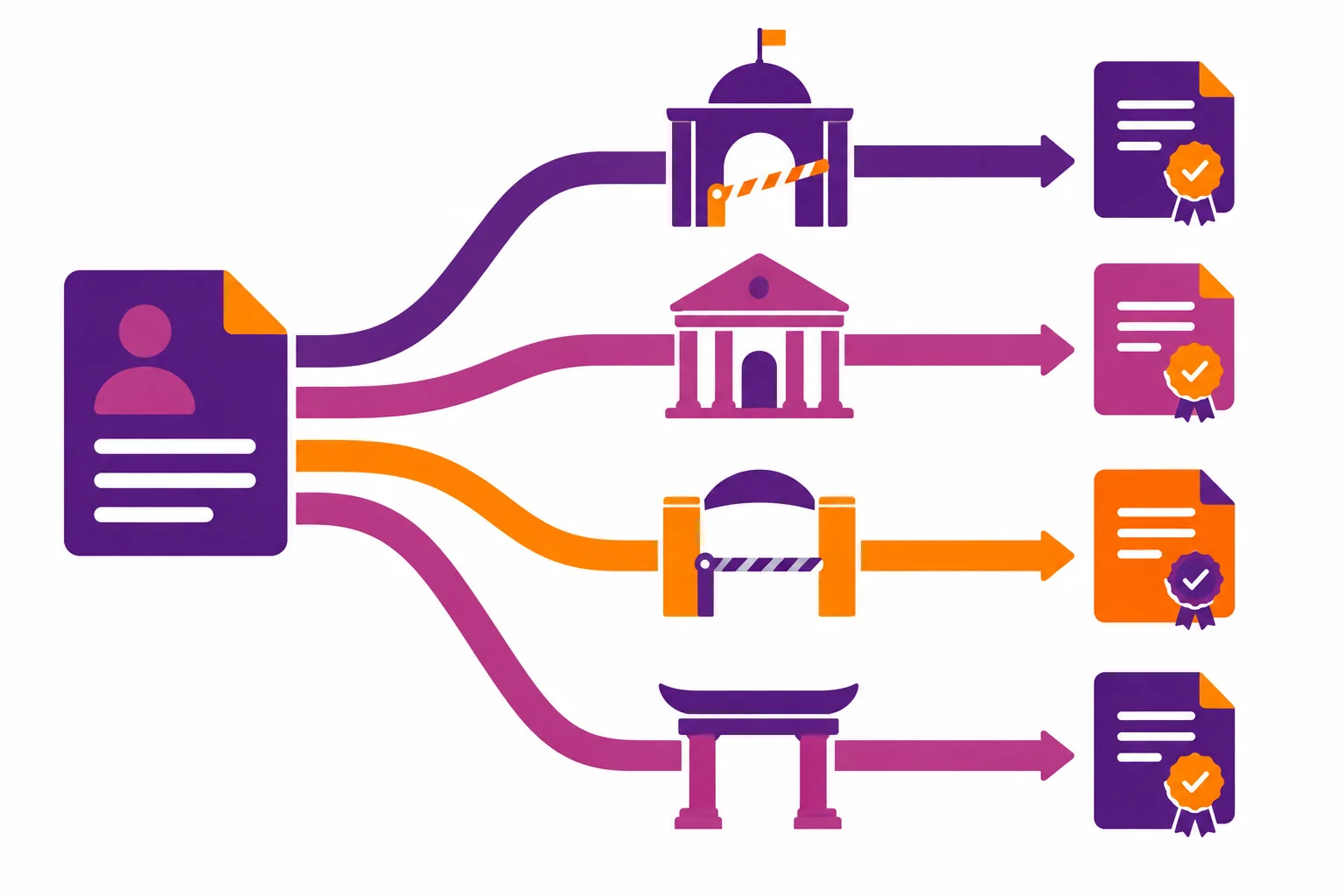
Build a per-country sheet for each hire location before you open the role. The table below shows what to ask, not what any country's law says. Confirm the answers with local counsel.
| Region | What to confirm before you start |
|---|---|
| India | Written authorisation; DPDP-style specific, informed consent; education, employment, identity, address and criminal checks are common; credit and reference checks are selective |
| USA | Stand-alone written notice and authorisation; rules on how a report may be used in an employment decision; state-level differences |
| Europe and UK | Data protection rules on criminal and personal data; right-to-work proof; local notice periods that shape the verification window |
| Singapore and wider APAC | Local work-pass rules; which checks a private firm may run; for agency-sourced hires, the agency's licence documents |
| Gulf and MENA | Attested education documents and local employment formalities; confirm the process with a local provider |
If you verify overseas education or employment from India, personal data crosses borders. Under Section 16 of the DPDP Act, transfers are allowed by default unless the Central Government restricts a specific country. As of mid-2026, no country was on a restricted list, and the detailed transfer rules were still not fully in force. That could change, so ask your legal team to re-check each time you add a country.
If you hire in several countries at once, the admin multiplies fast: different providers, different forms, different timelines. This is the same vendor sprawl problem we see in agency contracts, and our piece on multi-geo hiring on one platform explains how a single contract keeps that manageable.
Layered screening filters candidates in stages before BGV, so verification is spent only on people who already look right. CBREX uses three levels: agency pre-screen, C Screen AI validation and stack ranking. Each stage removes mismatches earlier, which cuts both the number of BGV runs and the chance of a late surprise.
BGV is slow and costs money per candidate, so it works best on a short list. Here is how our three levels feed it:

The effect shows up in interviews. After 3-level screening, clients have seen an interview-to-offer ratio of 1:3 to 1:4 per recent search. Fewer wasted interviews means fewer candidates reaching the BGV stage who should never have been there. For a deeper look, read how AI candidate screening works.
Some checks happen at submission, which makes later verification cleaner:
One caution. Layered screening reduces the odds of a bad hire; it does not replace BGV. A candidate can pass all three levels and still have a degree that does not exist. Use screening to narrow, and BGV to confirm.
One thing remains unsettled: how far cross-border data rules will tighten, in India and in the countries you hire in. Treat your consent forms and provider contracts as documents to review at least once a year, not set once.
There is no single rule that makes BGV mandatory for every employer. Some regulated sectors and client contracts require it, and many companies make it a standard condition of joining. Check the rules for your sector and hire country with counsel, and write BGV into the offer letter.
It depends on which checks you run and how fast third parties reply. Identity checks are usually quick; education, employment and criminal checks take longer and vary by country. Ask your provider for a per-check turnaround in writing and run the process inside the candidate's notice period.
Most employers run it after a conditional offer, so only the chosen candidate is verified and the offer letter can state clearance as a condition. Send the consent form with the offer and begin immediately, so checks finish within the notice period.
Yes, a candidate can refuse to give consent. Without consent, you cannot lawfully run the checks. Most employers then treat the offer as conditional and unfulfilled, but write that rule into your hiring policy so the response is the same for every candidate.
In most hiring processes the employer pays, because it is the employer's risk control. Recruiting firms normally do not carry the cost. Agree this in the vendor terms up front so nobody disputes it when a check fails.
If you are hiring outside India and want fewer failed verifications, start with who reaches the shortlist. CBREX gives you vetted local talent across 55 countries from a network of 4,000+ recruiting firms under a single contract, with three-level screening before any candidate reaches you.
You pay only when a hire is made. To see how that fits your BGV process, book a demo. You can also read how to choose an AI resume screening tool, or talk to us directly through Let's Talk.
Recruiting firms that want to fill these roles and earn a commission on each successful hire can sign up as a talent supplier; registration is free.