Read Time:
GCC Full Form in Business: What a Global Capability Centre Is


GCC full form in business is Global Capability Centre: a company-owned unit set up in another country to do core work such as engineering, analytics, finance and product, not only back-office tasks. Some firms call it a Global In-house Centre. In Gulf news, GCC instead means the Gulf Cooperation Council.
| Question | Short answer |
|---|---|
| GCC full form (business) | Global Capability Centre |
| Other name | Global In-house Centre |
| Other meaning (Gulf) | Gulf Cooperation Council, a union of six Gulf states |
| Who owns it | The parent multinational, which keeps the staff, processes and IP in-house |
| Size in India (FY26) | 2,117 GCCs, 3,728 units, about 2.36 million employees |
| Roles that usually hire first | Centre head, engineering leads, data and AI, cybersecurity, finance and HR set-up |
| CBREX model for GCC hiring | One contract across 4,000+ specialist recruiting firms; clients pay only when they hire |
GCC stands for Global Capability Centre, also written Global Capability Center. It is an offshore or nearshore unit that a multinational owns and runs itself. Many companies also use the older label Global In-house Centre, which stresses the same idea: the work stays inside the company.
Wikipedia describes a GCC as an entity a multinational sets up to take advantage of lower costs or the human and technological resources in another geography. The key word is "owned". A GCC is not a vendor. Its employees sit on the parent company's payroll and report into its leadership.
You will also hear "captive centre" or "captive". These terms point to the same model. "Capability" is the newer word, and it signals a shift: centres now carry product, research and decision work, not just cost-saving tasks.
Yes. In news and politics, GCC means the Gulf Cooperation Council, a political and economic union of the six states bordering the Persian Gulf: Bahrain, Kuwait, Oman, Qatar, Saudi Arabia and the United Arab Emirates. It has nothing to do with company-owned offshore centres.
Other uses exist. India's Department of Telecommunications, for example, issues No Objection Certificates for international roaming SIM cards and Global Calling Cards (GCC) of foreign operators. Three quick clues tell you which meaning applies:
This article uses GCC only in the business sense from here on.
A GCC performs work for its parent company from another country. That work ranges from back-office tasks such as finance operations and customer support to engineering, analytics, cybersecurity and product development. The parent owns the output, the processes and the intellectual property.
Many centres start small. A multinational may open with a few dozen people running one process, then add teams as the parent gains trust in the location. A GCC's functions can include back-office operations at one end and technology work at the other.
The Invest India paper on the GCC value proposition sorts centres along a spectrum, from "doer" to "optimiser" to "thinker", based on how much of the parent's work they own. A doer executes a defined process. A thinker helps decide what the company builds next.
A GCC is owned by the parent company; an outsourcing vendor is a separate firm paid to deliver a service. The GCC gives the parent direct control of staff, data and IP. Outsourcing gives flexibility and lower setup effort. Many companies use both at the same time.
One question is still open: how many centres are truly strategic and how many remain cost-driven delivery hubs? Public data counts centres and headcount well. It does not yet tell you how much decision-making each one owns, and the answer varies by company.
India hosts so many GCCs because it combines a deep pool of technical and professional talent, lower operating costs than most parent markets, and active state-level policy support. FY26 data counts 2,117 GCCs in India, employing around 2.36 million people.
The same data shows the base grew 32% between FY21 and FY26, with more than 500 centres added in five years. For the full numbers and what they mean for recruiters, read our breakdown of the Zinnov-Nasscom GCC report.
Three forces keep pulling centres to India:
That last point matters for hiring. Bengaluru remains the largest hub, with Hyderabad closing the gap, but new centres increasingly look at second-tier cities. Talent there is thinner, and sourcing gets harder. Our guide to hiring niche skills overseas covers how to approach a market you have never recruited in.
New GCCs usually hire the centre head first, then technical or functional leads, then the specialists those leads need. Typical early hires are engineering managers, data and AI engineers, cybersecurity staff and finance or HR set-up roles. The exact order depends on the centre's mandate.

This is a pattern from how centres are built, not a published ranking. A centre that supports engineering will hire engineering leads early. One that supports finance operations will start with process and controllers. Treat the list below as a starting point and adjust it to your parent company's brief.
GCC roles are hard to fill because the best candidates are usually employed and not job hunting, many centres compete for the same scarce skills, and senior profiles accept offers fast or not at all. Job boards mostly reach active seekers, so passive talent stays hidden.
Four problems show up again and again for TA teams:
Parent companies add pressure from the other side. They want the centre running quickly, and they judge the India head on how fast the team is built.
Niche GCC talent is sourced by routing each role to specialist recruiting firms that already work in that skill and city, rather than relying on one generalist agency or a job board. CBREX does this on one contract across 4,000+ recruiting firms, and clients pay only when they hire.
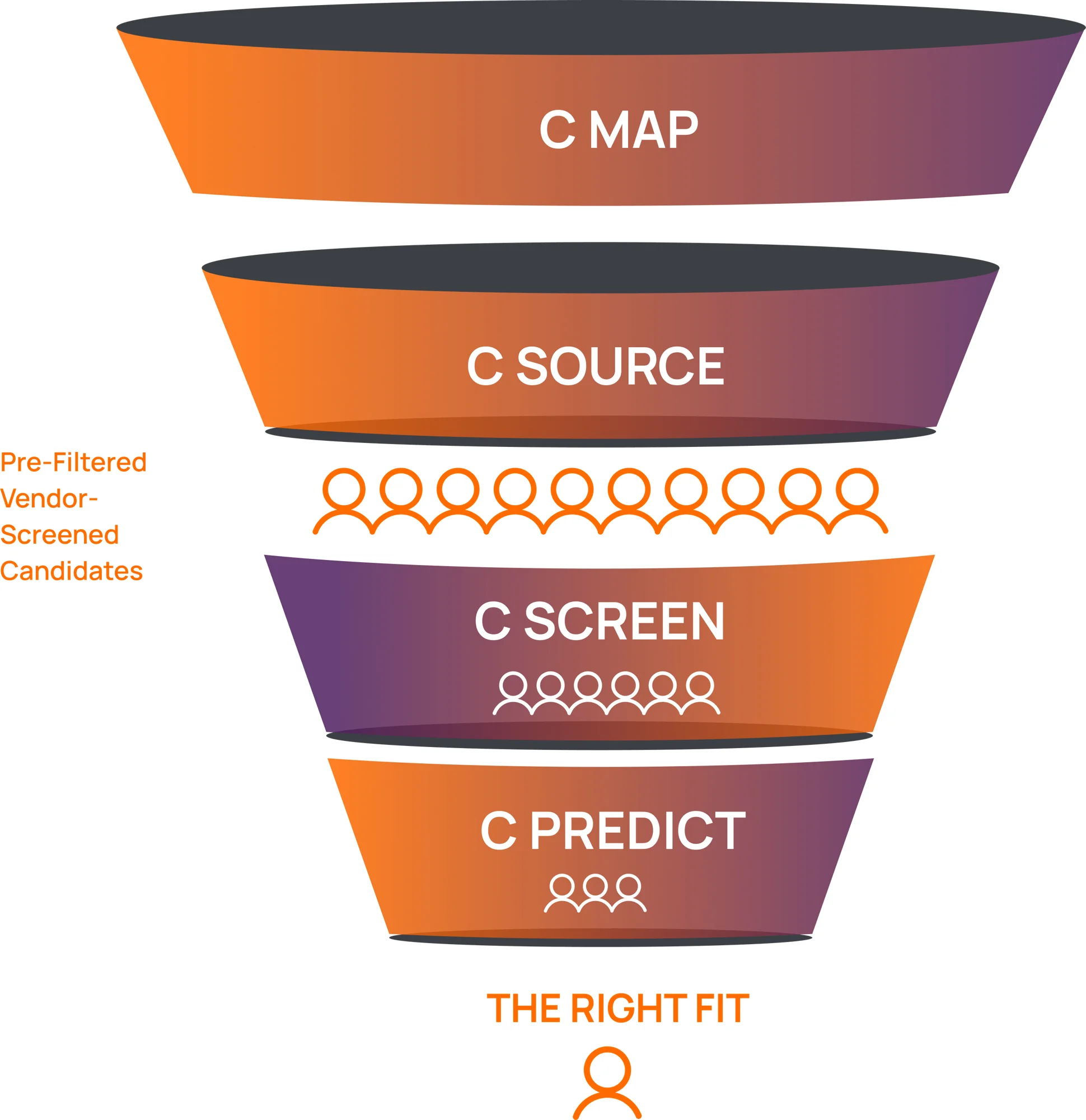
Here is how the process runs on CBREX. You post the role once. Our AI vendor matching tool, C Map, routes it to the specialist agencies most likely to fill it. Those agencies submit candidates, and every profile goes through three levels of screening: the agency's own pre-screen, C Screen AI validation, then stack ranking.
C Screen is trained on 250,000+ anonymised resumes across 570+ job categories. We measured its 98% accuracy rate on more than 10,000 cases. You see a ranked shortlist, not a pile of CVs.
The speed and reach figures we report for the platform as a whole are these:
These are platform-wide numbers, not results for GCC roles alone. A very senior or highly niche role can take longer than the average, and we say so up front when we scope it.
A new centre often needs ten or more different skills in its first year, in a city where the TA team is still being built. One contract and one invoice replace a stack of agency agreements. Our breakdown of recruitment agency cost in India explains what that stack costs you in practice.
Pay-on-hire also changes the risk. With a retainer, you pay while the search runs, even if it fails. Here a search that does not produce a hire costs you nothing, so you can open several hard roles at once without a budget fight.
Use specialist agencies on one contract when the role is niche, senior, or needed in a city where you have no recruiting presence. Choose another route for high-volume entry-level batches, where a job board and an internal team may cost less per hire.
Our view: do not hand a centre head search to a single agency. Run it across several specialists in parallel and keep the brief confidential. Run volume roles in-house once the TA team is hired. That mix is what we would build ourselves.
Use this checklist before you open the first role. Each step has a pass mark, and a fix if it fails.
Consider a hypothetical case. A European manufacturer opens a Hyderabad centre for engineering and data work. It needs a centre head, two engineering managers and three machine learning engineers within the first quarter. Following the checklist, it posts the centre head role confidentially first, opens the engineering manager roles in parallel, and holds the machine learning roles until the managers join and can shape the brief.
No. A BPO is a third-party firm that performs processes for many clients. A GCC is owned by one parent company and works only for it. A GCC may run similar processes, but it also takes on engineering, analytics and product work, and the parent keeps full control.
Very little. "Captive" is the older term for a company-owned offshore unit. "Global Capability Centre" is the newer name and highlights the wider scope of work, such as innovation and product development. In everyday HR and hiring conversations, people use the two words interchangeably.
Companies choose India for its large talent pool, lower costs than home markets and state incentives. India's FY26 count of 2,117 GCCs shows how many have made that choice. Centres also give parents closer control over data and IP than outsourcing does.
Centre heads, machine learning and AI engineers, cybersecurity specialists and senior domain experts are usually the hardest. These people are mostly employed and not applying. Specialist recruiters with networks in each field find them faster than job boards.
You now have the GCC full form, the Gulf Cooperation Council distinction and a clear view of which hires come first. The harder part is filling those roles. To see how one contract across specialist agencies would work for your centre, book a CBREX demo and bring your first three open roles.
Want to know what vendor sprawl already costs your team? Calculate your hidden hiring tax. Prefer a direct conversation about a specific GCC build? Let's talk.


