Read Time:

India now hosts 2,117 global capability centres employing 2.36 million professionals and generating $98.4 billion in revenue, according to the 2026 Zinnov-Nasscom GCC Landscape Report. For talent acquisition leaders, this is not a growth story to admire from the sidelines. It is a warning: the specialists you need in AI, cloud and data are being hired by better-funded GCCs faster than your pipeline can replace them.
| Metric | FY26 Figure | What It Means for Hiring |
|---|---|---|
| Number of GCCs | 2,117 | More employers bidding for the same specialist pool |
| GCC units | 3,728 | Multiple centres per company, more local hiring teams |
| Total GCC revenue | $98.4 billion | Deep budgets for compensation and retention |
| Professionals employed | 2.36 million | A talent base this large still can't meet AI/cloud demand |
| Growth since FY21 | 32% | Demand has been rising steadily, not a one-off spike |
| Projected centres by 2030 | 4,300-4,400 | Competition for specialists will keep intensifying |
| Bengaluru's share of units | Over 29% | Single-city sourcing strategies hit a ceiling fast |
The numbers in the Zinnov-Nasscom India GCC Landscape Report 2026 are large enough to miss the point. India's GCC ecosystem has grown 32% since FY21, reaching 2,117 centres spread across 3,728 units, employing 2.36 million professionals and producing $98.4 billion in revenue, as reported by the Financial Express. That is not a niche segment of India's economy anymore.
It is a parallel labour market, one that competes directly with every other employer for the same engineers, data scientists and cloud architects. Bengaluru still leads this market by a wide margin, holding over 29% of all GCC units, according to the India GCC Index 2026. If your sourcing strategy is built around Bengaluru alone, you are fishing in the most crowded pond in the country.
Hyderabad, Pune and Chennai are catching up, but concentration in two or three cities means local agency networks run out of candidates quickly for specialist roles. A TA leader hiring a single machine learning engineer in Bengaluru today is competing against recruiters from dozens of GCCs with GE- and Oracle-scale budgets behind them, plus every well-funded startup in the city.
The first GCC wave and the current one solve different problems, which is why comparing them by headcount alone is misleading.
The early 2000s captives built by companies like GE and Oracle were largely cost-arbitrage back offices: Oracle's Hyderabad centre started with seven people doing bug fixes before it grew into a full development hub, a trajectory it has publicly described as starting from basic support work in 2000. These centres existed to move routine, lower-skill work offshore cheaply.
Today's GCCs are built to own product roadmaps, run AI research, and operate as innovation hubs for their parent companies. That single shift changes who they compete with for talent. A back-office captive competed with other back offices for process-oriented staff. An innovation-led GCC competes with venture-funded startups and global tech companies for the same AI researcher, the same platform engineer, the same data scientist.
This is the structural difference TA leaders need to internalise. The threat isn't more hiring volume. It's more hiring volume aimed at the exact same narrow skill set your company also needs.
The sharpest competition sits in AI, cybersecurity, cloud and data roles, where scarcity premiums are reshaping compensation structures across the market. Legacy IT and routine engineering roles face a cooler, more balanced market by comparison.
According to Zinnov's 2026 analysis of India's GCC talent market, two very different labour markets are now running inside the same ecosystem. Compensation architectures for AI, cybersecurity, cloud and data roles are being redesigned with scarcity premiums and equity structures, while legacy IT and routine engineering roles are being managed on a more conventional track.
This split also drives attrition risk. The specialists who matter most, the ones Zinnov describes as the people who "spot the problem before the meeting ends" or "connect the insight to the business" in its GCC talent trends analysis, are the same people every GCC, startup and global company is trying to retain and poach simultaneously.
If your company hires 10 to 15 AI or cloud specialists a year in India, you are no longer just competing against three or four other local employers. You are competing against hundreds of well-capitalised GCCs running the exact same job description through the exact same recruiter networks.
India-founded, global-HQ companies and mid-market firms outside the GCC tier face a structural disadvantage here. GCCs backed by $98.4 billion in collective revenue can afford scarcity premiums that a 500-crore company cannot match role for role.
The practical consequence is that sourcing strategies built entirely around local agencies in two or three metro cities will keep underperforming. If every GCC and startup is drawing from the same Bengaluru and Hyderabad talent pool, your open requisitions sit longer, and your best candidates get counter-offered before you can close them.
Companies dealing with this today are already rethinking vendor strategy, as covered in our guide to building global capability centres in 2026. The answer isn't to outbid GCC compensation structures. It's to widen the geography and the specialist network you recruit from, so you're not fighting the same five agencies for the same twelve candidates.
Widening your sourcing funnel without adding vendor chaos means replacing dozens of separate city-level agency contracts with one agreement that reaches specialist recruiters across many markets at once. That is the structural fix to GCC-driven scarcity, not higher pay alone.

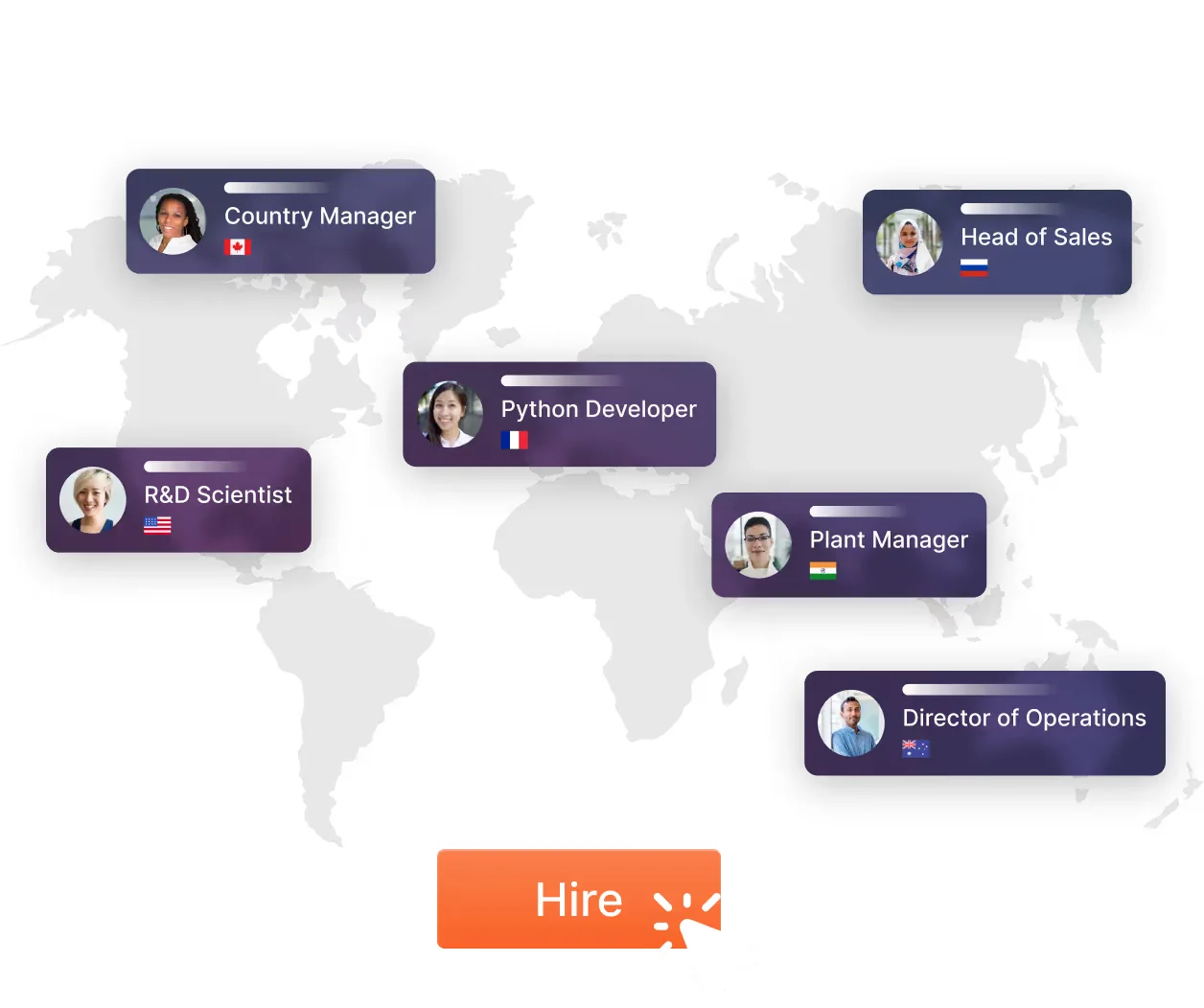
CBREX built its model around exactly this problem. The platform connects companies to vetted local talent across 55 countries from a network of 4,000+ recruiting firms, all under a single contract.
Instead of onboarding a new agency every time a role opens in a new city or country, a TA team posts the role once and CBREX's AI vendor matching (C Map) routes it to the specialist firms best positioned to fill it.
This matters most for the scarcity-premium roles the Zinnov report flags. A specialist AI recruiting firm in Bengaluru, a cloud talent boutique in Singapore, and a data science search firm in the UK can all be working your requisition simultaneously, something a single local agency relationship can never replicate.
CBREX also applies three-level screening, agency pre-screen, AI validation, and stack ranking, which is why the platform reports a 98% resume shortlist ratio. That matters directly for scarce roles: hiring managers stop wasting interview slots on resumes that were never a real fit. The firm has supported 6,500+ global hires since launching in mid-2016, built on a founding team with over 100 years of combined recruitment industry experience.
For companies spending over $500,000 a year on agency fees, CBREX offers flat pricing on that spend instead of per-hire percentages that scale unpredictably with headcount. Either way, you pay CBREX only when a hire is made, no retainers and no seat licences sitting idle while a scarce role stays open.
If you're evaluating how this compares to running RPO or staying fully in-house, our breakdown of RPO vs staffing in India walks through where each model fits.
Here is a short checklist worth running before you finalize next year's hiring plan:
For companies specifically hiring technical and niche skill roles, our mid-market niche skill hiring guide goes deeper into role-by-role sourcing tactics.
A global capability centre, or GCC, is an offshore unit a multinational company sets up in a country like India to run core functions, engineering, product, finance or operations, for its global parent rather than for local clients. Unlike a traditional outsourcing vendor, a GCC is owned and directed by the parent company itself.
India had 2,117 GCCs operating across 3,728 units as of FY26, employing 2.36 million professionals and generating $98.4 billion in revenue, according to the Nasscom-Zinnov Landscape Report. That count is expected to keep climbing toward the 4,300-4,400 range by 2030.
Yes. Those early captives were largely cost-arbitrage back offices and call centres built to move routine work offshore cheaply. Today's GCCs run AI research, product development and engineering functions, which puts them in direct competition with startups and global firms for the same scarce specialists.
CBREX widens a company's sourcing reach to 4,000+ specialist recruiting firms across 55 countries under one contract, instead of relying on a handful of local agencies that are also working GCC requisitions. Companies pay only when they hire, which keeps search costs predictable even as scarcity premiums rise.
The Zinnov-Nasscom numbers aren't a forecast you can wait out. They describe a labour market already reshaped by $98.4 billion in GCC spending power, and it keeps growing. If your current sourcing strategy still runs on two or three city-level agencies, that gap will only widen as GCC count climbs toward 4,300 by 2030.
See what this scarcity is actually costing your open roles with CBREX's Hidden Hiring Tax calculator, or book a demo to see how single-contract sourcing across 55 countries works in practice. Specialist recruiting firms can also sign up as a talent supplier to join the network, or log in if already registered. For a direct conversation about your 2026 hiring plan, reach out to our team.


