Read Time:

A proposed $103,265 H-1B visa fee on cap-subject petitions means Indian companies staffing US roles now pay six figures per sponsored hire before salary even starts. Many are turning to US-based specialist recruiting agencies instead, hiring local talent who need no visa at all and cost far less to place.
| Factor | H-1B Sponsorship (proposed rule) | Local US Hiring via Specialist Agency |
|---|---|---|
| Government fee per hire | $103,265 proposed, cap-subject only | None |
| Existing USCIS fees | Separate base filing, training and biometric fees still apply | None |
| Selection process | Subject to annual lottery, cap-subject only | No lottery; candidate availability driven by sourcing |
| Typical timeline | Months, tied to registration and petition cycles | Weeks, depending on role seniority |
| Candidate pool | Foreign nationals requiring sponsorship | US-based residents and citizens, no visa needed |
| Cost structure | Large fixed fee plus legal costs, paid regardless of outcome risk | Agency fee, often contingent on a confirmed hire |
The proposed fee adds $103,265 to every cap-subject H-1B petition, a figure confirmed directly by DHS in its August 2026 Federal Register filing. It stacks on top of fees employers already pay, not in place of them.
Today's base H-1B filing costs run far lower, typically a few thousand dollars across registration, Form I-129, training, fraud prevention and biometric charges. The new fee would dwarf all of that combined, regardless of the sponsoring company's size or nonprofit status.
There's an important carve-out. The fee applies only to cap-subject petitions, meaning the annual lottery-based H-1B filings. Cap-exempt roles, generally at universities, affiliated nonprofits, and certain research institutions, are not covered by this proposal.
As of this writing, the rule is still a proposal, not final law. It has gone through a correction notice in the Federal Register, and the rulemaking process, including public comment periods, is ongoing. Companies planning US hiring strategy should track the docket directly and consult immigration counsel before making final decisions, since the effective date and any carve-outs could still shift.
Indian IT firms are not waiting for the rule to finalize. FY27 H-1B registrations from Indian IT firms fell sharply, a trend reported by Communications Today as a direct response to rising immigration costs reshaping staffing plans.
The pullback isn't limited to giants. Large firms have more balance sheet room to absorb a six-figure fee per hire. Mid-market and dual-HQ companies, the ones running lean on headcount budgets, feel the squeeze faster, according to analysis from Outlook Business.
The practical response for many is a mix of offshore delivery and direct local hiring in the US. If the role genuinely needs an on-ground presence, a candidate who already has work authorization skips the entire sponsorship question.
This is where many India-HQ teams start asking a different question. Instead of "how do we sponsor this hire," it becomes "do we need to sponsor at all, or can a specialist US recruiting partner find us someone already authorized to work."
Run the math on a single role. Sponsorship under the proposed rule means $103,265 in government fees alone, before legal counsel, relocation, and the base USCIS charges that still apply. None of that is contingent, you pay it whether or not the hire works out long-term, and the petition could still lose the lottery.
Local hiring flips the risk. A specialist agency sourcing a US-based candidate charges a fee tied to the hire, often a percentage of first-year salary, with no government filing cost at all. There's no lottery, no biometric fee, no multi-month petition cycle. The trade-off is candidate pool breadth.
Sponsorship opens access to talent anywhere in the world; local hiring limits the search to people already authorized to work in the US. For roles where the specific skill set is genuinely scarce globally, sponsorship may still be the only path. For most mid-market roles, though, a well-sourced local candidate solves the problem faster and cheaper.
Specialist agencies find local candidates by reaching people who are not actively browsing job boards. Most of the strongest US talent for mid-level and senior roles is employed and not applying anywhere, which is why passive sourcing matters more than posting volume.

A specialist firm with deep roots in a specific US region or function usually has a standing network: former placements, referral chains, and relationships built over years in that niche. That's different from a generalist board that recycles the same applicant pool across every employer.
Screening quality matters just as much as reach. A resume that looks good on paper can still waste a hiring manager's time if nobody checked it against the actual role requirements. Agencies that run structured multi-level candidate screening cut down on that noise before a hiring manager ever sees a profile.
For India-HQ teams unfamiliar with the US market, finding the right specialist agency, one that actually knows the role and the region, used to mean separate vendor searches and separate contracts for every geography.
CBREX routes US staffing requirements to specialist recruiting firms through a single contract instead of a new agreement per vendor. The platform has facilitated 6,500+ global hires across 55 countries, drawing on a network of 4,000+ recruiting firms.
The pricing structure matters most here. CBREX customers pay only when a hire is made, with no retainer and no seat licence. For companies with agency spend exceeding $500K a year, CBREX also offers flat pricing on that spend, a different economic shape than stacking per-petition government fees.
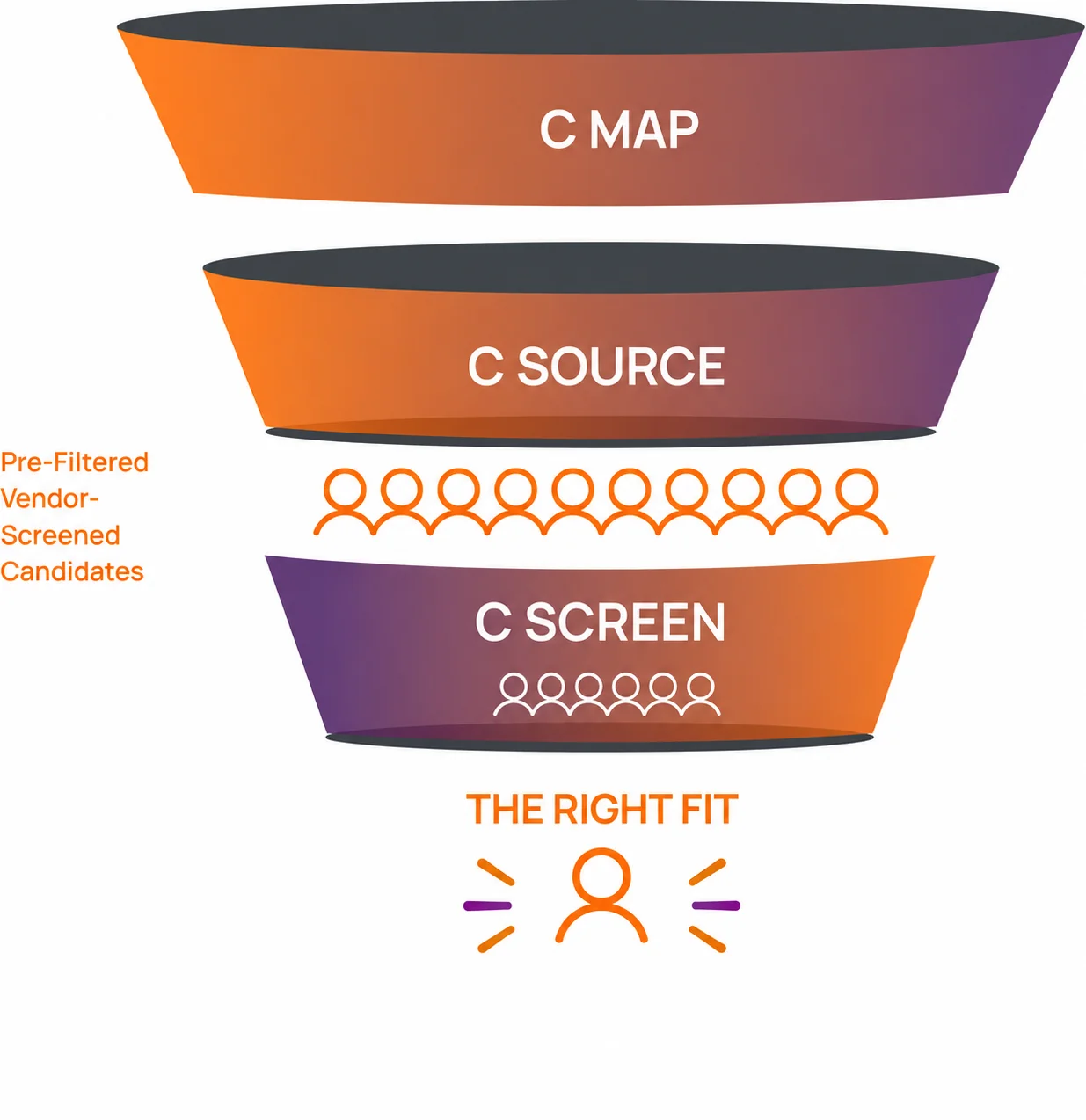
Screening is layered, not single-pass. Candidates go through agency pre-screening, then AI validation, landing at a reported 98% resume shortlist ratio before a hiring manager reviews anyone. That matters for US roles specifically, where time lost to unqualified submissions compounds against an already tighter timeline than sponsorship.
The team behind this has over 100 years of combined recruitment industry experience, led by co-founders Gautam Sinha (CEO), Sanjeev Punwani (COO), Karunjay Anand (CTO) and Divya Chetan (CPO). CBREX launched in 2018-19.
For India-HQ teams specifically weighing vendor sprawl against a single relationship, this is the structural fix most are looking for when the fee math on sponsorship stops making sense. Read more on global hiring from India for the broader playbook beyond just the US.
Sponsorship still makes sense when the skill is genuinely scarce worldwide and the candidate you need simply isn't available domestically, when the role is cap-exempt (university, nonprofit research), or when you already have an identified candidate mid-process who is too valuable to lose.
Local hiring wins when the role doesn't require a specific individual, when time-to-fill matters more than reaching every possible global candidate, or when the fee math alone makes sponsorship uneconomical for the role's salary band. A $103,265 fee rarely pencils out for a role paying under $150K a year.
Either way, this isn't a decision to make alone. Consult immigration counsel before committing to a sponsorship filing or walking away from one already in progress. Rules are still proposed, not final, and case-specific details change the calculus.
No, it is a proposed rule published by DHS, not a finalized regulation. The Federal Register listing includes a correction notice, and the standard rulemaking process, including public comment, is still underway.
The proposal as published targets cap-subject petitions, the lottery-based new filings, while cap-exempt categories such as university and nonprofit research roles sit outside its scope. Confirm current treatment of renewals and transfers with immigration counsel, since rule text and guidance can be refined before finalization.
CBREX is a recruiting marketplace that connects companies to specialist agencies for sourcing and screening; it does not provide immigration legal services. For sponsorship-specific questions, pair CBREX's sourcing network with your immigration counsel's guidance.
Timelines vary by role seniority and specialization, but local hiring through a specialist agency network generally moves in weeks rather than the months tied to an H-1B petition and lottery cycle. Niche or senior roles can take longer depending on candidate availability.
The proposed fee changes the arithmetic for a lot of India-HQ teams, but it doesn't close off US hiring. It just makes the local-hire path look a lot more attractive than it did a year ago. If sponsorship costs are pushing your next US role out of budget, vetting the right specialist agency is the faster fix.
Start by seeing what the switch actually saves. Calculate your hidden hiring tax against your current sponsorship pipeline, or book a demo to see how CBREX routes US roles to vetted specialist agencies under one contract, paid only when you hire. Recruiting firms interested in joining the network can sign up as a talent supplier or log in to their existing account. Questions about your specific US staffing plan? Let's talk.


