Read Time:
16 Mins
Outcome-Based Hiring: Pay for Results, Not Recruiter Activity
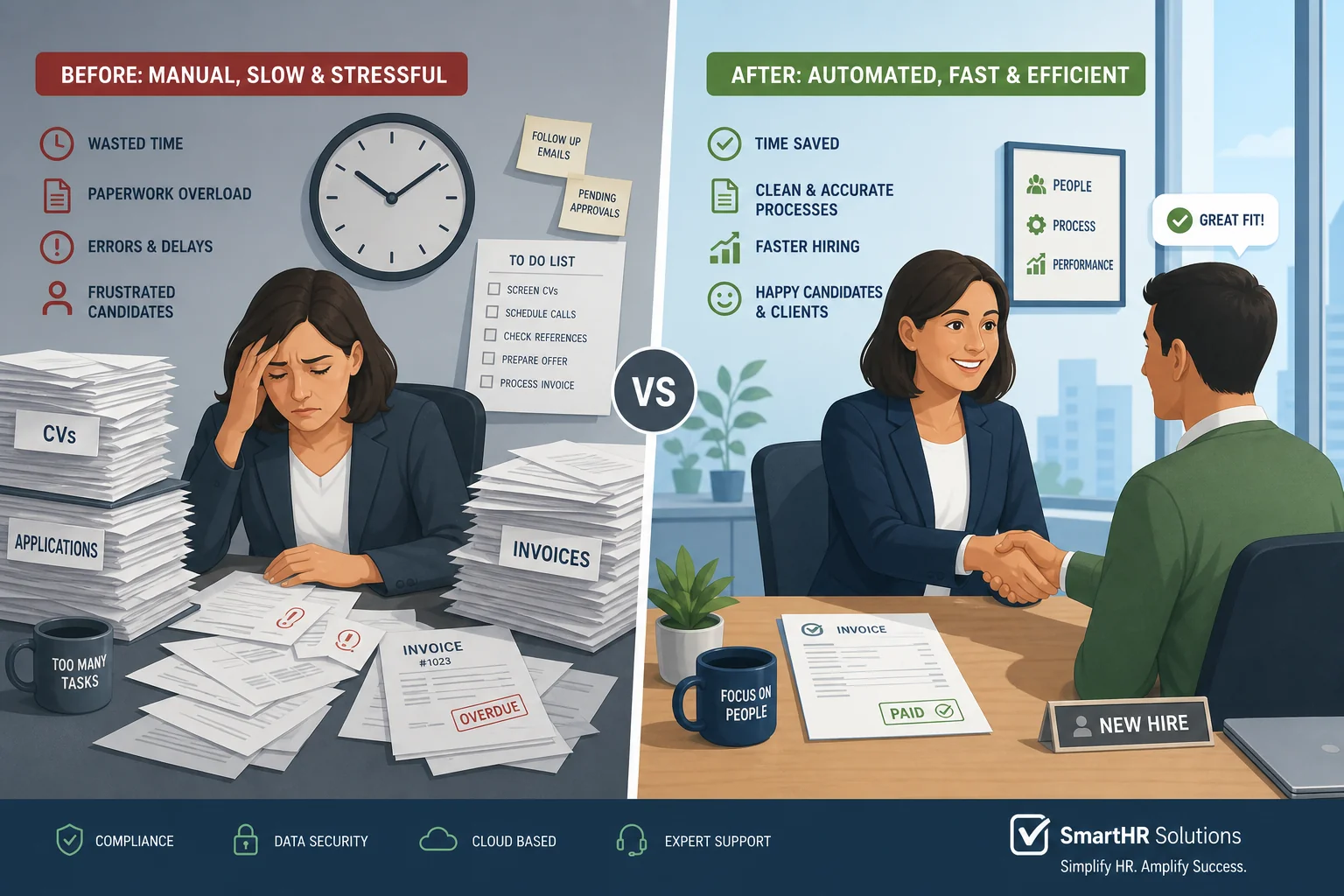

Your agency sent 14 CVs last month. Three were remotely relevant. One candidate made it to a second interview. Nobody joined. The invoice still arrived.
This is the defining frustration of traditional recruitment billing: you pay for activity, not outcomes. Retainers, monthly platform fees, seat licences — these costs accumulate whether or not a single hire is made. For TA leaders and CFOs at Indian mid-market companies, especially those hiring across multiple geographies, this misalignment between recruiter incentives and employer results is not a minor irritant. It is a structural problem that inflates cost-per-hire, distorts vendor behaviour, and makes talent acquisition budgets nearly impossible to predict.
Outcome-based hiring flips this model entirely. You pay when — and only when — a candidate joins. This post explains how that works in practice, why it changes recruiter behaviour, what shifts for the employer, and where the genuine risks lie.
Traditional recruitment has three dominant billing structures: retained search (upfront fee, regardless of outcome), contingency (fee on placement, but often with no quality controls), and SaaS platform subscriptions (monthly or annual seat licences for job posting or ATS access). Each has a version of the same flaw: the recruiter or platform gets paid before, or independent of, the result you actually need.
Retained search firms charge 30-40% of first-year salary, split across three milestones. The first payment is due at engagement, before a single candidate is sourced. If the search takes six months and produces no hire, you have still paid a third of the total fee. This structure made sense when executive search required months of discreet market mapping. For most mid-market hiring today, it is an anachronism.
SaaS recruiting platforms charge monthly or annual fees for access to job boards, ATS seats, or candidate databases. The fee is fixed regardless of how many roles you fill. A company paying ₹15, 25 lakh per year for a recruiting platform that fills 4 of its 20 open roles is effectively subsidising the 16 that went unfilled.
The deeper problem is behavioural. When a recruiter earns regardless of outcome, the incentive is to manage the relationship, not to fill the role. CV volume becomes a proxy for effort. Agencies send whoever is available, not whoever is right. Hiring managers spend hours screening irrelevant profiles. Time-to-fill stretches. And the recruiter's invoice arrives on schedule.
For Indian companies hiring outside India, across markets like Germany, Singapore, Japan, or Brazil, this problem compounds. You are paying retainers or platform fees to agencies that may have limited local market depth, while the role sits open for months. The hidden cost of an open role is rarely captured in the recruitment budget, but it is very real: delayed product launches, missed revenue targets, and overloaded existing teams.
Outcome-based hiring is a recruitment model where the employer pays a fee only when a candidate successfully joins the organisation. No retainer. No monthly platform fee. No seat licence. The financial transaction is triggered by a single event: a hire.
This is sometimes called pay-on-hire or pay-per-placement recruitment. The concept is not new, contingency recruiting has existed for decades. What has changed is the infrastructure around it. Modern outcome-based hiring platforms add AI-driven matching, multi-agency competition, and structured quality controls that traditional contingency models lacked. The result is a model that combines the financial logic of pay-on-hire with the quality and speed of a managed recruitment process.
The incentive alignment is straightforward. A recruiter who earns only on placement has a direct financial reason to prioritise quality over volume, speed over delay, and genuine fit over convenient availability. Every CV they send that wastes your time is a CV that reduces their own probability of earning a fee. Every week a role stays open is a week they earn nothing. Their interests and yours are, for the first time, pointing in the same direction.
This is not the same as cheap recruiting. Outcome-based hiring platforms typically charge a placement fee as a percentage of first-year salary, comparable to traditional agency fees. The difference is not the rate; it is when and whether you pay. You pay only when you win.
The core logic: In a pay-on-hire model, the recruiter absorbs the sourcing cost. The employer absorbs only the cost of a successful outcome. Risk is redistributed to the party best positioned to manage it.
Understanding the mechanics matters, because not all pay-on-hire platforms are built the same way. Here is how a structured outcome-based hiring platform operates, using CBREX as the reference model.
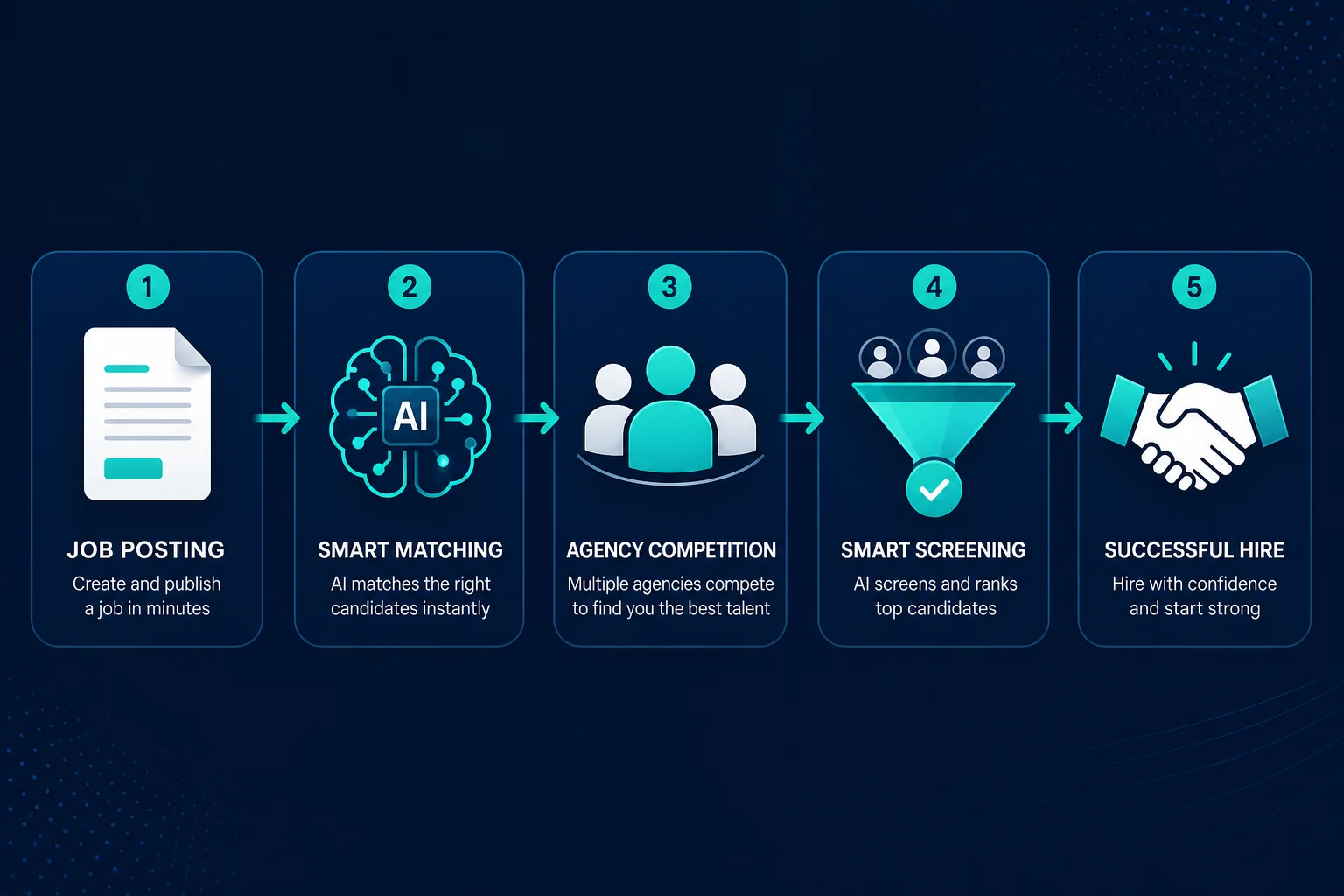
The employer posts a job requirement on the platform. No retainer is paid. No contract is signed with an individual agency. The role brief goes into the system, and the clock starts.
CBREX's AI matching engine, C Map, analyses the role requirements and routes the brief to the most relevant specialist recruiting firms from a network of 4,000+ agencies across 33 countries. A pharma regulatory role in Germany goes to firms with deep life sciences expertise in the DACH region. A senior Java developer role in Singapore goes to tech-specialist agencies with active networks in Southeast Asia. Generalist agencies that would waste everyone's time are filtered out before they ever see the brief.
Multiple specialist agencies work the role simultaneously. Because they only earn on placement, each agency is motivated to move quickly and submit their strongest candidates, not their most available ones. Competition between agencies, structured by the platform, drives quality up and time-to-fill down.
Candidates go through agency pre-screening, then CBREX's AI screening tool, C Screen, which is trained on 250,000+ anonymised resumes across 570+ job categories and operates at 98% shortlist accuracy. The result is a stack-ranked shortlist of interview-ready candidates. Hiring managers see pre-screened profiles, not raw CV dumps. For a deeper look at how AI screening works in this context, see how to choose the right AI resume screening tool.
The employer interviews, selects, and makes an offer. The placement fee is triggered at offer acceptance or joining, depending on the agreed terms. A single invoice is generated through CBREX's unified billing system, regardless of which agency or agencies contributed to the hire. One contract. One invoice. No per-agency negotiation.
The shift from activity-based to outcome-based billing is not just a financial restructuring. It changes how recruiters behave at every stage of the process.
Consider what happens when an agency is paid a monthly retainer. Their primary obligation is to demonstrate effort: calls made, CVs sent, market maps produced. Whether those CVs lead to hires is secondary. The retainer is already secured.
Now consider what happens when that same agency earns only on placement. Every CV they submit is a bet. If the candidate doesn't get hired, they earn nothing and have absorbed the sourcing cost. This creates a powerful filter: agencies become selective about what they send. They invest more time in understanding the brief. They reach into their passive talent networks, candidates who are not actively job-hunting but who are the right fit, rather than recycling active job seekers from public databases.
Speed also improves. In a pay-on-hire model, time is literally money for the recruiter. A role that sits open for three months while they "manage the search" is three months of zero revenue. Agencies on outcome-based platforms move faster because delay costs them directly.
The numbers from CBREX's platform reflect this dynamic. Across 6,500+ global hires facilitated through the platform, the average fulfillment time is 17 days. The shortlist-to-interview ratio holds at 98%, meaning nearly every candidate presented to an employer is genuinely interview-ready. These are not marketing claims; they are the measurable output of a model where recruiter incentives are aligned with employer outcomes.
For TA leaders managing multiple hiring channels across India and internationally, this kind of consistency is rare. Most recruitment relationships produce unpredictable quality and variable speed. An outcome-based platform with structured quality controls makes talent acquisition more like a managed process and less like a series of individual gambles.
Switching to an outcome-based hiring model is not a passive decision. It changes several things about how your TA function operates, most of them for the better, but some require adjustment.
The most immediate change is financial. Your recruitment spend becomes directly tied to hiring outcomes. Zero hires in a quarter means zero recruitment fees. This is a significant shift for companies that currently pay retainers or platform subscriptions regardless of results. CFOs tend to find this model intuitive: it converts a fixed cost into a variable cost that scales with actual hiring activity.
For a detailed breakdown of what traditional agency fees actually cost versus what you pay in a pay-on-hire model, the full breakdown of recruitment agency costs in India is worth reviewing before your next vendor conversation.
Managing 15 agency relationships across 6 countries, each with its own contract, invoicing cycle, and account manager, is a significant administrative burden. An outcome-based platform with a single-contract model collapses this into one agreement. One legal review. One invoicing relationship. One point of accountability. For companies dealing with the complexity of multi-agency recruitment management, this consolidation alone can recover meaningful TA team capacity.
In a traditional retained model, the employer absorbs sourcing risk. You pay whether or not the search succeeds. In an outcome-based model, the recruiting firm absorbs sourcing risk. They invest time, network access, and operational effort before earning anything. This is a fundamental shift in who bears the cost of an unsuccessful search.
Outcome-based hiring is not a hands-off model. The employer's responsibilities shift rather than disappear. Three things matter most:
The pay-on-hire model is valuable for domestic hiring. For international hiring from India, it is transformative.

When an Indian mid-market company needs to hire a regulatory affairs specialist in Germany, a plant operations head in Mexico, and a senior data engineer in Singapore, simultaneously, the traditional approach requires three separate agency relationships, three contracts, three invoicing cycles, and three sets of compliance considerations. Each agency may or may not have genuine depth in their claimed market. Each retainer is paid regardless of outcome.
An outcome-based platform with genuine global specialist coverage changes this equation. CBREX connects employers to 4,000+ specialist recruiting firms across 33 countries through a single contract. A pharma company hiring in Germany accesses agencies with deep DACH life sciences networks. A technology company hiring in Singapore accesses firms that know the local engineering talent market. A manufacturing company hiring in Mexico accesses recruiters who understand local labour law and compensation norms.
All of this happens under one agreement. All fees are triggered only on successful hires. All invoicing flows through a single channel. For Indian companies managing global expansion hiring, across markets like the UAE, Brazil, Japan, South Korea, Kenya, or Hong Kong, this model removes the administrative and financial friction that makes international talent acquisition so difficult to scale.
The complete guide to global hiring from India covers the country-specific compliance and market considerations in detail. The outcome-based model addresses the structural and financial layer that sits above those country-specific details.
Industries where this model has proven particularly effective include Healthcare and Pharma (where specialist knowledge is non-negotiable), IT and Technology (where passive talent is the primary target), and Manufacturing (where niche engineering skills are geographically concentrated). CBREX's specialist agency network is built around these verticals, with domain-specific firms rather than generalist agencies attempting to cover every sector.
Outcome-based hiring is not without trade-offs. Any TA leader evaluating this model should understand where it can underperform and what mitigations matter.
In a pure contingency model, agencies may avoid roles they consider difficult to fill, because the probability of earning a fee is low relative to the effort required. This is a real risk with single-agency contingency arrangements. On a multi-agency platform, competition between firms mitigates this: if one agency passes, others may take the role. AI matching to specialist firms, rather than generalists, further reduces the risk that niche roles go unworked.
This is not unique to outcome-based hiring, but it is amplified by it. Specialist agencies working on a pay-on-hire basis will ask sharper questions about the brief before investing sourcing effort. If your job description is vague or internally inconsistent, expect pushback, or poor shortlists. Treat the brief as a contract with the recruiter, not a formality.
Top candidates in active markets, Singapore tech, German pharma, UAE finance, receive multiple offers simultaneously. If your interview process takes six weeks, you will lose candidates to faster-moving employers. In a pay-on-hire model, this means the recruiter absorbs the sourcing cost and you restart the search. Speed of decision-making is a competitive advantage in outcome-based hiring.
The pay-on-hire label does not guarantee quality. Some platforms are simply CV aggregators with a contingency billing wrapper, agencies submit unscreened profiles, and the employer does all the filtering. The differentiator is structured screening: AI validation, specialist matching, and stack-ranked shortlists. Without these controls, pay-on-hire can produce the same CV dump problem as traditional contingency, just with a different billing trigger.
CBREX's three-level screening process, agency pre-screen, C Screen AI validation, and stack ranking, is specifically designed to prevent this. The 98% shortlist ratio is the measurable output of that process.
The placement fee percentage is often comparable to traditional agency fees, typically 8-20% of first-year CTC depending on seniority and geography. The difference is that you pay only on success. A retained search that fails costs you the retainer with no hire. A pay-on-hire search that fails costs you nothing. Over a portfolio of roles, the expected cost is lower in the outcome-based model because you do not pay for unsuccessful searches.
Most outcome-based platforms include a replacement guarantee period, typically 30 to 90 days. If the candidate leaves or is let go within that window, the agency re-works the search at no additional fee. The specific terms vary by platform and role type; confirm these before signing.
Yes, and this is one of the most significant advantages over traditional retained executive search. Leadership hiring on a pay-on-hire basis means no upfront retainer, no milestone payments for inconclusive searches, and no fee if the search fails. CBREX's leadership hiring service uses curated boutique firms and independent search consultants with no retainer requirement. For more on this, see the complete guide to leadership hiring in India.
On a platform like CBREX, multi-country hiring operates under a single contract. You post roles across multiple geographies, the AI matches each role to the relevant specialist agencies in each market, and all successful placements are invoiced through a single channel. There is no need to negotiate separate agreements with agencies in each country. The pay-on-hire FAQ guide covers the mechanics of multi-geo billing in more detail.
CBREX does not require a minimum hiring volume. The platform is designed for companies with variable hiring needs, from a single critical role to large-scale multi-country hiring programmes. Because there are no retainers or seat licences, there is no financial penalty for low-volume periods.
Outcome-based hiring is not a new concept dressed up in new language. It is a structural correction to a billing model that has misaligned recruiter and employer incentives for decades. When recruiters earn only on successful placements, they behave differently: they source more carefully, screen more rigorously, and move faster. When employers pay only on successful hires, their recruitment budget becomes predictable, their vendor relationships simplify, and their cost-per-hire reflects actual outcomes rather than activity.
For Indian mid-market companies hiring across multiple geographies, managing roles in markets as different as Japan, Brazil, Germany, and Kenya, the combination of outcome-based billing and a global specialist agency network under a single contract is a meaningful operational advantage. It removes the administrative overhead of multi-agency management, eliminates upfront financial risk, and gives specialist recruiters in each market a direct incentive to deliver.
The risks are real but manageable: brief quality, interview speed, and platform quality controls are the variables that determine whether pay-on-hire delivers on its promise. Choose a platform with structured screening, specialist matching, and a track record of global placements, not just a contingency billing wrapper on a generic CV database.
If your current recruitment model is costing you money before a single hire is made, it is worth understanding what a genuinely outcome-based alternative looks like in practice. Book a demo with a CBREX specialist to see how the platform works across your specific hiring markets, and what a pay-on-hire model would mean for your recruitment budget and time-to-fill.


