Read Time:
Recruitment Agency in Lebanon: How to Hire Through Vetted Specialist Agencies (2026)


A recruitment agency in Lebanon finds, screens and presents candidates for your open role, and you should pay only when someone is hired. Before you sign, check the agency's registration papers, put the fee trigger and replacement terms in writing, and agree who owns each candidate. Across CBREX searches, qualified candidates start arriving within 24-72 hours.
This guide is for employers hiring in Lebanon, including India-headquartered companies that hire there without a local team. CBREX is an AI-powered talent acquisition marketplace. It gives you one contract and one invoice that reach 4,000+ specialist recruiting firms across 55 countries, and Lebanon roles are routed to vetted specialist agencies, not to a single generalist.
Below you will find what these agencies do, how their fees work, how long a search takes, and a checklist to run before any signature.
A Lebanon recruitment agency sources candidates from its own network, pre-screens them against your brief, and presents a shortlist. The employer then interviews, makes the offer and pays the fee. Agencies differ mainly in how they are paid, how deep their niche is, and whether they hunt passive talent.
Three service types matter when you compare agencies:
For an India-HQ company, the practical value is local reach. A Beirut-based boutique knows who is quietly open to a move. Your own job post does not reach those people, and an AI-only job board recycles people who are actively applying.
Most failed searches start with the brief, not the agency. A vague brief sends the agency to the wrong pool, and the shortlist comes back wrong. Spend an hour on it before you post anything.
Cover these points:
One mistake we see often is asking for very high-quality talent while paying below the level that talent commands. Benchmark the salary against the seniority you want, then adjust the ask if the budget does not match. If you need a method, our guide on recruitment agency fees by country shows how fees and pay scale together.
Three fee models dominate. A retainer is paid upfront whether or not you hire. A percentage-of-salary fee is paid on placement. A pay-on-hire marketplace model charges only when a hire is made. The model changes your risk more than the headline rate does.
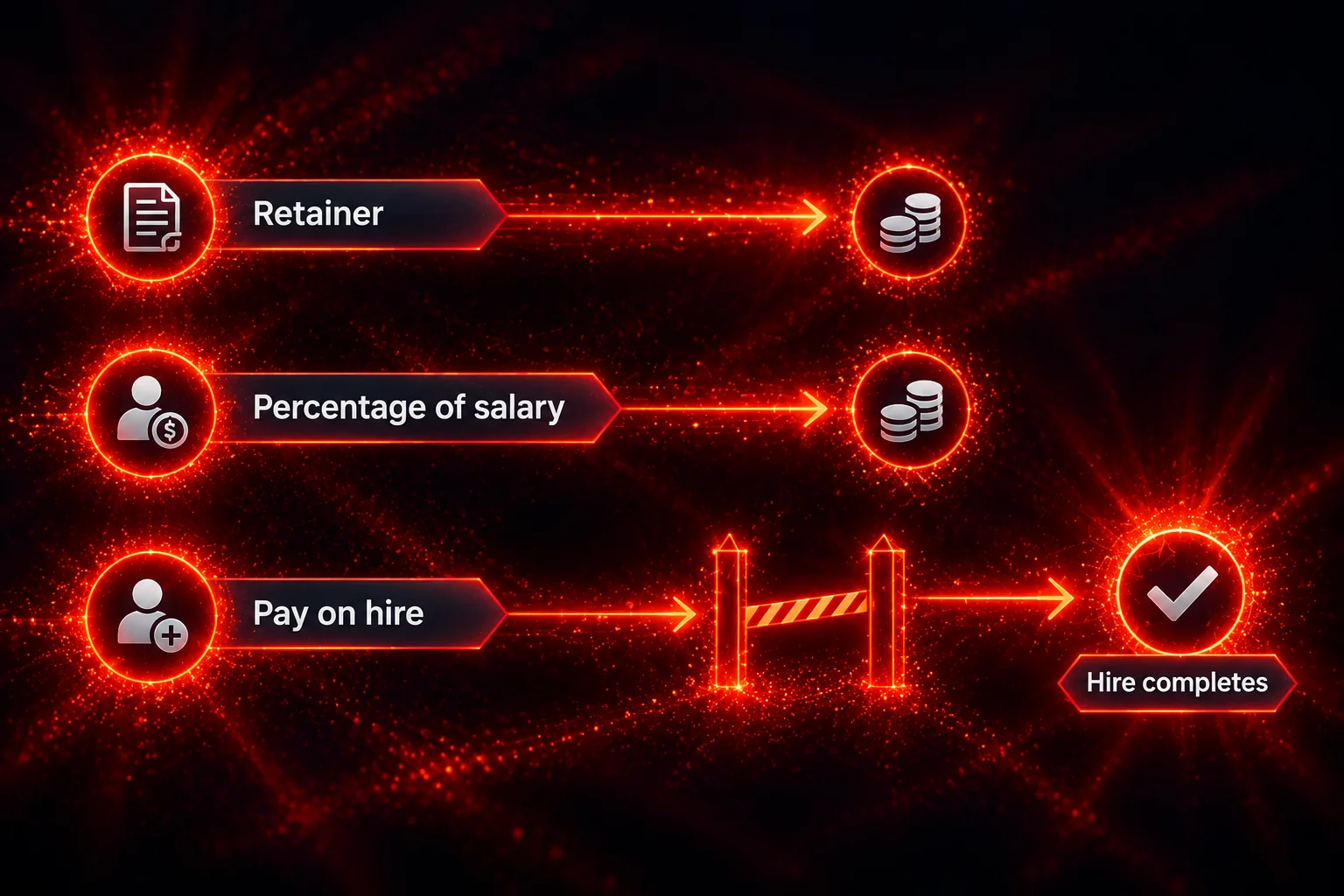
| Model | When you pay | Main risk | Best for |
|---|---|---|---|
| Retainer | Part of the fee upfront, rest in stages | You pay even if no one is hired | Confidential senior searches where you want exclusivity |
| Percentage of salary (contingency) | On a successful hire | Several agencies may submit the same candidate, and the terms differ per agency | Mid-level and specialist roles with one trusted agency |
| Pay-on-hire marketplace | On a successful hire, under the terms in each job's Job Details | You must confirm the terms for each role | Multi-agency searches that need one contract |
On CBREX there are no retainers, seat licences or monthly fees, and payment follows the terms in each job's Job Details section, which can vary by job. We do not publish one fee percentage for Lebanon. The fee depends on the country where you hire.
Ask each agency for the same four things in writing: the fee basis (first-year fixed pay or total pay), when the fee falls due, what counts as a hire, and the replacement period. A lower percentage on a wider salary base can cost more than a higher percentage on base pay alone.
Do not scale the fee by how hard the role is to fill. Scale it by the candidate's years of experience, which is the more stable measure. Difficulty is a reason to widen the agency pool, not to pay more per head. For a wider view, see how much recruitment agencies charge.
Expect qualified candidates within 24-72 hours of opening a role on CBREX, then about three more weeks to complete the hire. Those are CBREX figures across searches, not a Lebanon-specific guarantee. Your own interview speed and the candidate's notice period will move the total.
Here are the reported CBREX timings that give a realistic range:
Three things stretch these timelines. Late feedback on shortlisted candidates is the biggest. A brief that changes mid-search is second. A slow offer approval is third, because strong candidates take other offers while they wait. Fix those on your side and an agency's speed shows up in the result.
Check six things before signing: the agency's registration papers, how it screens, who owns each candidate, how fees are triggered, what the replacement guarantee covers, and how it treats candidate data. A good agency answers all six in writing without delay.

For a contract review, the International Organization for Migration publishes a checklist for labour recruiter service agreements that employers can use as a starting list of provisions. It is aimed at migrant worker recruitment, so use the parts that fit a professional placement.
If you plan to recruit Indian citizens for jobs in Lebanon, a separate rule applies. The Ministry of External Affairs explains that the Emigration Act, 1983 requires those who recruit Indian citizens for employment abroad to register with the Protector General of Emigrants. Check this with the agency first.
The duplicate check is built into the CBREX platform. At the moment of a duplicate submission, the agency learns it is a duplicate and cannot upload the candidate. That removes the credit disputes that make multi-agency searches messy.
You post the role once. CBREX's AI vendor matching, called C Map, routes it to the most relevant specialist agencies for Lebanon. Candidates pass three screening levels, and you receive a ranked shortlist. One contract and one invoice cover the whole search, and you pay only on hire.

In practice the route looks like this:
Why does this beat signing one agency? If a single agency runs dry, your search stalls. CBREX adds new agencies to the marketplace on demand, so supply does not drop when one firm is out of capacity. A standalone vendor management system cannot do that, because it only manages the vendors you already have.
The commercial side is simple too. There is one contract and one invoice, with no retainers, seat licences or monthly fees. One client consolidated 54 agency contracts into a single CBREX contract, and its time to hire fell from 60-75 days before consolidation.
CBREX does not have a post-consolidation time-to-hire figure to share here. CBREX has run this model since 2019, and more than 90% of local hires in the cohort it tracked stayed at least 12 months.
If you work with agencies in other markets too, our guides to the overseas recruitment agency route and to an international recruitment agency across 55 countries show how the same contract extends to more countries.
Ask three things next: whether the role needs a local specialist or can be remote, whether your pay and seniority match, and whether one contract can cover other countries you plan to hire in. Settle those before you post the role.
A staffing agency supplies people from its own pool, often onto its own payroll. A recruiting marketplace connects you to many independent recruiting firms under one contract. You get wider reach and one invoice, and each firm competes on candidate quality for your role.
If you want the long version, read our comparison of a recruitment marketplace and a staffing agency.
Yes. Recruitment, staffing and executive search agencies, and self-employed recruiters, can sign up. Corporates post jobs globally, recruiters fill them and earn a commission on each successful hire. Registration is free, and CBREX does not charge sourcing partners fees or subscriptions.
CBREX also does not provide a candidate database or help buy job-board subscriptions, so partners bring their own networks. Lebanese firms can sign up as a recruiting firm to receive roles.
Write the brief, choose the fee model, and run the six checks before any signature. If you want to see how a Lebanon role would be routed and screened, book a demo and bring your open role. You can also calculate your hidden hiring tax to see what multiple agency contracts cost you today, or talk to the CBREX team about a confidential search.