Read Time:
18 Mins
Vendor Sprawl in Recruitment: 15 FAQs Answered


Count the recruitment agencies your company has worked with in the last three years. Now count how many have active contracts. Now count how many sent you a CV in the last 90 days. If those three numbers are wildly different — and if no one on your TA team can answer all three without opening a spreadsheet — you have a vendor sprawl problem. You're not alone. It's one of the most common, most expensive, and least-discussed challenges facing TA leaders at Indian mid-market companies today, especially those hiring across multiple geographies.
This guide answers the 15 questions we hear most often about recruitment vendor sprawl: what it is, why it happens, what it costs, and — most importantly, how to fix it without dismantling the specialist coverage your hiring managers depend on.
Vendor sprawl is the uncontrolled accumulation of recruitment agency relationships over time, without a corresponding governance structure to manage them. It's not the same as having a large vendor panel. A well-managed panel of 15 specialist agencies, each with clear SLAs, defined role categories, and regular performance reviews, is a strategic asset. Vendor sprawl is what happens when that panel grows to 40 agencies, through ad hoc additions, legacy relationships, and departmental workarounds, with no one accountable for the whole.
The distinction matters. Vendor sprawl isn't about the number of agencies. It's about the absence of control. Companies with sprawl typically have multiple overlapping agency mandates, no centralised performance data, fragmented invoicing across business units, and hiring managers who call agencies directly without TA involvement. The result is a system that looks like a vendor strategy but functions like organised chaos.
Vendor sprawl rarely happens through a single bad decision. It accumulates through dozens of reasonable ones. A hiring manager in the Mumbai office has a good relationship with an agency that filled a role two years ago, so they call them again. The Singapore team needs a data engineer and the existing panel has no one with APAC coverage, so they onboard a new agency. The finance function wants a CFO and someone recommends a boutique executive search firm. Each decision makes sense in isolation. Together, they create a vendor landscape no one designed and no one fully understands.
Several structural factors accelerate the problem:
For Indian mid-market companies going global, this process is especially fast. Hiring in Germany, Singapore, and the UAE simultaneously, each with different labour markets, different agency ecosystems, and different compliance requirements, can triple a vendor panel in under 12 months.
The most visible cost is the agency fee itself. But vendor sprawl creates a much larger set of costs that rarely appear on a single line item. Understanding the full picture is essential before you can make the case for change internally.
Administrative overhead is the first hidden cost. Managing 30 agency relationships means 30 contracts to negotiate and renew, 30 invoicing cycles to reconcile, and 30 sets of SLAs to monitor. A TA team of three people cannot do this well. Something always slips, usually performance management.
Duplicate submissions are a direct financial risk. When multiple agencies work the same role without a clear exclusivity or priority structure, the same candidate often arrives from two or three vendors simultaneously. Resolving ownership disputes takes time, damages agency relationships, and occasionally ends in legal disputes over placement fees.
Inconsistent candidate quality is harder to quantify but equally damaging. When agencies are selected reactively rather than strategically, you end up with a mix of generalist and specialist firms working the same roles. The quality variance is significant, and it falls on hiring managers to absorb it.
Compliance exposure grows with every new agency relationship, particularly for companies hiring internationally. Each contract carries different terms, different liability clauses, and different data protection obligations. Across 20+ agencies in multiple jurisdictions, the compliance surface area becomes genuinely difficult to manage.
For a deeper breakdown of what recruitment agency relationships actually cost beyond the headline fee, see our analysis of recruitment agency costs in India: what you're really paying.
The symptoms are usually obvious once you know what to look for. Here are the most reliable indicators:
If three or more of these apply, vendor sprawl is already costing you more than you realise. The question is whether you're ready to measure it honestly. Calculate your hidden hiring tax to get a clearer picture of what the sprawl is actually costing your organisation.

Yes, significantly. Domestic vendor sprawl is a management problem. International vendor sprawl is a management problem multiplied by every country you hire in, each with its own agency ecosystem, employment law, currency, and compliance framework.
Consider a mid-market Indian technology company hiring in Singapore, Germany, and the UAE simultaneously. In each market, they've onboarded two or three local agencies. That's potentially nine new vendor relationships, nine new contracts (in three different legal jurisdictions), nine invoicing cycles in three currencies, and nine sets of SLAs to monitor, all managed by a TA team that was already stretched before the international expansion began.
The problem compounds further because international agencies often have very different working norms. Agencies in Germany operate under strict data protection rules (GDPR). Agencies in the UAE have different fee structures and candidate ownership conventions. Agencies in Singapore may expect exclusivity on senior roles. Managing these nuances across a sprawling vendor panel is genuinely difficult without dedicated local expertise.
For Indian companies building global teams, this is one of the most common points of failure. The hiring strategy is sound; the vendor infrastructure to execute it simply isn't built for multi-country scale. Our complete guide to global hiring from India covers this in detail, including how to structure your vendor approach before you expand.
This is the question hiring managers care about most, and the answer is more direct than most TA leaders want to admit. Vendor sprawl degrades candidate quality, not because individual agencies are poor, but because the system incentivises the wrong behaviours.
When multiple agencies work the same role simultaneously with no clear differentiation, they compete on speed rather than quality. The first CV submitted wins the race, regardless of fit. Agencies know this, so they lower their internal screening bar to get submissions in faster. The result is a flood of CVs that look plausible on paper but don't survive a 10-minute hiring manager review.
There's also a structural quality problem. Vendor sprawl typically means a mix of generalist and specialist agencies working the same roles. A generalist agency filling a regulatory affairs role in Germany or a semiconductor process engineer role in South Korea will almost always produce weaker candidates than a specialist firm with genuine domain depth in that market. But in a sprawling vendor panel, there's often no mechanism to route roles to the right type of agency, so everything goes to everyone.
Standardised screening criteria are also impossible to enforce across 20+ agencies. Each agency has its own definition of "qualified." Without a consistent screening layer, candidate quality becomes a lottery. For a detailed look at how structured screening solves this, see candidate screening in 2026: 15 most-asked questions answered.
Vendor consolidation in recruitment means deliberately reducing the number of active agency relationships and replacing them with a smaller, better-governed set of partnerships, or a single platform that manages those relationships on your behalf.
The case for consolidation is strong: fewer contracts, unified invoicing, consistent SLAs, cleaner performance data, and a TA team that spends time on strategy rather than admin. But consolidation has a reputation problem. Most TA leaders assume it means trading breadth for simplicity, that consolidating to fewer vendors means losing specialist coverage in niche markets or skill sets.
That trade-off was real when consolidation meant choosing between Agency A and Agency B. It's no longer real when consolidation means moving to a marketplace model that gives you access to thousands of specialist agencies through a single contract. The question isn't "how many agencies do I need?" It's "how do I access the right agency for every role without managing each relationship individually?" For a structured approach to this, see vendor consolidation in recruitment: top 10 questions answered.
This is the question that stops most consolidation projects before they start. The short answer is yes, if you use the right model.
Traditional consolidation forces a genuine trade-off. If you reduce from 30 agencies to 5, you almost certainly lose specialist coverage in some geographies or skill categories. The 5 agencies you keep are likely to be generalists or large firms with broad but shallow networks.
A marketplace model inverts this logic. CBREX, for example, gives companies access to a curated network of 4,000+ specialist recruiting firms across 33 countries, all through a single contract and a single point of contact. When a role is posted, CBREX's AI matching engine (C Map) routes it to the most relevant specialist agencies for that specific skill set and geography. A regulatory affairs role in Germany goes to agencies with genuine pharma regulatory expertise in the DACH market. A fintech engineering role in Singapore goes to agencies with proven APAC tech networks.
The result is specialist coverage at scale, without the administrative burden of managing hundreds of individual agency relationships. Companies hiring niche skills across multiple countries, a common challenge for Indian mid-market firms expanding globally, get the depth of a specialist panel without the sprawl of managing one. For more on this approach, see our playbook for hiring niche skills overseas.
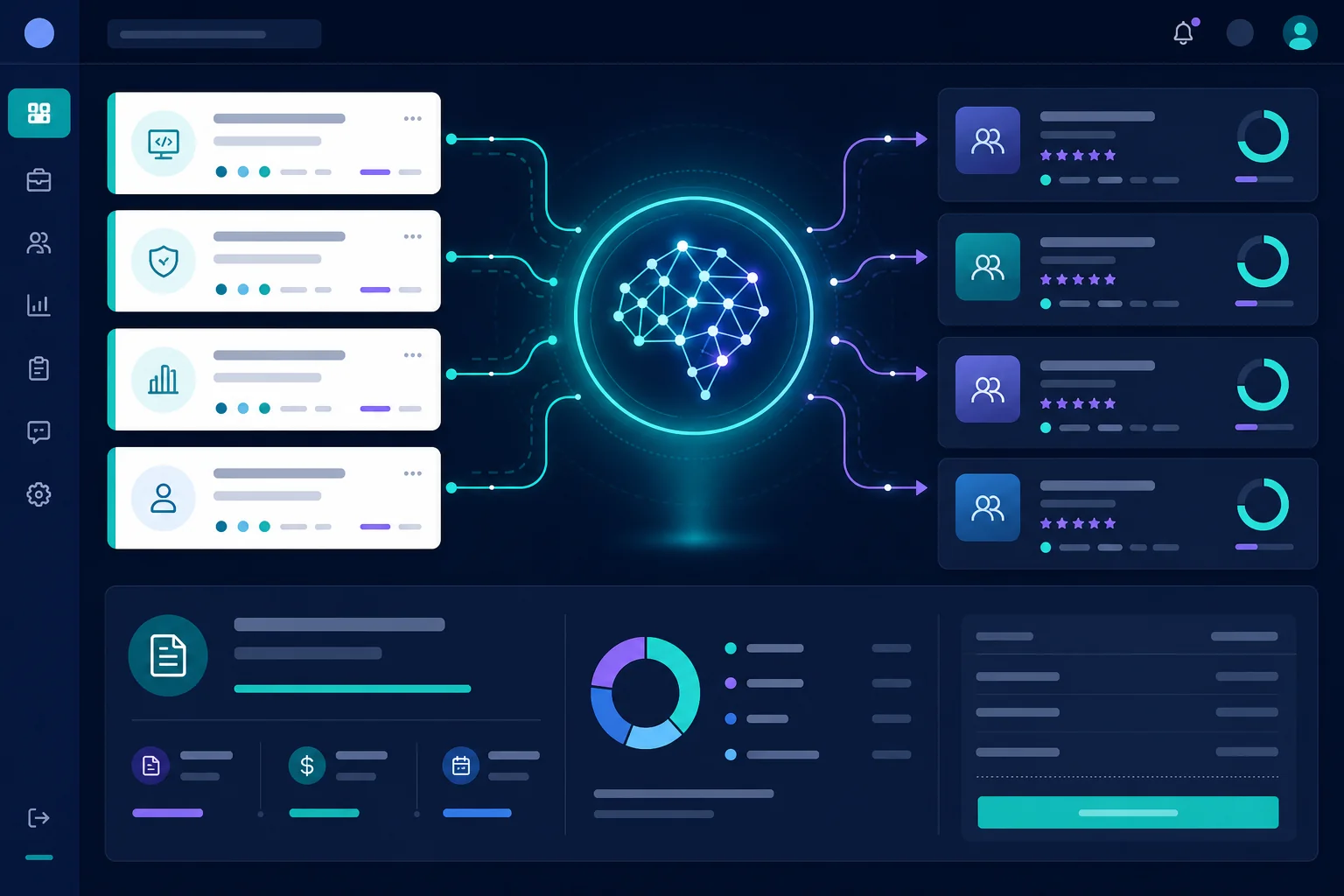
A recruitment marketplace addresses vendor sprawl at its structural root, not just its symptoms. Here's how the model works in practice:
Single contract, multiple agencies. Instead of negotiating and maintaining individual contracts with every agency, you sign one agreement with the marketplace. That single contract covers every agency in the network, across all geographies, all skill categories, and all seniority levels. Contract administration drops from a full-time task to a non-issue.
Unified invoicing. Every placement, regardless of which specialist agency made it or which country it was in, flows through a single invoice. No more reconciling payments across 20 different entities in three currencies. Finance teams love this almost as much as TA teams do.
AI-powered vendor matching. The marketplace's AI engine replaces the manual process of deciding which agency to brief on which role. When you post a role, the system analyses the requirement, skill set, seniority, geography, industry, and routes it to the agencies most likely to fill it successfully. This eliminates the "brief everyone and hope" approach that drives duplicate submissions and quality variance.
Transparent performance data. Because all activity flows through one platform, you get a single source of truth for agency performance. Submission-to-interview ratios, time-to-fill by role type, offer acceptance rates, all visible in one place, without manual data aggregation.
For a broader comparison of how marketplace models compare to traditional job boards and agency panels, see hiring platforms in India: job boards vs. agencies vs. AI marketplaces.
Not all consolidation solutions are equal. When evaluating options, these are the criteria that separate a genuine fix from a rebranded version of the same problem:
The pay-on-hire model deserves particular attention. Traditional agency retainers create a misalignment: you pay whether or not a hire is made. A marketplace model that charges only on successful placement removes that risk entirely and makes the cost of hiring genuinely predictable.
The honest answer depends on how deeply embedded the sprawl is and which fix you choose. A traditional vendor rationalisation project, auditing the panel, renegotiating contracts, offboarding underperformers, and building a governance framework, typically takes three to six months. Larger enterprises with complex procurement processes can take longer.
A marketplace model can compress this significantly. Because the platform provides the governance infrastructure (single contract, unified invoicing, AI matching, performance reporting), you're not building those systems from scratch. The transition involves onboarding to the platform, migrating active roles, and winding down legacy agency contracts as they expire. Many companies see the administrative benefits within the first 30 days.
The key is not to let "perfect" be the enemy of "better." Companies that wait for a complete vendor audit before making any changes often find themselves 12 months later with the same sprawl and a very detailed spreadsheet. Starting with a parallel track, running new roles through a consolidated platform while legacy contracts wind down, is usually faster and less disruptive.
This is a legitimate concern, particularly for TA leaders who have built strong relationships with specific agencies over years. The good news is that consolidation doesn't have to mean abandoning those relationships entirely.
The first step is an honest performance audit. For each active agency, ask: What roles have they filled in the last 12 months? What was the time-to-fill? What was the offer acceptance rate? How many submissions did it take to get a hire? Most TA leaders find that 20% of their agencies are responsible for 80% of their successful placements, and the rest are consuming administrative bandwidth without delivering proportionate value.
For agencies that genuinely perform, there are two paths: retain them as preferred vendors within a more structured governance framework, or check whether they're already part of a marketplace network (many specialist agencies are). For agencies that don't perform, the transition to a consolidated model provides a natural and professionally defensible reason to wind down the relationship.
Internally, the communication is straightforward: the company is moving to a more structured vendor model to improve hiring quality, reduce administrative overhead, and support international expansion. Most hiring managers, once they understand the benefits, are supportive, especially if the new model delivers better candidates faster.
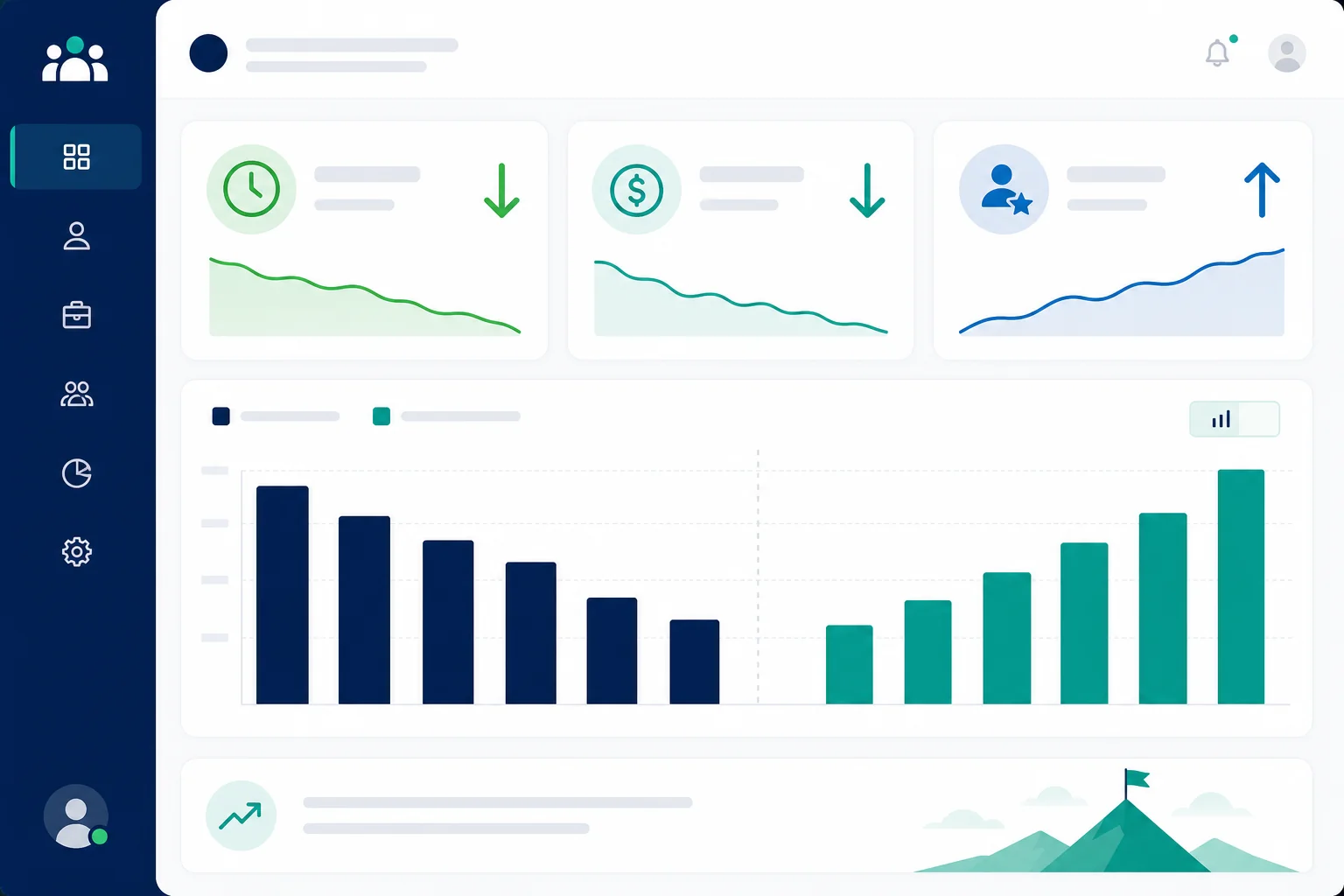
Measuring the impact of vendor consolidation requires establishing a baseline before you start. If you don't know your current time-to-fill, cost-per-hire, and submission-to-interview ratio, you won't be able to demonstrate improvement, which matters when you're making the case to a CFO or CHRO.
The KPIs that matter most after consolidation:
For a detailed framework on measuring recruitment ROI, including how to present these metrics to senior leadership, see time to hire: the hidden cost of roles left open.
Mid-market companies often hit vendor sprawl faster and harder than large enterprises, and with fewer resources to manage it. Here's why.
Large enterprises typically have dedicated vendor management functions, procurement teams, and TA operations specialists whose job is to govern the agency panel. Mid-market companies rarely have this infrastructure. A TA team of two or three people is managing hiring across multiple functions, multiple seniority levels, and increasingly multiple geographies, while also handling the agency relationships, contracts, and invoicing that a larger company would have a dedicated team for.
The growth dynamic makes it worse. Mid-market companies in India that are expanding internationally, into Southeast Asia, the Middle East, Europe, or the Americas, are adding new geographies faster than they can build the vendor governance to support them. Each new market adds new agencies, new contracts, and new compliance obligations. The sprawl accelerates precisely when the TA team is already at capacity.
This is exactly the profile of CBREX's core clientele: India-headquartered mid-market companies between INR 50 crores and INR 5,000 crores in revenue, hiring critical talent across countries like Singapore, Germany, UAE, the UK, and the USA. For these companies, a single-contract marketplace model isn't a luxury, it's the only operationally viable path to international hiring at scale. See how the model compares to traditional options in our analysis of RPO vs. agency models for Indian mid-market companies.
The first step is the one most companies skip: an honest audit. Pull together every agency your company has worked with in the last 24 months. For each one, record the number of roles briefed, the number of CVs submitted, the number of interviews generated, and the number of hires made. Calculate a cost-per-hire for each agency, including the time your TA team spent managing the relationship.
What you'll find, almost universally, is that a small number of agencies are delivering most of your hires, and a large number are consuming time and money without proportionate return. That data is the foundation of your consolidation case. It's also the data your CFO needs to approve the change.
The second step is to evaluate whether your consolidation path is a rationalised panel (fewer agencies, better governed) or a marketplace model (single contract, AI-matched specialist access). For most mid-market Indian companies hiring internationally, the marketplace model is the faster, lower-risk path, because it solves the governance problem structurally rather than requiring you to build the infrastructure yourself.
If you're ready to see what that looks like in practice, book a demo with CBREX to walk through how the platform handles vendor sprawl for companies at your stage of growth. Or if you want to start by quantifying the problem, calculate your hidden hiring tax, it takes less than five minutes and usually produces a number that makes the consolidation conversation much easier to have internally.
The bottom line on vendor sprawl: It's not a sign that your TA team made bad decisions. It's a predictable outcome of growing hiring needs without a governance infrastructure to match. The fix isn't to work harder within the existing system, it's to change the system. A recruitment marketplace model gives you specialist coverage at scale, without the administrative chaos of managing it yourself.
Vendor sprawl is solvable. The companies that solve it fastest are the ones that stop treating it as a vendor management problem and start treating it as a structural design problem. If your current setup has more agencies than your team can meaningfully manage, the answer isn't better spreadsheets, it's a better model. Talk to CBREX about what consolidation looks like for your specific hiring footprint, or sign up to explore the platform and see the network in action.


