Read Time:
19 Mins
How to Hire in Germany Without a Local Entity


Your German headcount just cleared finance. The role is scoped, the salary band is benchmarked in euros, and the hiring manager in Frankfurt has already asked when the first shortlist will land. Back in your Bengaluru or Mumbai office, one question stops everything: do we need to register a GmbH before we can legally employ someone in Germany?
The short answer is no. The longer answer is what this guide is for. Indian mid-market companies and global-HQ firms are hiring in Germany every quarter without a registered local entity — but the ones who do it well understand three things upfront: the legal pathways available, the compliance obligations that come with German employment law, and how to source candidates who are actually worth hiring in one of Europe's most competitive talent markets.
Germany is the largest economy in Europe and the third-largest in the world by GDP. For Indian companies expanding into EMEA, it is often the first or second market they target — for engineering talent, pharmaceutical expertise, manufacturing operations, or enterprise sales. The talent pool is deep, the infrastructure is world-class, and the market is stable.
The problem is that Germany also has some of the most employee-protective labor laws on the continent. Dismissal protection kicks in after six months. Works councils hold co-determination rights that affect hiring, restructuring, and termination. Collective bargaining agreements apply across entire sectors. And GDPR enforcement in Germany is among the strictest in the EU, with state-level data protection authorities that actively investigate violations.
Most Indian TA leaders assume the first step is entity registration — a GmbH (Gesellschaft mit beschränkter Haftung) or a branch office. That process takes three to six months, costs €25,000 or more in legal and notarial fees, and requires a German bank account, a registered address, and ongoing compliance obligations. For companies hiring one to five people in Germany, it is almost never the right first move.
The real risk isn't the entity gap. It's hiring without understanding the compliance obligations that apply regardless of which pathway you choose. That's where Indian companies get into trouble, not because they lack a GmbH, but because they treat a German hire like an Indian contractor engagement.
Three structures allow you to hire in Germany without registering a local entity. Each has a different risk profile, cost structure, and use case.
An EOR is a third-party company that is legally registered in Germany and employs the worker on your behalf. The EOR handles the employment contract, payroll, social security contributions, tax filings, and statutory benefits. You direct the employee's day-to-day work; the EOR is the legal employer of record. This is the most compliant and scalable pathway for permanent or long-term hires, and it's the structure most Indian companies use when entering Germany for the first time.
For project-based or fixed-term roles, a licensed German staffing agency can place a worker with your company under a temporary work arrangement (Arbeitnehmerüberlassung). Germany's Temporary Employment Act (AÜG) governs this structure strictly, maximum assignment duration is 18 months, and equal pay rules apply after nine months. This pathway works for defined projects but is not suitable for permanent headcount.
Germany has a concept called Scheinselbstständigkeit, false self-employment. If a person works exclusively or primarily for one company, follows your instructions, and integrates into your team structure, German authorities will reclassify them as an employee regardless of what the contract says. The penalties include back taxes, social security contributions, and fines. Genuine freelancer engagement is possible in Germany, but the bar is high and the risk of misclassification is significant. Use this pathway only with legal advice and for genuinely independent work.
For most Indian companies hiring permanent roles in Germany, the EOR model is the correct starting point. It is compliant, fast to set up (typically two to four weeks), and eliminates the need for entity registration until your German headcount justifies the investment.
German employment law is not optional reading. Whether you use an EOR or eventually register an entity, these rules govern every employment relationship in Germany.
After six months of employment, German workers gain strong protection against unfair dismissal under the Kündigungsschutzgesetz (KSchG). Termination must be justified by one of three grounds: personal reasons (e.g., incapacity), conduct-related reasons, or operational reasons (redundancy). Wrongful termination claims are common and expensive. This applies to EOR-employed workers too, the EOR bears the legal risk, but you bear the commercial cost through your EOR agreement.
Statutory notice periods in Germany start at four weeks and increase with tenure, up to seven months for employees with 20 or more years of service. Employment contracts often specify longer periods. Budget for this when planning headcount changes.
Any German workplace with five or more permanent employees can elect a works council. Works councils have co-determination rights over hiring decisions, working hours, performance monitoring, and terminations. If your EOR employs multiple workers at the same German location, a works council may already exist or may be established. Ignoring works council consultation requirements is a serious compliance breach. Your EOR partner should manage this, but you need to understand it exists.
Many German industries, including chemicals, metalworking, construction, and retail, are governed by sector-wide collective bargaining agreements. These set minimum pay scales, working hours, and leave entitlements that override individual employment contracts. Check whether your target role falls under a relevant Tarifvertrag before setting salary bands.
Germany's statutory minimum wage (Mindestlohn) is reviewed regularly and applies to all workers. The standard working week is 40 hours, with a legal maximum of 48 hours averaged over six months. Overtime rules and rest period requirements are strictly enforced by the Gewerbeaufsicht (trade supervisory authority).
Germany's data protection authorities, particularly the Bavarian State Office for Data Protection Supervision and the Hamburg Commissioner for Data Protection, are among the most active GDPR enforcers in the EU. For Indian companies, this creates a specific challenge: candidate data collected in Germany cannot flow freely to India without a legal transfer mechanism in place.
India is not currently on the EU's list of countries with an adequacy decision, which means transfers of personal data from Germany to India require additional safeguards. The standard mechanism is the European Commission's Standard Contractual Clauses (SCCs), which must be incorporated into your data processing agreements with any vendor, ATS provider, or internal system that handles German candidate data.
Before you begin sourcing candidates in Germany, put these in place:
If you are using CBREX's platform, the AI screening and candidate management workflows are designed with GDPR-compliant data handling in mind. Your EOR partner should also have DPAs in place as part of their standard service agreement. Verify this before signing.
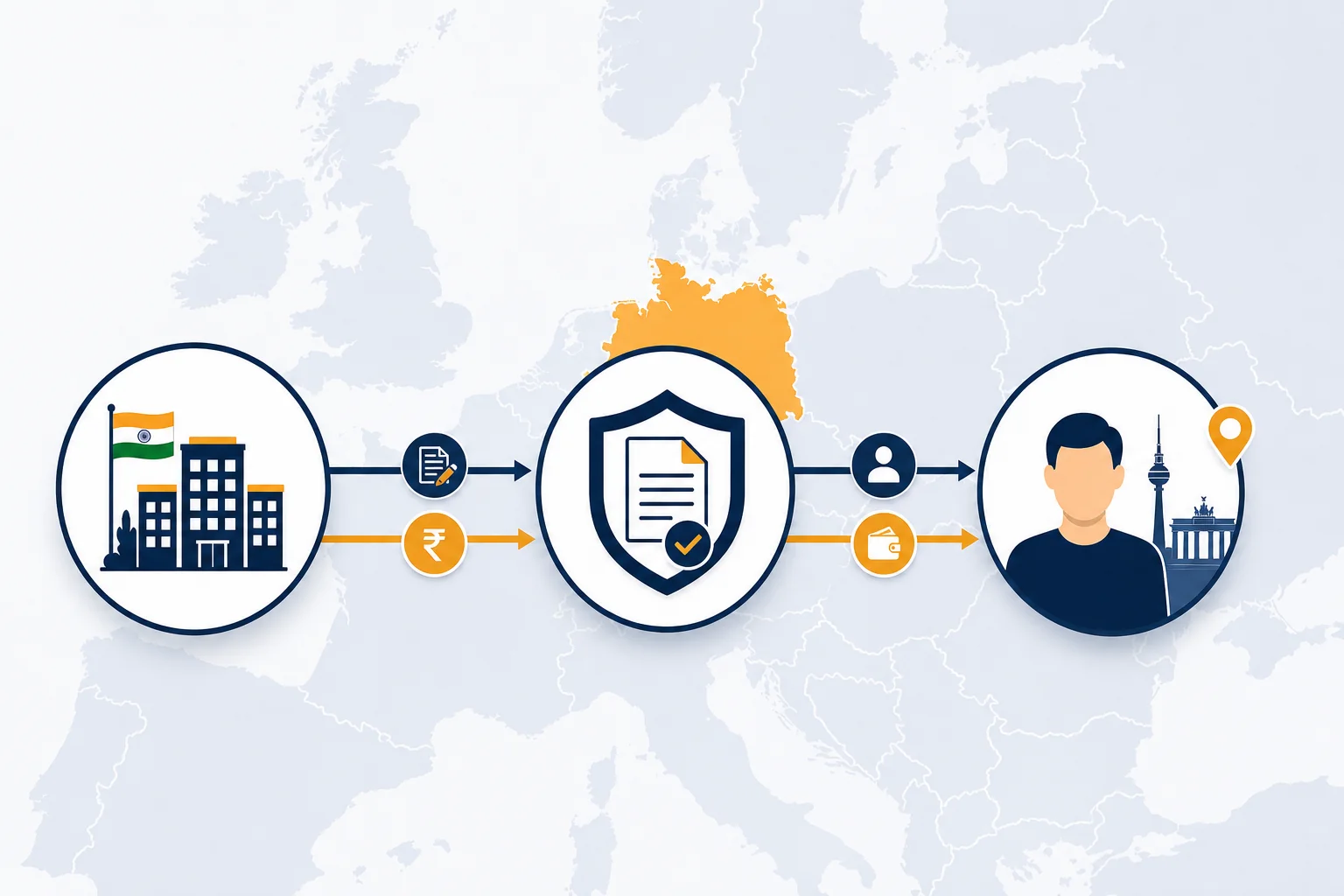
Not all EOR providers are equal, and the difference matters significantly in Germany. A provider with strong Germany-specific expertise will have established payroll infrastructure, relationships with German tax authorities, and experience navigating works council requirements. A generic global EOR with thin Germany coverage may create more compliance risk than it solves.
Your EOR partner in Germany will handle: drafting a compliant German employment contract, registering the employee with the relevant social security authorities (Sozialversicherung), processing monthly payroll in euros, filing wage tax (Lohnsteuer) with the Finanzamt, managing statutory benefits including health insurance (Krankenversicherung), pension (Rentenversicherung), unemployment insurance (Arbeitslosenversicherung), and accident insurance (Unfallversicherung), and issuing payslips in the format required by German law.
EOR works well for one to approximately 20 employees in Germany. Beyond that threshold, the cumulative EOR fee often exceeds the cost of registering a GmbH and running your own payroll. If your Germany headcount plan exceeds 20 people within 18 months, begin entity registration in parallel with your first EOR hires so the transition is planned rather than reactive.
For a broader view of how pay-on-hire and outsourced recruitment models compare on cost, the pay-on-hire recruitment FAQ on this site breaks down the mechanics in detail.
Germany's talent market has structural characteristics that catch Indian TA teams off guard. Unemployment sits below 3% in most skilled categories. The most capable candidates, senior engineers, regulatory affairs specialists, enterprise sales leaders, are not actively browsing job boards. They are employed, performing well, and not responding to InMail from recruiters they don't know.
Posting on LinkedIn or Indeed Germany will surface active job seekers. That pool is real, but it skews toward candidates who are between roles or dissatisfied, not necessarily the top performers you need for a critical hire. XING, Germany's professional network, has a larger share of passive German professionals than LinkedIn in some sectors, but it still doesn't solve the passive sourcing problem.
For specialist roles, a regulatory affairs manager in the pharma sector, a senior embedded systems engineer in automotive, a compliance officer with German banking law expertise, you need recruiters who have spent years building relationships with passive candidates in that specific niche. That means specialist agencies with Germany-specific networks, not generalist job boards.
Germany has a mature specialist recruitment agency ecosystem. Boutique firms focused on automotive engineering, life sciences, financial services, and technology have candidate networks that no job board can replicate. The challenge for Indian companies is identifying which agencies are genuinely specialist versus which ones claim to be, and then managing multiple agency relationships across different roles and geographies.
This is precisely the problem CBREX was built to solve. Through a single contract, Indian companies get access to 4,000+ specialist recruiting firms across 33 countries, including Germany-focused agencies with deep networks in the sectors that matter most to Indian mid-market companies expanding into EMEA. CBREX's AI vendor matching tool, C Map, routes your Germany role to the agencies most qualified to fill it based on sector, seniority, and location, not just whoever responds first.
For context on how this compares to managing agencies directly, the recruitment marketplace vs. staffing agency comparison covers the trade-offs in detail.
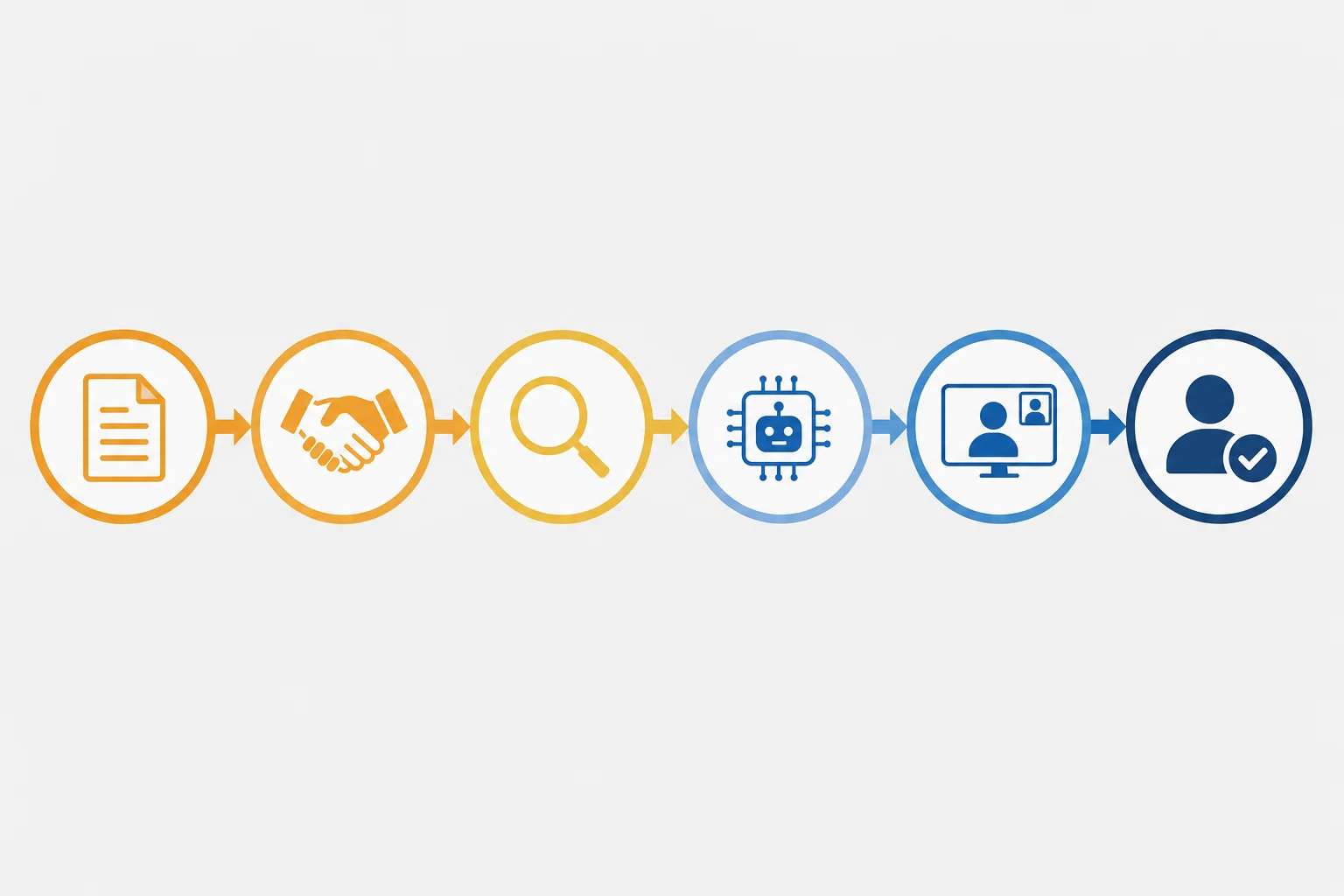
Once you have your EOR partner selected and your sourcing strategy in place, the actual hiring process follows a clear sequence. Skipping steps or running them out of order is where most Indian companies create compliance exposure.
German salary expectations differ significantly from Indian benchmarks and from other European markets. A senior software engineer in Munich commands a different package than the same role in Leipzig. Use German-specific salary data, sources like the Federal Statistical Office (Destatis) or sector-specific surveys, to set realistic bands before you begin sourcing. Misaligned salary expectations are the single biggest reason German hiring processes stall.
Before a single candidate is approached, have your EOR partner review the employment contract template for the role. Confirm that the contract reflects any applicable Tarifvertrag, includes the correct notice period, and specifies the probation period (up to six months is standard). This step takes one to two weeks and prevents costly renegotiation after a candidate accepts an offer.
Brief your specialist agencies with a detailed role specification including the salary band, required qualifications, and any sector-specific certifications. In Germany, qualifications matter, a candidate's Ausbildung (vocational training) or university degree is often a hard requirement, not a preference. Agencies with Germany-specific networks will know this; generalist agencies often don't.
CBREX's three-level screening process, agency pre-screen, C Screen AI validation, and stack ranking, ensures that the CVs reaching your hiring manager have already been filtered for relevance and quality. This is particularly valuable for Germany hires, where the volume of inbound applications from job boards can be high but the quality variable. The AI resume screening guide explains how to evaluate screening tools for cross-border hiring contexts.
If the role is at a German location where a works council exists, the works council must be informed of the intended hire before the employment contract is signed. This is not a veto right for most roles, but it is a mandatory consultation step. Your EOR partner should manage this notification; confirm it is part of their service scope before you reach the offer stage.
The offer letter and employment contract are issued by the EOR, not by your Indian entity. The employee signs with the EOR as their legal employer. Your EOR then registers the employee with German social security authorities, sets up payroll, and confirms the start date. Onboarding documentation, including the employee's tax identification number (Steuer-ID) and health insurance provider, is collected by the EOR. Your role is to provide the role brief, the day-one access, and the onboarding plan for the employee's actual work.
Hiring compliantly is step one. Staying compliant through the employment lifecycle is where many Indian companies underinvest.
The standard probation period in Germany is six months. During this period, either party can terminate with two weeks' notice, significantly shorter than post-probation notice periods. Use this window to assess fit carefully. Exiting an employee after probation is substantially more complex and expensive.
German employees are entitled to a minimum of 20 days of annual leave per year (based on a five-day working week), but most employment contracts and Tarifverträge provide 25 to 30 days. Unused leave must be carried over or paid out under specific conditions. Working time records must be kept, the European Court of Justice ruling in 2019 confirmed this obligation, and German courts have reinforced it since.
Employer social security contributions in Germany run approximately 20% of gross salary, split across health insurance, pension, unemployment insurance, and long-term care insurance. Your EOR handles these payments, but they are a real cost that must be factored into your total employment cost modelling. A €80,000 gross salary role costs approximately €96,000–€100,000 in total employer cost before EOR fees.
The conversion trigger is usually headcount volume or strategic permanence. If your Germany team grows beyond 15, 20 people, or if you are establishing a permanent operational presence (a sales office, a manufacturing site, an R&D centre), registering a GmbH becomes cost-effective and operationally cleaner. Your EOR partner should support the transition, transferring employment contracts from the EOR to your new entity is a defined legal process in Germany.
For a broader view of how global hiring strategy evolves as Indian companies scale, the global hiring from India complete guide covers the full multi-market picture.

The compliance framework above is non-negotiable, but the sourcing challenge is where most Indian companies lose time and money. Finding a genuinely specialist recruiter in Germany who understands your sector, can reach passive candidates, and will prioritise your role over their existing client base is harder than it sounds from Bengaluru or Mumbai.
CBREX removes that friction through a model built specifically for Indian companies hiring across borders.
Instead of negotiating individual agreements with German recruiting firms, each with their own fee structures, payment terms, and performance expectations, CBREX gives you access to a curated network of specialist agencies across 33 countries, including Germany-focused firms, through one contract and one invoice. Your legal and finance teams deal with one counterparty. Your TA team deals with one platform.
When you post a Germany role on CBREX, the C Map AI analyses the role requirements, sector, seniority, location, skill specificity, and routes it to the agencies in the network best positioned to fill it. You don't spend weeks vetting agencies or chasing responses. The right specialist firms are engaged automatically, and they compete to deliver the best candidates.
Every candidate submitted through CBREX goes through agency pre-screening, C Screen AI validation (trained on 250,000+ anonymised resumes across 570+ job categories), and stack ranking before it reaches your hiring manager. For Germany hires, where the cost of a wrong hire is amplified by strong dismissal protection laws, this quality filter is not a nice-to-have, it is a risk management tool.
CBREX operates on a pay-on-hire model. You pay when a hire is made, no retainer fees, no seat licences, no upfront commitments. For Indian companies testing a new market like Germany, this eliminates the financial risk of paying for recruitment activity that doesn't convert to hires. The RPO vs. agency model comparison explains why this structure outperforms traditional retained search for most mid-market hiring scenarios.
CBREX integrates with your existing ATS, so Germany candidates flow into the same pipeline as your domestic hires. Invoicing is unified, one invoice covers all agency placements across all geographies, eliminating the multi-currency, multi-vendor billing chaos that plagues Indian companies managing international hiring through fragmented agency relationships.
German hiring without a local entity is entirely achievable, but it requires the right legal structure, the right compliance knowledge, and the right sourcing partner. Getting one of those three wrong is expensive. Getting all three right is a competitive advantage.
Technically yes, but practically risky. Germany's Scheinselbstständigkeit rules mean that if the working arrangement looks like employment, exclusive engagement, integration into your team, following your instructions, German authorities will reclassify the relationship as employment. The consequences include back taxes, social security contributions, and penalties. Use genuine contractor engagement only for truly independent, project-based work, and get legal advice before proceeding.
From role approval to employee start date, expect eight to twelve weeks for a well-run process. EOR setup takes two to four weeks. Candidate sourcing and screening for specialist roles in Germany typically takes four to eight weeks. Interview and offer stages add one to two weeks. Works council notification (where applicable) adds a few days. Rushing any of these stages increases compliance risk.
EOR fees in Germany typically range from 15% to 25% of gross employee salary per month, depending on the provider and the scope of services included. Some providers charge a flat monthly fee per employee instead. Always confirm what is included, payroll processing, tax filings, benefits administration, and termination support should all be covered. Contact your EOR provider directly for current pricing specific to your role and headcount.
No. A works council can only be established in workplaces with five or more permanent employees. With one to four employees in Germany, works council obligations do not apply. However, if your German headcount grows, whether through direct hires or EOR-employed workers at the same location, works council eligibility may be triggered. Plan for this threshold in your headcount modelling.
CBREX specialises in the sourcing and screening side of Germany hiring, connecting Indian companies to specialist recruiting agencies with Germany-specific networks through a single contract and AI-powered vendor matching. For the EOR component, CBREX can guide you toward the right structure and partners. The combination of CBREX for sourcing and a specialist EOR for employment gives Indian companies a complete, compliant Germany hiring solution without registering a local entity.
Hiring in Germany without a local entity is not a workaround, it is a legitimate, well-established approach used by hundreds of Indian companies expanding into EMEA. The companies that do it well have three things in place: a compliant EOR structure, a clear understanding of German labor law and GDPR obligations, and a sourcing partner who can reach the passive, specialist talent that German job boards never surface.
CBREX gives Indian mid-market and global-HQ companies the sourcing infrastructure to hire in Germany, and in 32 other countries, through a single contract, AI-powered agency matching, and a pay-on-hire model that eliminates upfront risk. If your Germany headcount is approved and you need interview-ready candidates without the complexity of managing German recruiting agencies from India, book a demo with the CBREX team to see how the platform works for your specific role and sector. Or if you're ready to get started, sign up on CBREX and post your first Germany role today. You can also reach the team directly at tara@cbrex.in to discuss your Germany hiring requirements before committing to anything.
Germany is a market worth hiring in. The compliance complexity is manageable. The talent is there. The question is whether your sourcing infrastructure is ready to reach it.


