Read Time:
Recruitment Agency in Estonia: How to Hire Through Vetted Specialist Agencies (2026)


A recruitment agency in Estonia finds, screens and presents candidates for your open role, and the employer pays a fee, ideally only when someone is hired. For an India-headquartered company, the practical route is to brief a specialist agency that already places your function, then check its credentials before you sign.
At CBREX, we route roles to vetted specialist agencies under a single contract. Our network covers 4,000+ recruiting firms across 55 countries, and Estonia is one of them. You post the role once, and you pay only when a hire is made. There are no retainers, seat licences or monthly fees.
This guide walks you through the steps in order: writing the brief, comparing fee models, running pre-signing checks, planning the timeline and using a single-contract route. Where a figure comes from our own hiring data, we say so.
Estonia is a small market. The talent pool is compact, many professionals are bilingual, and the strongest candidates are often passive. They are not on job boards, and they are rarely answering cold adverts. A local agency earns its fee by knowing who these people are and by approaching them discreetly.
In practice, a good agency does five things:
An agency does not become the employer. If you have no Estonian entity, someone still has to run payroll, contracts and tax for the hire. That is a separate question from recruitment, and we cover it in the checks below. For a deeper comparison of the two services, see our explainer on how a recruitment marketplace differs from an employer of record.
Most failed searches begin with a weak brief, not a weak agency. Estonian agencies work fastest when the brief names the role scope, the work location, a market-level pay range and the real must-haves. Vague briefs produce long shortlists that nobody wants to interview.
Two mistakes come up often in our work with India-based hiring heads. The first is benchmarking pay below the quality you want. Companies ask for very high-quality talent but do not pay at that level. Agencies then spend weeks presenting people who say no, or no one at all.
The second is fee logic. Do not calibrate the agency fee on how hard the hire feels. Calibrate it on the candidate's years of experience. Difficulty is subjective and invites argument after the shortlist arrives. Experience is a number both sides can verify.
The right-to-work line matters more than it looks. An Estonian shortlist built from local and EU candidates moves faster than one that depends on a permit. Say which one you can accept.
Agency fees depend on the country of the hire. For European placements, we typically see fees of 15-30%, quoted on the hire's pay. Estonia-specific terms vary by agency and role level, so ask for the percentage, the pay base it applies to and the trigger point in writing.

The percentage is only one part of the cost. How and when you pay matters just as much. Here is how the three common routes compare.
| Fee route | When you pay | Main risk | Best for |
|---|---|---|---|
| Contingency agency | On a successful hire | One agency may under-prioritise a hard role; a separate contract per agency | Standard roles in one market |
| Retained search | Part of the fee upfront, the rest at milestones | You pay before a hire exists | Rare senior searches where you want exclusivity |
| CBREX single contract | Only when a hire is made | Fee still varies by country and seniority; confirm in your contract | Multi-agency, multi-country hiring from one contract and one invoice |
The visible fee is rarely the full price. Hidden cost comes from slow cycles, repeated contract negotiation, mismatched CVs and hires that leave early. A cheap agency that delivers a poor shortlist costs more than a fair-priced one that delivers a clean one.
Before you accept any quote, ask four questions:
On our platform, the replacement guarantee runs 30-90 days after joining, depending on the level of the hire. Across our local hires, more than 90% stayed at least 12 months. If you want to run your own numbers, try the Hidden Hiring Tax calculator and see what slow cycles and agency admin cost you.
Before you sign with an Estonian agency, verify its registration, read the fee trigger and replacement terms, confirm who owns each candidate, and agree how personal data is handled. Ask for documentation at onboarding, not after the first shortlist. A sound agency will hand it over without friction.

Ask the agency for its business registration details and any licence or registration it relies on to place candidates. Guidance from the International Organization for Migration says to work only with recruiters licensed or registered to provide recruitment services in both the origin and destination countries. If any candidate will move across borders, apply that standard.
Indian employers should also know about fraud. The Embassy of India in Tallinn has issued an advisory on overcharging and fake overseas jobs, noting that registered agents hold a licence number displayed on their premises and advertisements. If an intermediary asks candidates for fees, walk away.
The contract should say that the fee is due on a defined event, normally the candidate's start date. It should state the replacement period, what counts as a qualifying departure and whether a replacement restarts the guarantee. Anything left to "discussion" will be argued later.
When two agencies submit the same candidate, someone gets credit and someone loses. On CBREX, the duplicate check is built into the platform. At the moment of a duplicate submission, the agency is told it is a duplicate and cannot upload the candidate. That removes the credit dispute before it starts.
If you work outside a platform, put a clear rule in each agency contract: first documented submission wins, with a time stamp.
Estonia is in the EU, so candidate data falls under GDPR. Ask for a data processing agreement. If staff outside the EU, including your own team in India, will see candidate personal data, ask how transfers are handled and where data is stored.
Decide early who will employ the person. With an Estonian entity, you hire directly. Without one, you may need an employer of record or a similar arrangement. Ask any provider in writing which company will be the legal employer.
For candidates from outside the EU, the salary criterion also applies. For applications accepted from 5 March 2026, the general monthly gross salary condition is EUR 2,092, with different rates for some categories such as top specialists and growth-company staff. Check the current rules with the Estonian Police and Border Guard Board before you make an offer.
Expect sourcing to start within days and a hire to follow in a few weeks when local or EU candidates are involved. Our own EU data shows sourcing in 24-72 hours and about three more weeks to hire. Candidates who need a residence permit add time on top.

These are CBREX figures from European and other searches, not guarantees for any single Estonian role. We list them so you can plan realistically.
| Milestone | CBREX reported figure |
|---|---|
| Posting to first sourced candidate | 48 hours |
| Average time to source on CBREX | 4-48 hours |
| EU sourcing, then hiring | 24-72 hours, plus another 3 weeks |
| Germany search, opening to hire | 30-45 days, with no visa step as candidates were local or EU citizens |
| Client time-to-hire before consolidating agencies | 60-75 days |
The last row shows why the process matters. One client that consolidated 54 agency contracts into a single CBREX contract had been taking 60-75 days per hire before the change.
If your preferred candidate is outside the EU, permit processing can add weeks. Published employer guides put residence permit handling at up to around 90 days, though this varies by case. Build that into the start date, and tell the agency upfront so it shortlists candidates with the right to work where it can.
Speed also depends on your side. Interview slots that take a week to schedule erase an agency's speed. After our three-level screening, clients saw an interview-to-offer ratio of 1:3 to 1:4, so keep panels short and decisions quick.
CBREX matches your role to specialist agencies with its AI vendor matching tool, C Map, then screens every shortlist in three levels before you see it. You get one contract and one invoice, and you pay only when a hire is made. Agencies in the network cover Estonia among 55 countries.
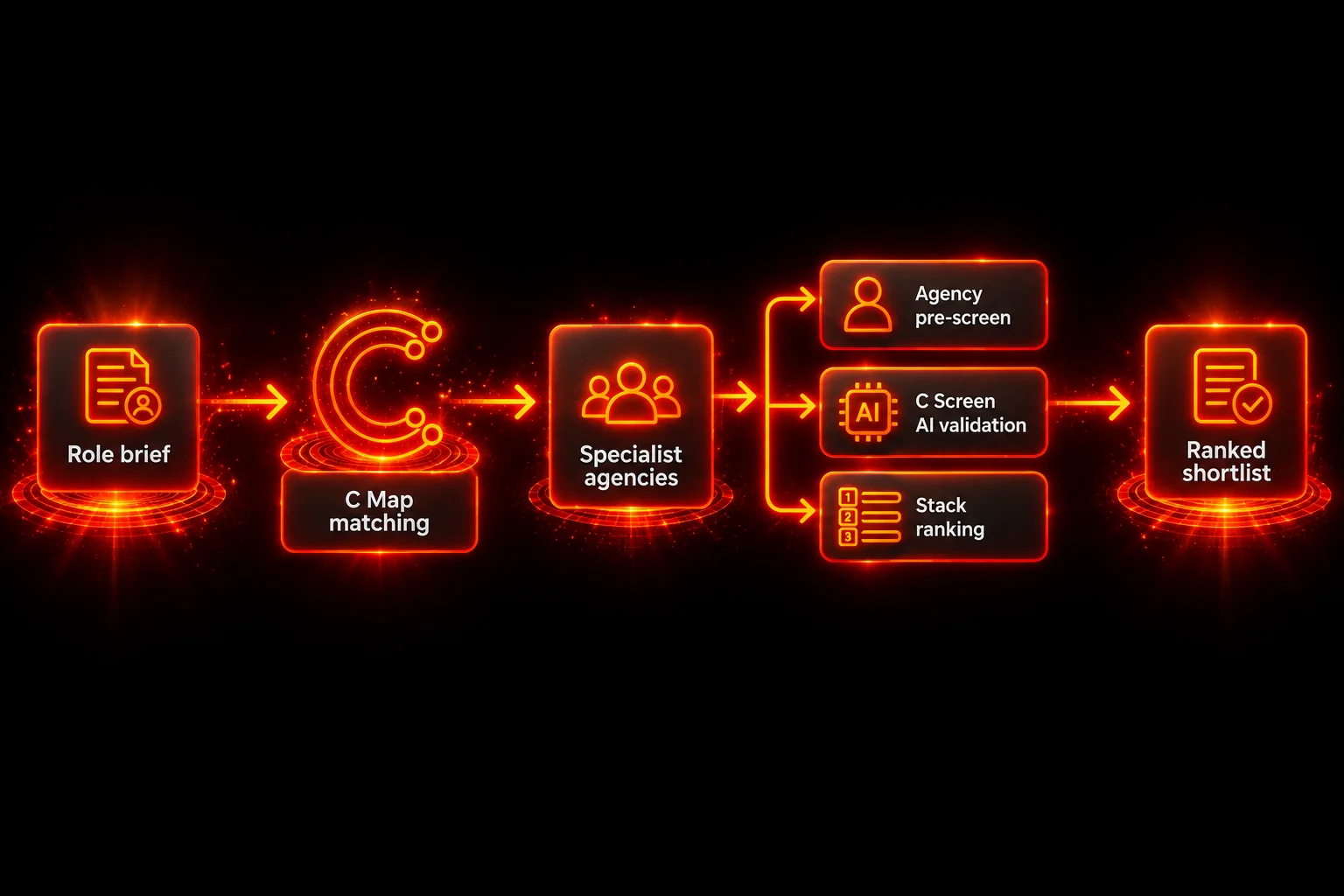
Every candidate passes the same sequence:
The result is less time spent on CVs that do not fit.
A standalone vendor management system manages the suppliers you already have. It cannot add specialists when your supply dries up. CBREX adds new agencies to the marketplace on demand, so if you need a niche supplier in Estonia or a neighbouring market, supply does not stall.
The effect on admin is large. One client consolidated 54 agency contracts into one CBREX contract. In an AI talent example, we consolidated 65+ specialist vendors. One interface replaces many separate agreements and invoices, which frees your TA team's bandwidth for interviews.
Estonia often forms part of a wider Baltic or Nordic plan. If you are hiring across nearby markets, our guides to a recruitment agency in Finland, a recruitment agency in Poland and a recruitment agency in Denmark cover the local checks for each.
Corporates post jobs globally, and recruiters fill them and earn a commission on each successful hire. Registration is free, and CBREX does not charge sourcing partners fees or a subscription. Recruitment, staffing and executive search agencies, or self-employed recruiters, may sign up as a recruiting firm. Individuals must use their official work email, because we do not validate accounts on personal email addresses.
Follow this order for your first Estonian search:
If you want to see how a role would be matched to agencies covering Estonia, book a demo and bring a live brief. You can also write to the team through tara@cbrex.in with questions about your hiring plan.