Read Time:
10 Mins
Recruitment Agency vs Job Board in India: 2026


A TA manager at a Chennai-based auto components company once ran an experiment. She posted the same senior process engineer role on a leading job board and simultaneously briefed a specialist manufacturing recruitment agency. Ten days later, the job board had delivered 340 applications. The agency had delivered four. She hired from the four.
That single experiment captures the entire recruitment agency vs job board India 2026 debate. Volume is not the same as fit, and for mid-market companies filling niche or business-critical roles, the choice between these two channels shapes cost, speed, and ultimately whether the seat gets filled at all. But framing this as a two-way decision misses what's actually changed in the Indian hiring market this year: a third model, the AI-powered recruitment marketplace, now sits between the two and, for many roles, beats them both.
This comparison breaks down candidate quality, time-to-fill, cost-per-hire, and passive talent access across all three paths, so TA and HR leaders can stop defaulting to whichever channel is easiest and start matching the tool to the role.
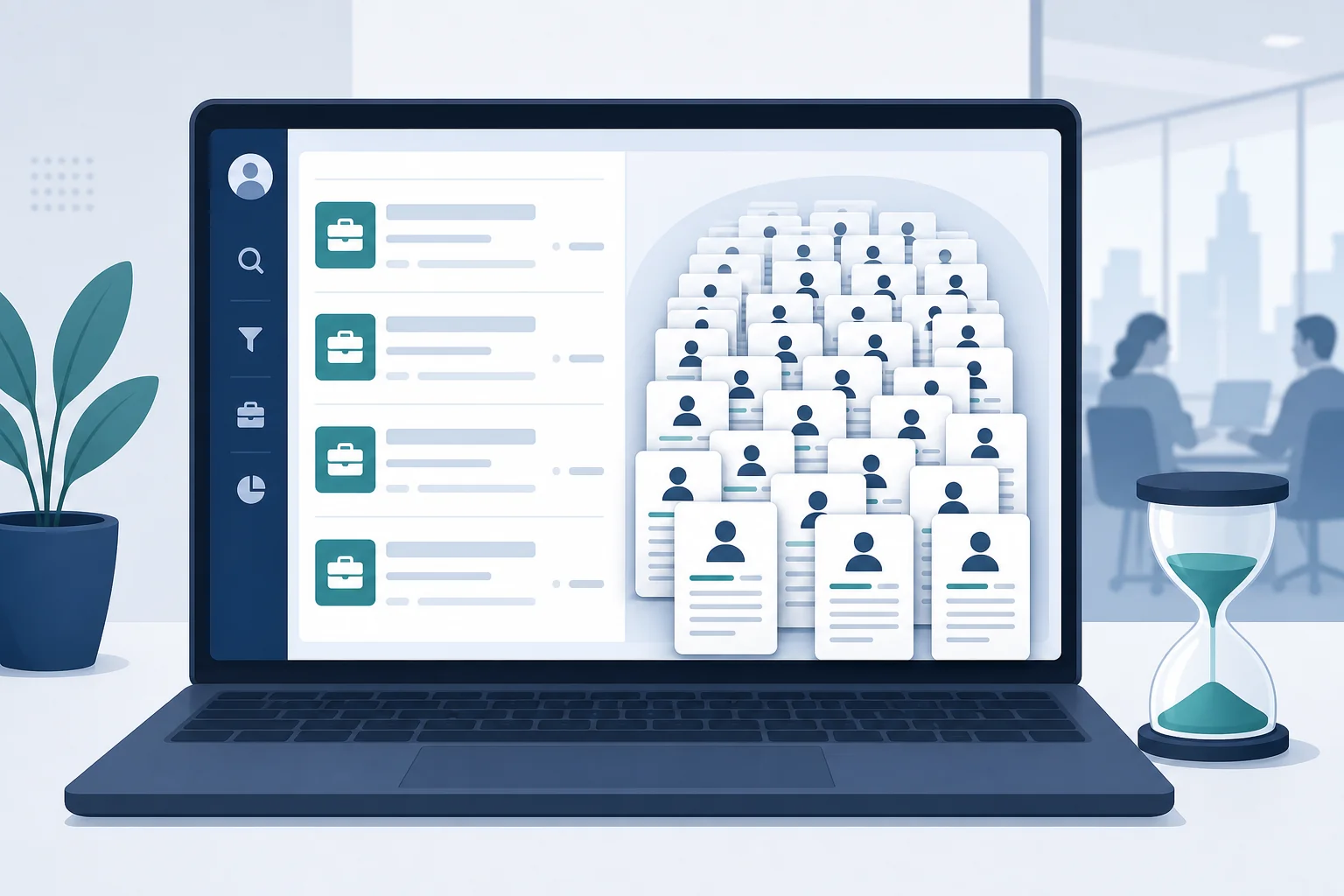
Job boards like Naukri built their business on volume. Post a role, and it gets indexed against a database of millions of active job seekers who are actively searching, applying, and refreshing their profiles. For high-supply roles like customer support executives, junior sales associates, or entry-level developers, this works well. The applicant pool is large, salary bands are standardized, and speed of first response matters more than depth of vetting.
The trouble starts when the role gets specific. Post a "Senior Embedded Systems Engineer with automotive safety certification experience" and a job board applies the same logic it uses for a data entry clerk: it shows the listing to anyone whose keywords loosely match, active or not. Most of those applicants are people between jobs, recently laid off, or simply keeping options open. The genuinely strong candidate, the one already six years into a stable role at a Tier-1 supplier, isn't scrolling job boards at all.
This is the structural limit of the model. A job board is a search engine for people who are already looking. It cannot reach passive talent, the roughly 70-80% of the skilled workforce that isn't actively applying anywhere but would move for the right opportunity. Our detailed breakdown in Hiring Platforms India: Job Boards vs. Agencies vs. AI Marketplaces covers this gap in more depth.
A good specialist agency solves the exact problem a job board can't: it goes out and finds people who aren't looking. A recruiter who has spent five years placing pharma quality assurance managers knows which companies have strong QA benches, which managers are quietly frustrated with their current role, and which counteroffers a candidate is likely to get. That market intimacy is the entire value proposition. Agencies also apply a first layer of screening before a resume ever reaches you. They verify employment history, gauge real interest, and check whether compensation expectations are realistic. For a hard-to-fill or senior role, this can cut weeks off the process compared to sorting through unfiltered job board applications.
The catch is scale and cost. A single specialist agency typically has bandwidth for a handful of live mandates at a time, and retained search fees can run high before a single candidate is even presented, a dynamic explored in Recruitment Agency Cost in India: What You're Really Paying. Try to hire across multiple functions or multiple countries, and most companies end up managing eight, twelve, sometimes twenty different agencies, each with its own contract, invoice cycle, and quality bar. That's when agency hiring quietly turns into a vendor management job nobody signed up for.
Laid side by side, the trade-offs are stark. Neither channel is "wrong," but each was built to solve a different hiring problem, and using the wrong one for a critical role is expensive in ways that don't always show up on an invoice.
Job boards surface volume; agencies surface fit. Unscreened job board applications often require hiring managers to review dozens of resumes to find two or three worth a call. Agency-sourced candidates arrive pre-vetted against the brief, though quality still varies widely by agency specialization, a point covered in AI Resume Screening: How to Choose the Right Tool in 2026.
Job boards generate fast application volume but slow qualified shortlists. Agencies compress the shortlist timeline but are constrained by how many live searches one recruiter can run well. Roles left open past 45-60 days start costing real money in lost productivity and overtime coverage, a cost we quantify in Time to Hire: The Hidden Cost of Roles Left Open.
Job board subscriptions look cheap on paper, until you add hiring manager hours spent screening irrelevant applications. Agency fees look expensive on paper, until you weigh them against a role sitting empty for three months. Neither number tells the whole story unless you account for total cost, not just the invoice line.
This is the clearest differentiator. Job boards reach almost exclusively active seekers. Agencies reach passive talent, but only within one recruiter's or one firm's existing network, which may not cover every geography or specialization you need.
Neither model scales cleanly across multiple countries. Running parallel agency relationships in, say, Japan, Mexico, and Kenya for a single global expansion project means three separate contracts, three fee structures, and three points of coordination, a challenge we unpack in Global Hiring from India: The 2026 Complete Guide.
Here's where it gets uncomfortable for TA leaders at India-founded, global-HQ companies. The moment you're hiring across more than two or three geographies, or filling more than a handful of niche roles a quarter, both the job board and the single-agency model start to strain. Vendor sprawl is the most visible symptom. A mid-market company hiring across India, the UAE, Singapore, and Brazil often ends up managing ten or more agency relationships simultaneously, each with different invoicing cycles, different service quality, and no consistent visibility into who's actually delivering. Our guide on How Does Pay-on-Hire Recruitment Work? FAQs. For leadership roles specifically, CBREX curates boutique search firms and independent consultants into the same no-retainer model, covered further in Leadership Hiring India: The 2026 Complete Guide.
Your best hire isn't looking. A job board can't find them. A single agency might, if it happens to have the right network. An AI-matched marketplace of specialist agencies is built to find them, every time.
For companies weighing this against building an in-house RPO function, the trade-offs are laid out in RPO vs Agency India: Which Model Wins for Mid-Market Companies. And if you're specifically comparing marketplace models against traditional staffing firms, see Recruitment Marketplace vs Staffing Agency: India 2026.
Not every role needs a marketplace, and not every role should go to a job board. Use role criticality, volume, and geography as your filters.
A quick self-check before your next requisition goes live: how many days has a similar role stayed open in the past using your current channel, and what did that delay actually cost in lost output, overtime, or missed deadlines? If you don't know the number, calculate your hidden hiring tax before deciding where to post the next critical role. For a deeper look at building a full multi-country hiring approach, see Talent Acquisition in India 2026: The Complete Local Guide.
For high-volume, standardized roles, yes. For niche technical, leadership, or hard-to-fill positions, job boards alone typically underperform because they surface active job seekers only, missing the passive candidates most likely to be strong fits.
Traditional agency fees often run 15-30% of annual CTC, sometimes with non-refundable retainers for senior searches. Marketplace models like CBREX typically operate on pay-on-hire pricing with no retainer or subscription fee, meaning you pay only on a successful placement. See Recruitment Agency Cost in India: What You're Really Paying for a full breakdown.
Yes, indirectly and effectively. The AI itself doesn't cold-call candidates; it matches your role to the specialist human agencies whose recruiters already have relationships with passive talent in that specific niche and geography, then screens the results at scale.
Not necessarily for every role. Job boards still make sense for high-volume, entry-level hiring. CBREX is built for the niche, senior, and multi-country roles where job boards and single agencies both struggle, whether that's a critical hire in India or one you need to make in South Korea, Bangladesh, or Brazil.
Because multiple specialist agencies work the same mandate simultaneously with AI-driven matching and screening, time-to-shortlist is typically faster than waiting on a single agency, and the shortlist quality is far higher than sorting unscreened job board applications.
If your last niche requisition sat open for weeks while job board applications piled up and a single agency's shortlist trickled in slowly, the channel was the problem, not your hiring bar. An AI-powered marketplace gives you specialist agency reach across 33 countries, three-layer candidate screening, and one contract, without retainers or recycled resumes standing between you and the hire you actually need.
Book a demo to see how CBREX routes your next critical role to the right specialist agencies within a single platform, or sign up to post your first requisition today. Recruiting firms interested in joining the network can access the recruiting firms login to get started. Have questions about fit for your hiring plan? Let's talk.


